Today, Intel and SambaNova, announced plans to build a multi-year strategic collaboration to deliver high performance and cost-efficient AI inference solutions for AI native start-ups, model providers, enterprises, and government organizations worldwide, built around Intel Xeon-based infrastructure. It was also announced that Intel Capital is participating in SambaNova’s Series E financing round.
https://t.co/0F9TixleRG
Excited to see @intel and @SambaNovaAI collaborate to advance cloud-scale AI inference and enable more scalable, efficient AI infrastructure. Having spent time at both companies, it’s especially meaningful to see this shared vision take shape. 🤝 Let's go!
https://t.co/5GszUJgrvt
I'm Boris and I created Claude Code. Lots of people have asked how I use Claude Code, so I wanted to show off my setup a bit.
My setup might be surprisingly vanilla! Claude Code works great out of the box, so I personally don't customize it much. There is no one correct way to use Claude Code: we intentionally build it in a way that you can use it, customize it, and hack it however you like. Each person on the Claude Code team uses it very differently.
So, here goes.
It's not just about raw memory bandwidth. Peak bandwidth utilization requires the architecture to overlap compute, memory, and cross-chip comms. And, minimize overheads from kernel launch and sync. Doing this needs PTX gymnastics on NV - which makes it hard to scale.
For e.g., see this study https://t.co/vDXC9pv8P2
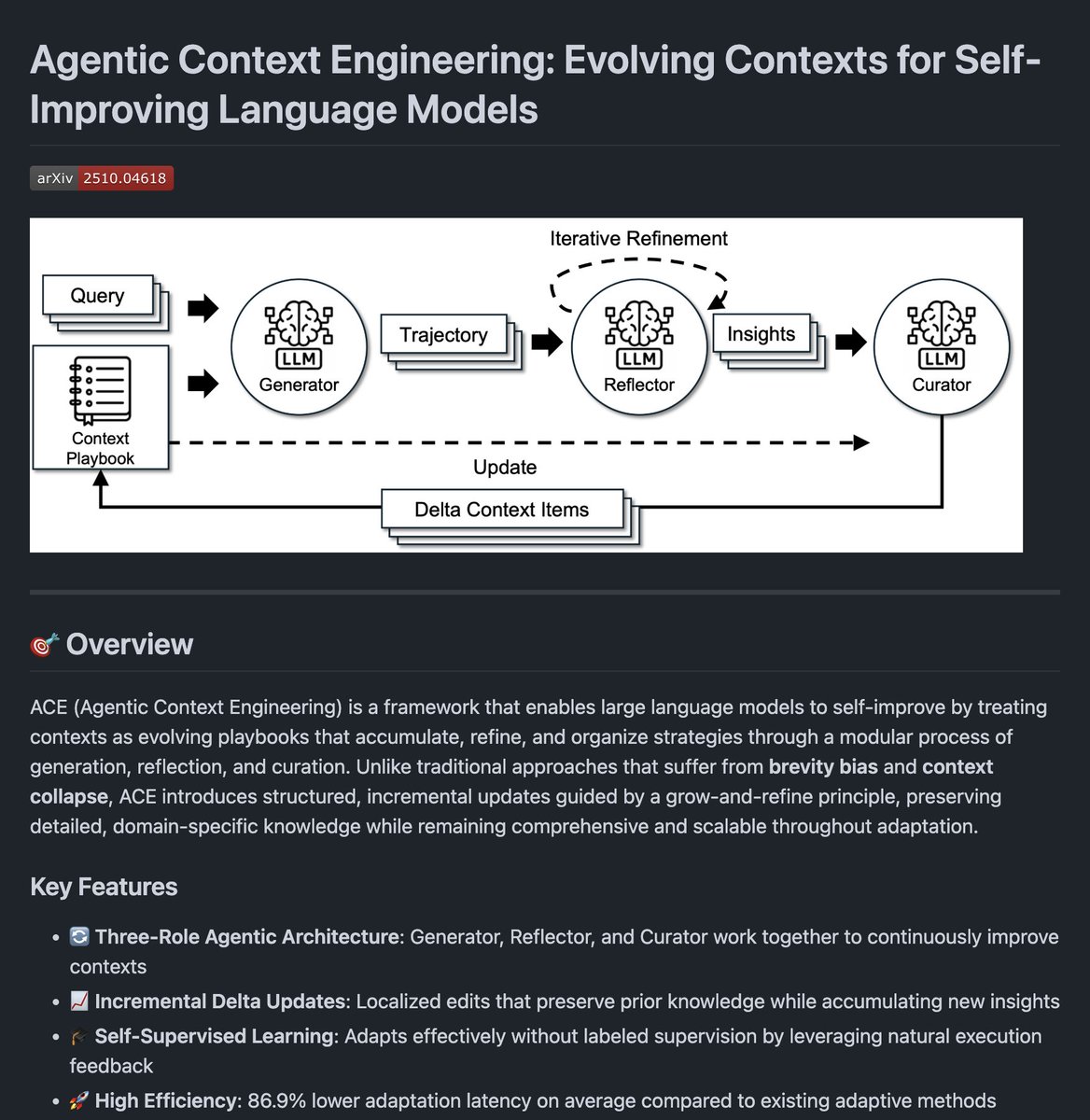
Agentic Context Engineering
The code for the paper is finally out!
I had built an implementation for this (not exactly the same) that already boosted performance for my agents.
Evolving context for AI agents is a great idea.
Official implementation out now!
https://t.co/xpYWqnqvGc
L'inférence haute performance en "token / seconde / flow" exécuté sur les RDU de SambaNova (au lieu de GPU de Nvidia). En savoir plus: https://t.co/WmrYgDjHSA
Intelligence is Power, but also costs Power! This paper from @HazyResearch@JonSaadFalcon@Avanika15 quantifies the true cost of intelligence. Nice work!
Why the disparity? Comes down to utilizing the underlying hardware better. Dataflow's great at that - Go @SambaNovaAI !
Data centers dominate AI, but they're hitting physical limits. What if the future of AI isn't just bigger data centers, but local intelligence in our hands?
The viability of local AI depends on intelligence efficiency. To measure this, we propose intelligence per watt (IPW): intelligence delivered (capabilities) per unit of power consumed (efficiency).
Today’s Local LMs already handle 88.7% of single-turn chat and reasoning queries, with local IPW improving 5.3× in 2 years—driven by better models (3.2×) and better accelerators (1.7×).
As local IPW improves, a meaningful fraction of workloads can shift from centralized infrastructure to local compute, with IPW serving as the critical metric for tracking this transition.
(1/N)
New independent study of energy usage for AI inference from local to cloud computing. To better normalize AI value across models, they introduce two key metrics : Intelligence per Watt (power) and Intelligence per Joule (energy). Research by @Avanika15@HazyResearch@StanfordAILab@JonSaadFalcon 👇
What is model bundling? 🧐
It's like having all your AI models hanging out on one rack, ready to tag in like a relay race. Now spread that across multiple racks, where every system pitches in to handle requests at warp speed.
Read more in our blog: https://t.co/4fCDSN6tdt