@arcot2arctic Hi @arcot2arctic did you use prompt engineering techniques to generate this content? I guess it is generated via claude opus, did you try with other models like grok, Gemini?
Takeaway:
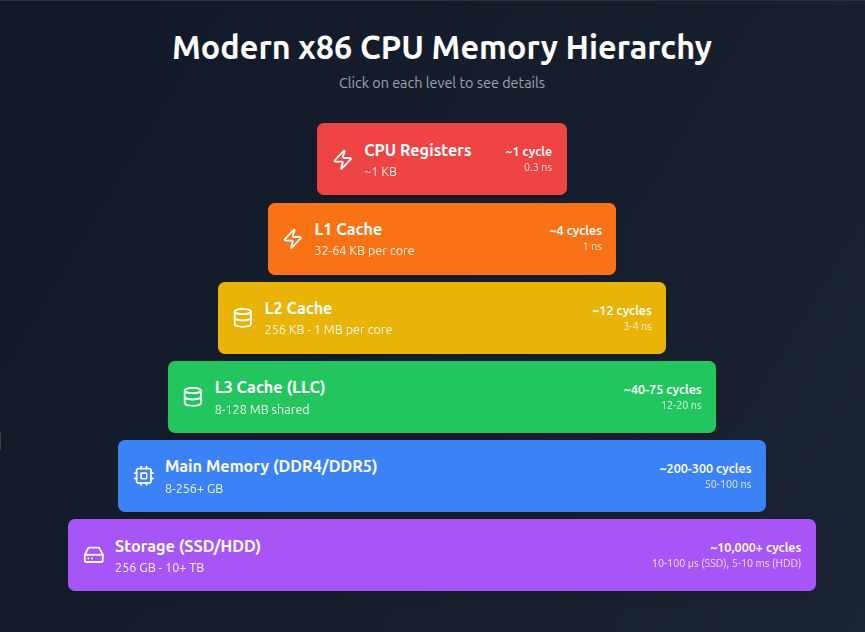
The jump from L1 to RAM is 200× slower.
This is exactly why “Memory access pattern” is #2 in the real Order of Optimization (and why blind parallelization/SIMD often fails).
Write code that respects this hierarchy = massive free speedups.
Which level surprised you the most?
Or what’s your worst “I ignored the cache and paid for it” story?
Drop it below 👇
#CPlusPlus #CPP #Performance #LearnInPublic
This single image explains why most C++ performance bugs happen.
Modern x86 CPU Memory Hierarchy:
Most devs only think about RAM… while the CPU is desperately fighting to stay in the top 3 layers.
Here’s every level broken down (with real latencies & sizes):
Thread 👇
#CPlusPlus #CPP #Performance #Optimization #CUDA
5. Main Memory (DDR4/DDR5)
• Latency: ~200-300 cycles (50-100 ns)
• Size: 8 GB – 256+ GB
6. Storage (SSD/HDD)
• Latency: 10,000+ cycles
Going to RAM is already painful.
Going to disk in performance-critical code is basically game over.
This is why we obsess over cache-friendly data structures.
Yeah, but it's not that simple...stuff like calculators and computers didn't just kill off jobs; they changed 'em. Accountants ditched the old-school ledgers for sophisticated analytics tools, and coders went from punching cards to AI-assisted coding. This software long tail could open things up for more creators, but we'll all just pivot and keep rolling in the new setup, not fade away. Thoughts?