Same condition. Same outcome. Fewer moving parts.
Traditional workflows can stack oracles, keepers, backend services, and bridges before an action reaches a smart contract.
Rialo’s Reactive Transactions connect conditions directly to execution:
Define → Evaluate → Execute
Less infrastructure. More possibilities.
Get Real. Get @RialoHQ
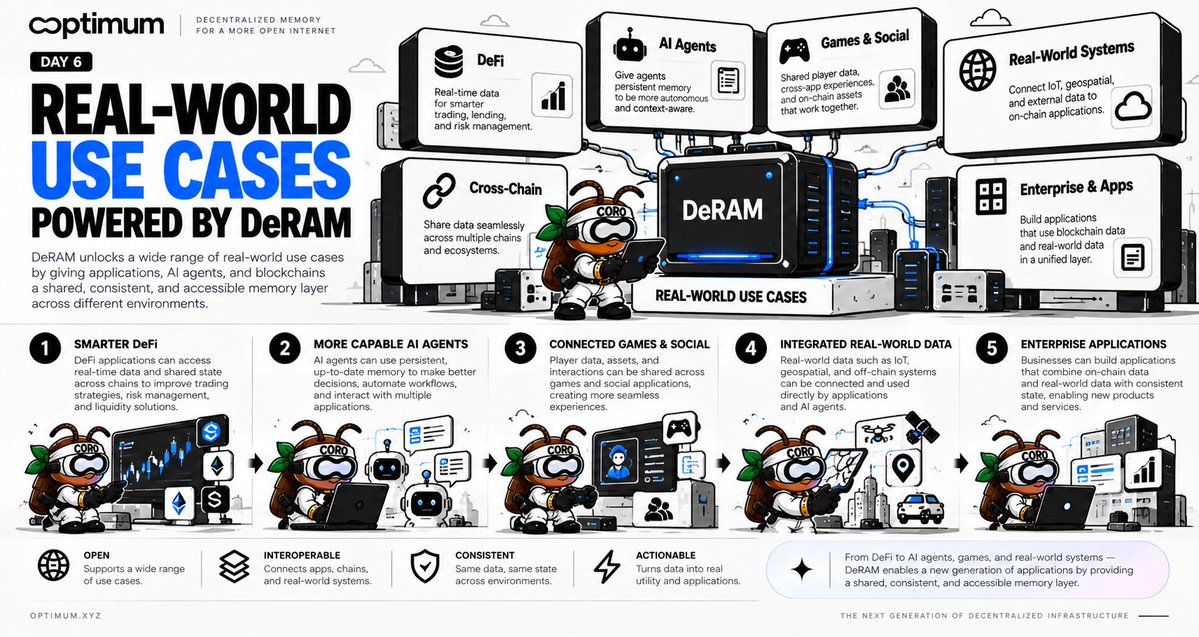
One shared memory layer. Many real-world possibilities.
DeFi that can access consistent data.
AI agents that retain context.
Games, social apps, enterprise systems, and cross-chain applications connected through decentralized memory.
Different use cases. One foundation.
@get_optimum DeRAM.
We’ve seen the problem.
Blockchains execute when transactions arrive.
But real applications often need to react to conditions that change over time.
Today, that can mean stitching together oracles, bots, keepers, schedulers, backend services, and other infrastructure.
So the bigger question isn’t:
“Can we automate this?”
We already can.
The question is:
What if the chain itself could express when an action should happen?
Reactive Transactions are Rialo’s answer to that question.
Conditions become part of the execution model, allowing the chain to react to events instead of relying entirely on external automation.
The next question is how it actually works.
That starts with predicates.
@RialoHQ
Real-world use cases powered by DeRAM.
DeRAM isn’t just about storing data. This shared memory layer has the potential to support a wide range of applications that require cross-environment data access.
From DeFi, which relies on data for decision-making, to AI agents that require persistent memory, to games, cross-chain applications, and systems connected to real-world data.
With a consistent, shared memory layer, developers have the foundation to build more connected applications.
The real value of infrastructure lies in what people can build on top of it.
@get_optimum
$STREAM didn’t just reduce supply. It removed 70% of it permanently.
@streamflow_fi Foundation burned 100% of its holdings: 699,994,595 $STREAM, cutting total supply from 1B to 300M.
No mint authority means those tokens cannot be reissued. The 300M cap is permanent.
The founder also returned ~90% of his personal allocation—part burned, part returned to the team bucket.
This was a programmatic Solana burn at the mint level. Not a transfer. Not a lock. Nothing to recover or unfreeze.
Burn proof:
https://t.co/xzBg0ADvuw
More on $STREAM:
https://t.co/zNON6c3yjT
One condition shouldn’t require an entire infrastructure stack.
Traditional flow:
Condition → oracle → keeper → backend → bridge → smart contract.
More handoffs.
More dependencies.
More points of failure.
With Rialo:
Condition → Reactive Transaction → Action
Define it.
Evaluate it during execution.
Trigger the action natively.
Same conditions. Same outcome.
Less infrastructure. More possibilities.
Get Real. Get @RialoHQ
Early alpha is here
Almost nowhere launches and swaps RGB.
A few clicks. Dark Horse Knight NFT, and 1,000 Horseshoes.
@RGBHorse can become the Pump on Bitcoin.
Link: https://t.co/oCkM7oZaNA
Next big move in BTC assets
USDT on RGB needs a launchpad.
Done in seconds. 1,000 Horseshoes, plus the Knight NFT.
@RGBHorse can become the Pump on Bitcoin.
Link: https://t.co/EA9HgUSz1U
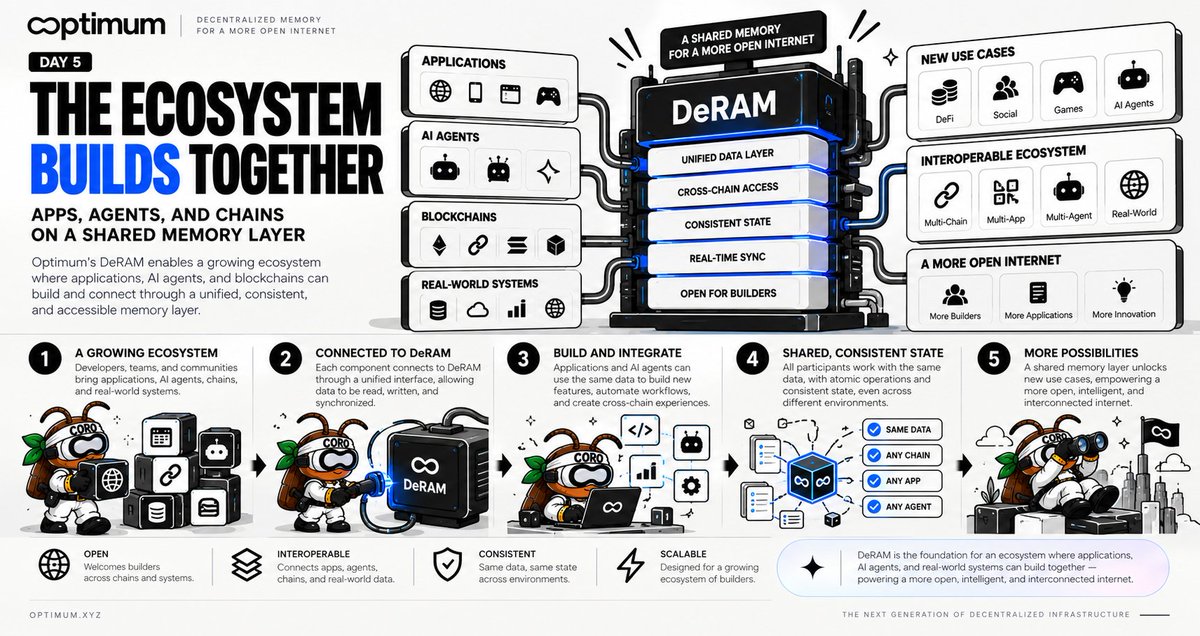
The Ecosystem Builds Together
Apps, agents, chains, and real-world systems still operate in separate worlds.
DeRAM is the shared memory layer built to connect them:
One unified interface
Cross-chain access
Consistent state
Real-time coordination
Same data.
Any chain.
Any app.
Any agent.
When the memory layer is shared, builders stop working in isolation.
More builders. More possibilities.
@get_optimum DeRAM.
One of the most interesting aspects of DeRAM is how the shared memory layer can serve as a common ground for various components within the ecosystem.
Applications, AI agents, blockchains, and real-world systems can connect through the same layer to read, write, and use data.
With consistent state and coordinated access, these components do not have to operate as separate silos.
Ultimately, infrastructure like this paves the way for more applications, use cases, and new ways to build a more interoperable internet.
@get_optimum
The old way turns one action into a dependency chain:
External data → oracle → bridge → watcher → smart contract.
More tools. More handoffs. More things that can fail.
Rialo connects conditions directly to execution.
Event → Condition → Action
Fewer moving parts.
Simpler flow.
More reliable execution.
Less infrastructure. More possibilities.
Get Real. Get @RialoHQ
How we use Zama ?
→ Every NFT mints sealed and is encrypted onchain using Zama’s FHE.
→ The contract computes on data it can never read.
→ Its look and essence are determined by FHE randomness. Nobody gets to choose. Not even us.
🟨 Built with FHE on @zama.