Temple's first validation study is out.
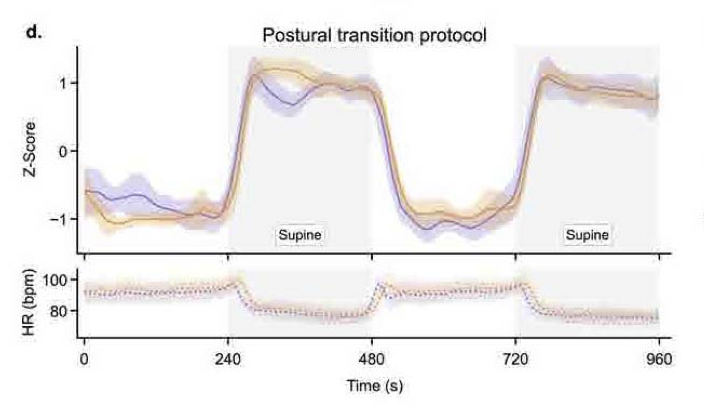
Researchers tested Temple's Brain Flow index head-to-head against Transcranial Doppler (TCD), the gold standard for measuring cerebrovascular function. 23 healthy adults, two challenges: cycling and a standing-to-supine postural shift.
The result that stood out most to me: when participants lay down, their heart rate dropped, but their brain blood flow went up. Temple tracked this accurately, right alongside the Doppler. Any device that only measures heart rate would have gotten this completely wrong.
Across both challenges, Temple's Brain Flow tracked Middle Cerebral Artery velocity (MCAv) with within-subject temporal correlation of r≈0.8 (p<0.001), which is very high even for medical devices.
The paper is posted as a preprint and submitted for peer review. One study, two interventions, healthy adults only, but it's the first step. More validations on Brain Flow, as well as on Entropy with different modalities are underway across the globe. We will keep sharing them as they trickle in.
We encourage researchers to replicate this. We'll happily loan Temples to any qualified researcher who wants to pressure-test any of our metrics independently.
https://t.co/86vUY9YQbV
Cc @agingroy
Temple is now less than half the size of what you've seen so far.
Volumetrically, Temple is now the smallest wearable on the market, and the most^10 powerful. Living and training with Temple is going to change your life.
We will start taking pre-orders for our limited launch edition @temple very soon - shipping before the end of 2026. Join our mailing list on https://t.co/XxGR9Hpq58 to stay up to date.
Hello everyone, here are the highlights from Eternal's last quarter –
- Eternal’s Q4FY26 Consolidated Adjusted Revenue grew 64% YoY (like-for-like) to 17,680 crore
- B2C NOV grew 54% YoY (4% QoQ) to INR 26,880 crore
- Consolidated Adjusted EBITDA increased 160% YoY to INR 429 crore while increasing 18% QoQ (vs INR 364 crore in Q3FY26)
- Blinkit NOV growth remains strong at 95.4% YoY (8.2% QoQ)
- Food Delivery NOV growth at 18.8% YoY (-0.9% QoQ) - continues to improve for the third quarter in a row, inching closer to our long-term expectation of 20%+ YoY
- Going-out NOV grew 42% YoY for the full year FY26
- Hyperpure’s overall Adjusted EBITDA margin improving to 0.5% resulting in absolute Adjusted EBITDA profit of INR 5 crore
- 109 million Indians completed transactions worth over $10 billion through Blinkit, District, and Zomato in FY26
- Delivery Partner Welfare: ~₹200 crore in government benefits unlocked in FY26; expanding to 1 lakh gig & contract workers by FY27
- Greening India: 1M saplings distributed to 3,000 farmers across 6 states; 600K+ planted over ~5,000 acres (free of cost)
- EV Adoption: EV delivery partners grew from 52K (Mar 2025) to 100K+ (Mar 2026)
- Plastic Waste: 15,000 MT recycled in FY26; 60,000+ MT recycled since inception (100% plastic neutral initiative)
- Feeding India: 1.4 lakh+ children fed daily across 2,300+ centres in 150+ cities
That’s all for now. To our customers, delivery partners, business partners, policymakers, and team members: your support is what moves us forward.
If there’s anything we can do better, we are always listening. Please feel free to share any questions or feedback at [email protected]
Full report here – https://t.co/r88GCLeggt
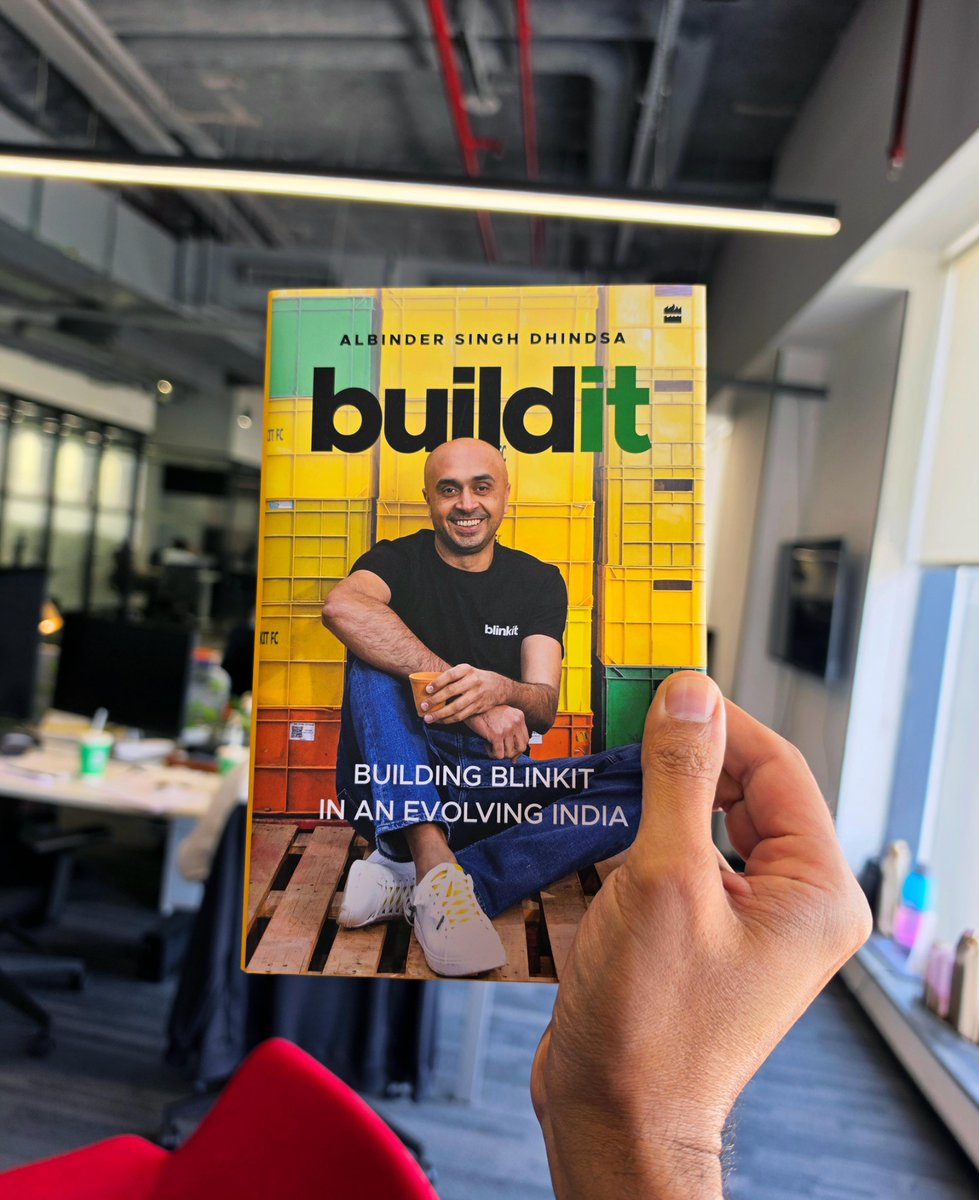
A book about Blinkit, now on Blinkit.
I have no idea how @albinder finds time for writing books alongside all that he has to do, but this is an excellent read about the challenges of starting up, building, breaking, and rebuilding for retail in India.
A few hundred signed copies available on Blinkit.
We just completed a successful flight for our tech demonstrator, Lat One v0.2.
Lat Aerospace is building ultra-short takeoff and landing aircraft using blown wing technology. Think fixed-wing performance with near-helicopter access.
A couple of months ago, v0.1 achieved uSTOL but crashed shortly after. That was expected. v0.2 was about completing the full mission, and it did. The blown wing concept worked in reality. Closed-loop control got validated. We'd predicted a cruise speed of 30-32 m/s and cruised comfortably at 33. No thermal issues despite a burning afternoon. The quick-detach wings held through aggressive turns. Was in the air for over 6 minutes. Smooth touchdown, and ready to fly again.
But the thing that makes me the happiest isn't any of that. It's that our CFD studies, aerodynamic models, SIL simulations, and flight logs all match, almost perfectly. That's what real engineering looks like. I am so proud of our team.
A long way to go, and we are getting there.
@lataerospace@surobhidas
Temple has raised its first round. Friends and family. $54m. Post-money valuation of ~$190m.
Every investor in this round is a founder friend or early-stage Zomato investor who wanted in, whether or not Temple ever makes it to market.
But here's what gives me goosebumps – more than 30 Temple employees participated in the round, at par valuation. No discount. Their own money. That's the kind of belief you can't buy.
We are assembling a dream team to build the ultimate wearable for elite performance athletes. Want in? Look up my last post.
If you used to work at Zomato, whether you chose to move on, or I was the one who asked you to leave, this is for you.
I know that for many of you, Zomato didn't have the environment, or the leadership you needed at the time. But I know for sure, that you loved being at Zomato, and it is quite possible that you never felt like home anywhere else since you left.
We have over four hundred people at Eternal today in their second or third stints. Many of them are doing their best work now. Maybe because they've grown, but also because the company has grown. We are more organised, a little less chaotic, and hopefully, I've learned a few things along the way too.
If you haven't reached out because you think the door is closed, or because you think I'm holding onto the past, I'm not. I want you back.
There is so much to build at Eternal. We are today, a family of companies. Zomato, Blinkit Quick-Commerce, Blinkit Ambulances, District, Hyperpure, Nugget, and Feeding India. We need people who already know what good looks like here, and who care enough to fight for it. There is no better person for that than someone who has been here, left, grown, and wants to come back.
You might say that Eternal is not going to be the same, because I am not the CEO anymore. But ask yourself a question. Did titles ever matter at Eternal? I am still very much here, and I'd love for you to be a part of this next phase of Eternal.
If you feel like you have unfinished business here, please don't overthink it. Write to me at [email protected]. The Gurgaon pollution is still a bug, but being at Eternal is the feature. Let's talk and find a role that fits your life as it is today.
Thanks for putting out these details in Public @deepigoyal I can testify to the fact that discussions on delivery partner welfare and fair compensation occupy a significant percentage of the time in Board meetings. The management and the board are bothered about these.
Now the people who ran this campaign and unsuccessfully tried to organise a strike could have written or come over and asked for this information and got it and had a discussion. However they preferred to instead launch a campaign on social media - it suited them and their political agenda better
Beyond insurance, we’ve added other forms of support where gaps are most visible. (5/5)
1. Period rest days of 2 days per month for women delivery partner
2. Support in filing income tax returns (95,000 delivery partners leveraged this)
3. Access to a gig-variant of National Pension Scheme (54,000 delivery partners enrolled in PRAN under NPS, enabling long-term retirement savings)
4. SOS Service for immediate support in case of emergencies, including accidents, vehicle breakdown, theft etc.
Gig workers GET welfare benefits AND long term support. (4/5)
In 2025, Zomato and Blinkit spent over ₹100 crore on insurance coverage for delivery partners. These premiums are borne entirely by us, and the benefits are administered with record speed without any fuss.
Coverage includes:
1. Accident insurance with coverage of up to INR 10 lakh:
2. Medical insurance with coverage of INR 1 lakh plus OPD coverage of INR 5,000
3. Loss of pay insurance of up to INR 50,000
4. Maternity insurance with coverage of up to INR 40,000
Quick commerce’s 10-minute promise DOES NOT put pressure on gig workers, and it DOESN’T lead to unsafe driving. Why? (3/5)
The most common concern is that faster delivery promises translate into pressure on delivery partners to drive unsafely. That isn’t how the system operates.
Firstly, delivery partners are not shown customer-facing time promises. There is no “10-minute timer” or countdown in the delivery app.
10 mins or faster deliveries are primarily due to our stores being closer to customers and not by higher speeds on the road.
In 2025, the average distance travelled per order on Blinkit was 2.03 km. Average driving time was ~8 minutes, which implies an average speed of ~16 km/h.
On Zomato, where delivery times are longer, average driving speeds in 2025 were ~21 km/h.
As you can see, average driving speeds are broadly similar across Zomato and Blinkit: 10 vs 30 min delivery time is not affected by driving speed.
Road safety, I agree, remains one of the hardest challenges in any logistics ecosystem. Which needs to be solved with shared responsibility across road builders, rule enforcers, customers and delivery partners alike, regardless of the platform they work with.
Delivery partners are not overworked on our platforms. (2/5)
In 2025, the average delivery partner on Zomato worked 38 days in the year and 7 hours per working day, reflecting true gig style participation rather than fixed schedules. Only 2.3% of partners worked more than 250 days in the year. Demanding full-time employee benefits like PF, or guaranteed salaries for gig roles doesn’t align with what the model is built for.
Delivery partners are not assigned shifts or geographies. They determine when to log in and log out, and their area of work in a specific city. Partners also have the freedom to add or remove a desired work area based on their preferences. Once a partner opts into a gig, the only expectation is availability for the duration of that gig; beyond this, there are no participation requirements.
This shows that gig work is a reliable source of secondary income for delivery partners which is available to them all 365 days of the year. It is used as a flexible, stop-gap earning option, not a long-term lock-in.
Flexibility isn't incidental to the gig model, it is the whole point.
Facts below (1/5):
In 2025, average earnings per hour (EPH), excluding tips, for a delivery partner on Zomato were ₹102.
In 2024, this number was ₹92. That’s a ~10.9% year-on-year increase. Over a longer horizon also, EPH has shown steady growth.
Most delivery partners work for a few hours and only a few days in a month. But if someone were to work for 10 hours/day, 26 days/month, this translates to ~₹26,500/month in gross earnings. After accounting for fuel and maintenance (~20%), the net earnings for the partner are ~₹21,000/month.
Note: Earnings per hour are calculated on total hours logged in, including the time when the partner might be waiting to receive an order. Earnings per “busy hour” will be higher but that’s not the right metric to look at.
On top of this - delivery partners earn 100% of tips given by customers. The average tip per hour in 2025 on Zomato was INR 2.6 and in 2024 was INR 2.4 per hour. Tips are transferred instantly, with zero deductions. We absorb the payment gateway processing cost ourselves. About 5% of the orders get tipped on Zomato; 2.5% on Blinkit.
Very well written @deepigoyal Every word is true. It beggars belief that a Champagne Socialist who married a film star and had a designer wedding in Udaipur and a first wedding anniversary in Maldives has the audacity to then shed crocodile tears around alleged exploitation of gig workers. Aam Aadmi my foot
Last one on this topic, and I have been holding this in myself for a while.
For centuries, class divides kept the labor of the poor invisible to the rich. Factory workers toiled behind walls, farmers in distant fields, domestic help in backrooms. The wealthy consumed the fruits of that labor without ever seeing the faces or the fatigue behind it. No direct encounter, no personal guilt.
The gig economy shattered that invisibility, at unprecedented scale.
Suddenly, the poor aren't hidden away. They're at your doorstep: the delivery partner handing over your ₹1000+ biryani, late-night groceries, or quick-commerce essentials. You see them in the rain, heat, traffic, often on borrowed bikes, working 8–10 hours for earnings that give them sustenance. You see their exhaustion, their polite smile masking frustration with life in general.
This is the first time in history at this scale that the working class and consuming class interact face-to-face, transaction after transaction. And that discomfort with our own selves is why we are uncomfortable about the gig economy. We want these people to look our part, so that the guilt we feel while taking orders from them feels less.
We aren't just debating economics. We are confronting guilt. That ₹800 order might equal their entire day's earnings after fuel, bike rent, and app cuts. We tip awkwardly, or avoid eye contact, because the inequality is no longer abstract. It's personal.
Pre-gig era, the rich could enjoy luxury without moral discomfort. Labor was out of sight. Now, every doorbell ring is a reminder of systemic inequality. That's why debates explode. It's not just policy. It's emotional reckoning. Some defend the system (“they choose it”), others demand change (“this isn't progress, its exploitation”).
And here’s the uncomfortable twist: the unsaid ask of clumsy ‘solutions’ isn’t dignity. It is about returning to invisibility.
Ban gig work and you don’t solve inequality. You remove livelihoods. These jobs don’t magically reappear as formal, protected employment the next day. They disappear, or they get pushed back into the informal economy where there are even fewer protections and even less accountability. Over-regulate it until the model breaks, and you achieve the same outcome through paperwork instead of slogans: the work evaporates, prices rise, demand collapses, and the people we claim to protect are the first to lose income.
And then what happens?
The rich get their old comfort back. Convenience returns without faces. Guilt dissolves. We go back to clean abstractions and moral posturing from a distance. The poor don’t become safer, they become invisible again: back in cash economies, back in backrooms, back in shadows where regulation rarely reaches and dignity isn’t even debated.
The gig economy just exposed the reality of inequality to the people who previously had the luxury of not seeing it. The doorbell is not the problem. The question is what we do after opening the door.
Visibility is the price of progress. We can either use this discomfort to build something better (which we keep doing continuously as delivery partners are our backbone), or we can ban and over-regulate our way back into ignorance. One of those choices improves lives. The other simply helps the consuming class feel virtuous in the dark.
I am all for peaceful protests against anything and everything. But violent protests and stopping others who want to work from working is not okay (proof attached).
Here’s what we know – a number of these protestors were not even our delivery partners. They were agents of political interests, piggybacking on the narrative to gain political mileage.
Agree.
I repeat – gig workers is one of the largest organised job creation engines in India. And we provide insurance, fair, timely and predictable wages.
Gig doesn’t need more regulation, it needs less regulation. It will bring more people into the fold, who will be able to earn some money, upskill themselves and later join India’s organised workforce. Not to mention, consistently send their kids to school - which will fundamentally change the fabric of our nation one generation later.
One more thing. Our 10 minute delivery promise is enabled by the density of stores around your homes. It’s not enabled by asking delivery partners to drive fast. Delivery partners don’t even have a timer on their app to indicate what was the original time promised to the customer.
After you place your order on Blinkit, it is picked and packed within 2.5 minutes. And then the rider drives an average of under 2kms in about 8 minutes. That's an average of 15kmph.
I understand why everybody thinks why 10 minutes must be risking lives, because it is indeed hard to imagine the sheer complexity of the system design which enables quick deliveries.
Also, if you've ever wanted to know why millions of Indians voluntarily take up platform work and sometimes even prefer it to regular jobs, JUST ASK any rider partner when you get your next food or grocery order.
You will be humbled by how rational and honest they will be with you.
Having said that, no system is perfect, and we are all for making it better than today. However, it is far from what it is being portrayed on social media by people who don't understand how our system works and why.
If I were outside the system, I would also believe that gig workers are being exploited, but that's not true.