I published a production implementation of OpenAC as an npm package.
@l8zk/sdk generates and verifies Spartan2 zero-knowledge proofs with performance matching the paper:
• ~96ms show proof
• ~34ms verification
• full reblinding for unlinkability
• transparent setup (no trusted ceremony)
Current scope: pre-compiled circuits with fixed payload size, matching official PSE benchmarks. Dynamic credential support is under active development.
Built on top of the MIT-licensed zkID work by the PSE / Ethereum Foundation team.
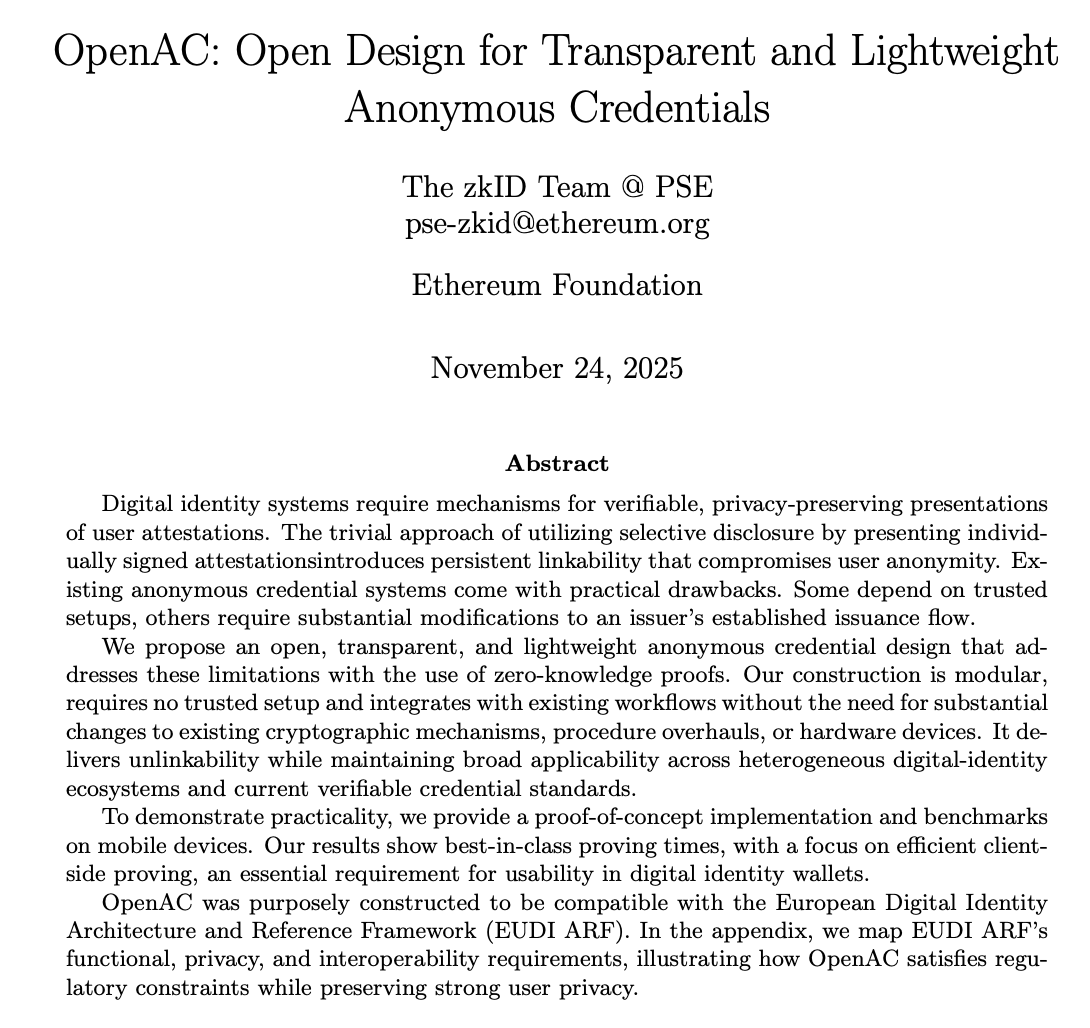
1/ 🌱 The zkID team published OpenAC: Open Design for Transparent and Lightweight Anonymous Credentials earlier this week with a show proof time of 0.129 seconds.
It describes a zero-knowledge identity construction designed to work with existing identity stacks and was purposely constructed to be compatible with the European Digital Identity Architecture and Reference Framework (EUDI ARF).
https://t.co/1T8QxFxuJT
EIP-8037 is scheduled for Glamsterdam and will increase the gas cost of creating new accounts and writing to new storage slots by 5-8x.
What protocols have hard-coded expectations about state gas costs? What is at risk of breaking?
@staker1971 Inclusion list. The committee in EIP-7805 publishes lists of transactions the next block proposer has to include (or have their block orphaned by attesters). It's a censorship-resistance mechanism.
FOCIL (EIP-7805) promises 1-of-N honesty among IL committee members: one non-equivocating member is enough to force a tx into the canonical block.
I formalized that claim in Lean 4. It holds, derived end-to-end from Ethereum's standard >2/3 honest-stake assumption.
No opaque validity predicate in the safety chain. The concrete EVM-validity layer is the nonce proxy @soispoke describes for the EOA case. Five pure safety theorems are zero-axiom. The PoS-derived chain inherits propext and Quot.sound only.
Three observations from doing this:
1. Equivocation is a free censorship channel for any tx listed by only one committee member. A Byzantine member can void their own contribution by signing two distinct ILs. 1-of-N degrades to 1-of-(N − equivocators).
2. Adversarial validity. A colluding party submits a tx from the same sender as the IL tx; the proposer appends it; the IL tx is now stale and legitimately omittable. Formalized as a theorem on a concrete account-state model. Cost: one gas fee, no slashing.
3. The honest-attester invariant has two non-equivalent formal readings. The natural global reading is unsatisfiable non-vacuously when EVM validity is opaque; the spec needs the locally-relativized reading. The English-prose version doesn't surface this.
I published a production implementation of OpenAC as an npm package.
@l8zk/sdk generates and verifies Spartan2 zero-knowledge proofs with performance matching the paper:
• ~96ms show proof
• ~34ms verification
• full reblinding for unlinkability
• transparent setup (no trusted ceremony)
Current scope: pre-compiled circuits with fixed payload size, matching official PSE benchmarks. Dynamic credential support is under active development.
Built on top of the MIT-licensed zkID work by the PSE / Ethereum Foundation team.
1/ 🌱 The zkID team published OpenAC: Open Design for Transparent and Lightweight Anonymous Credentials earlier this week with a show proof time of 0.129 seconds.
It describes a zero-knowledge identity construction designed to work with existing identity stacks and was purposely constructed to be compatible with the European Digital Identity Architecture and Reference Framework (EUDI ARF).
https://t.co/1T8QxFxuJT