@NammaBESCOM , if the power is going to cut every 20 minutes, you might as well publish a timetable for power cuts.
Location: Murugeshpalya
@BescomHelpline
@aelson389@thesysdev you can build task-specific agents in Agent Builder, connect tools/actions, and embed different agents on different Framer pages.
Entire flow is no-code.
We turned OpenClaw into a workspace
A cron handles my morning brief from PostHog, GitHub, and Stripe
That part's solved. But I'm obsessed with those metrics - which means I'm reprompting all day
I just wanted one place to see them all
I've been making the case all year that AI needs more than chat. Had to put our money where our mouth is.
Built it for myself first. Now can't work without it.
So we generalized it and shipped it as open source.
This is what SaaS 2.0 should feel like
Introducing OpenUI v0.5
v0.1 helped you build chat with UI
v0.5 lets LLMs build full apps
State, data, actions. All handled seamlessly without the security risks of generating raw code
Love what Claude shipped with Cowork Artifacts but generating code for Generative UI is the wrong architecture
Wasteful: A single dashboard costs 2k boilterplate React/HTML tokens before any meaningful pixel is streamed
Inconsistent: Two dashboards generated 5 mins apart don't feel like the same product. No design system. No shared components. Every output is a one off
Security Liability: Today its a single-user sandboxed demo. But real software has shared dashboards, team views, embedded reports - LLM generated code for one user running in another user's session. Sandboxed or not, that's OWASP LLM05 territory.
Multi-surface: A dashboard generated for desktop never works reliably on mobile. Want to render it on an iPhone? Your only option is an iframe. Yuck.
Unstreamable: Partial code is extremely hard to stream meaningfully. What you get is hundreds of chunks of broken renders that flash and flicker. That's not progressive UI - that's broken UX.
Code generation is a great starting point. It's not a production architecture.
Generative UI in production needs an abstraction layer. The model describes intent. The renderer owns the pixels. Everything else is a liability.
1/ Got a flood of 'how to build that?' DMs on the dashboard demo
Short answer: OpenUI Lang v0.5.
It's the layer that lets the agent go beyond rendering UI and actually wire up a working app.
State, Data & Actions - the three building blocks for real Generative UI
@Appyg99 The currents implementations are lazy, but I would also argue that the interfaces will AI powered and its the best decision we can make when we talk about user empathy
Yeah. I don’t think this will be end state of everything. You could put more things in the screen, you can also change this screen.
Giving the perfect initial view to user is a hard problem in product that is used by many roles, company sizes. And mind reading doesn’t exist yet.
Some products try to do these with home screens but often end up with this dashboard of various things.
Maybe some feed could be the best that flexible enough, show some protectiveness and allow some jumping off points.
notice something?
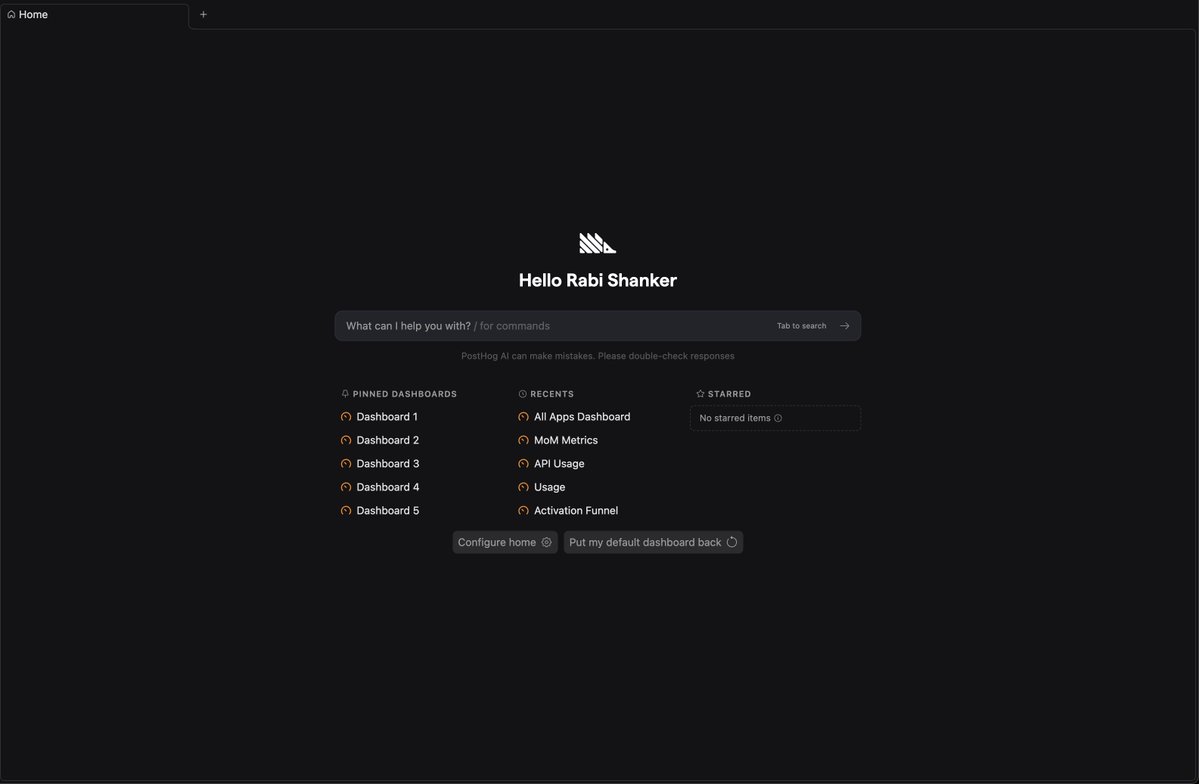
Linear, PostHog, Attio - all shipped the same thing in the last few weeks. Homepage is a chat bar - not a dashboard.
This is the SaaS industry quietly admitting that traditional UI doesn't work anymore. Every user is different. One homepage can't serve them all.
The playbook is shifting:
→ expose your core APIs
→ connect an agentic layer
→ let users use software the way they want
SaaS became chat. Chat will become Generative UI - the agent won't just reply in text, it will compose the interface itself.
We're closer than people think.
@cjayls@rabi_guha Chat as the default UI is a lazy implementation.
Generative UI promises smth bigger, predict intent from context and render the right interface upfront.
Prompting is useful and should exist by default, but it shouldn’t be required for things we already know users came to do.