The most expensive part of a hospital bill may never touch the hospital at all.
A patient admitted for care has no way of knowing whether the price on a medical consumable reflects its actual cost or a markup fixed long before it ever reached the ward. That gap in information is, at its core, a public health issue.
A survey of hospital consumables in Maharashtra found an IV infusion set with a trade price of ₹11.05 carrying a printed MRP of ₹325 ; a markup of 2,841%. A syringe procured at ₹6.75 carried an MRP of ₹57.20. A catheter procured at ₹29.41 carried an MRP of ₹310.
These are not elective purchases. Patients cannot compare prices, seek alternatives, or question a number printed on a box while receiving care and the MRP itself is often fixed upstream by manufacturers and distributors, disconnected from the trade price by a wide, unexplained margin. The result is a system where the party bearing the cost has the least information to evaluate it.
The regulatory gap is structural: scheduled medicines are capped under the Drugs (Prices Control) Order, 2013. Most medical devices and consumables are not leaving both the pricing and the information around it almost entirely unmonitored.
A review of these findings and clear guidelines on the permissible gap between trade procurement price and declared MRP have been recommended to the Department of Pharmaceuticals and the NPPA ; a step toward closing not just a pricing gap, but the information gap patients are left to bear alone.
#PublicHealth #GoodGovernance #Leadership #TukaramMundhe
https://t.co/Ye9CVzr8qU
"I accumulated 3,000 shares of Titan around ₹27.40. The price kept swinging between 30 and 75, back and forth, almost 5 times. I sold and re-bought 3-4 times. Then suddenly it moved to 140, and the fundamentals never showed anything to justify that kind of jump."
"Fear crept in, that this gain might slip away. That's the same fear most investors have. So people sell. But there's no real benefit to that decision, because now you're free with cash, and you have to go find one more stock and cover that entire journey all over again."
"When I sold, the fundamentals weren't telling me anything. But the stock went on to 280, then 400. That's when they entered the jewellery business, and we all know the Titan story from there, how much wealth even Rakesh ji created from it."
"Buying low wasn't intelligence. Holding onto it and understanding the value chain was. Today's investors have access to all that information. Build conviction first. Ask yourself why you're actually investing in a company. If you can't answer that, don't invest in it."
Aunali Rupani (Founder, ARM Research Private Limited) on How Titan Gave 15x
Discl: Stocks discussed are examples used to explain concepts, not a recommendation. Please consult a SEBI regd. advisor.
Watch Full Podcast : https://t.co/4YiqL84oSk
This is probably the most mind blowing and stunning onboard footage I’ve seen in ages. Wow 😮
Even @elonmusk may appreciate this… that is if he ever actually looked at any of my posts 🤭
A team of mostly University of Waterloo undergrads sent a rocket more than 19 kilometres into the sky, setting a world record for the highest amateur liquid rocket. The successful flight happened on August 21 at the Launch Canada Challenge, in Timmins.
You can clearly see the curve of the Earth and space. What an incredible view.
Credit: Waterloo Rocketry
@jugeshinder Calling the concern “pure comedy” feels a bit premature. US federal debt is dramatically larger today and that reality is missing in your analysis Sirji.
There is a process that I have used, and still use, to reignite life...
Create two timelines—6 months and 12 months—and list up to five things you dream of having (including, but not limited to, material wants: house, car, clothing, etc.), being (be a great cook, be fluent in Chinese, etc.), and doing (visiting Thailand, tracing your roots overseas, racing ostriches, etc.) in that order.
If you have difficulty identifying what you want in some categories, as most will, consider what you hate or fear in each and write down the opposite.
Do not limit yourself, and do not concern yourself with how these things will be accomplished. For now, it’s unimportant. This is an exercise in reversing repression.
Be sure not to judge or fool yourself. If you really want a Ferrari, don’t put down solving world hunger out of guilt. For some, the dream will be fame, for others fortune or prestige. All people have their vices and insecurities. If something will improve your feeling of self-worth, put it down.
Drawing a blank? In that case, consider these questions:
1) What would you do, day to day, if you had $100 million in the bank?
2) What would make you most excited to wake up in the morning to another day?
Don’t rush—think about it for a few minutes.
If still blocked, fill in the five “doing” spots with the following:
— one place to visit
— one thing to do before you die (a memory of a lifetime)
— one thing to do daily
— one thing to do weekly
— one thing you’ve always wanted to learn
What does “being” entail doing?
Convert each “being” into a “doing” to make it actionable. Identify an action that would characterize this state of being or a task that would mean you had achieved it. People find it easier to brainstorm “being” first, but this column is just a temporary holding spot for “doing” actions.
Here are a few examples:
1) Great cook —> make Christmas dinner without help
2) Fluent in Chinese —> have a five-minute conversation with a Chinese co-worker
Determine three steps for each of the dreams in just the 6-month timeline and take the first step now.
Define three steps for each dream that will get you closer to its actualization.
Set actions—simple, well-defined actions—for now, tomorrow (complete before 11 A.M.) and the day after (again completed before 11 A.M.). Once you have three steps for each of the four goals, complete the three actions in the “now” column.
Do it now. Each should be simple enough to do in five minutes or less. If not, rachet it down. If it’s the middle of the night and you can’t call someone, do something else now, such as send an e-mail, and set the call for first thing tomorrow.
If the next stage is some form of research, get in touch with someone who knows the answer instead of spending too much time in books or online, which can turn into paralysis by analysis.
The best first step, the one I recommend, is finding someone who’s done it and ask for advice on how to do the same.
Good air, clean water, and food are fundamental to a good life. In that sense, they should be treated as fundamental rights.
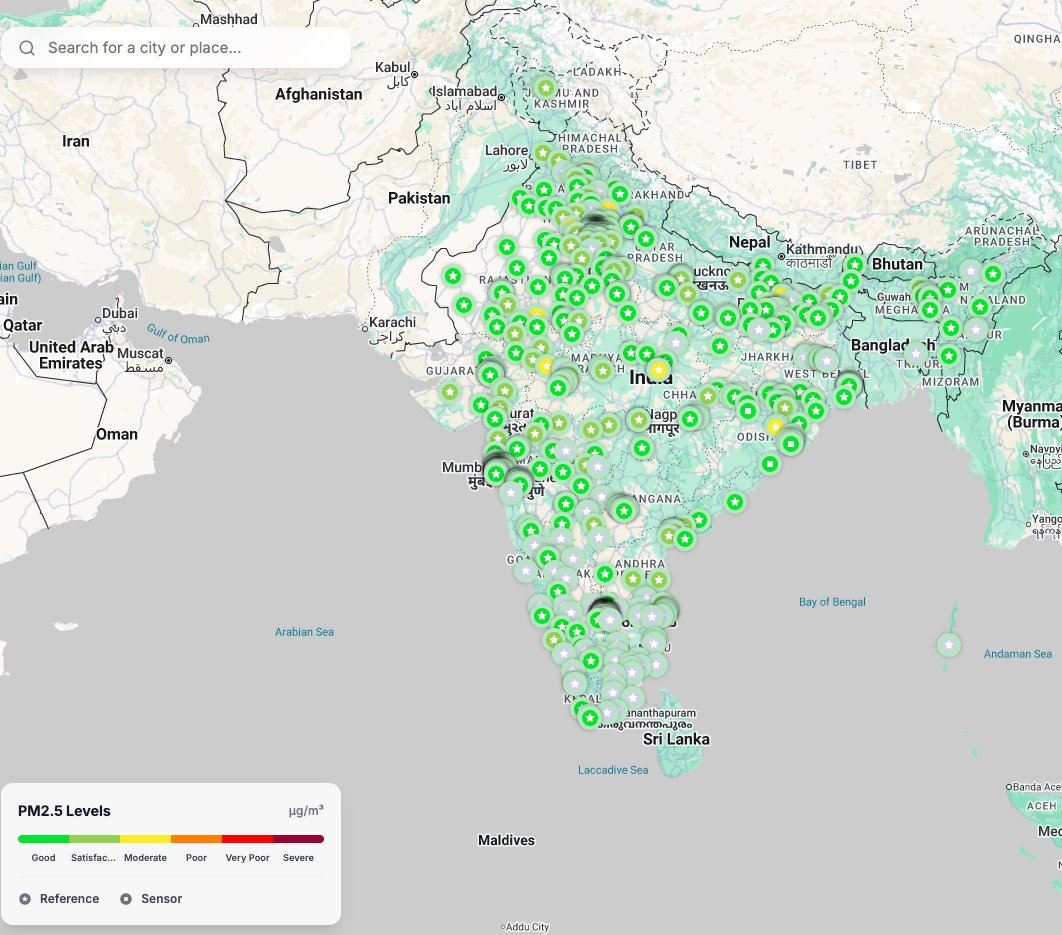
But air quality has been steadily degrading, and it's not really part of the mainstream conversation. That needs to change. Right now, if you look at the site (link in comments), everything looks green. But as we get closer to the end of the year, things will start looking much worse.
Solving air pollution is hard, but the first step is simple: people need to know what they're breathing.
Right now, that's not possible. India does collect air quality data, but it's either locked away, too broad to tell you anything about your locality, or just not published at all. There's no single place a citizen can go to get a clear, neighbourhood-level picture.
So we set out to fix that.
Today, we're launching an open, pan-India air quality platform, built in partnership with leading organisations in the field. The goal: give citizens, schools, local governments, and communities direct access to the data that affects their daily lives.
At @RainmatterOrg , we've been committed to keeping this conversation alive, and this platform is our attempt at making that happen. All the data on the site is free and open, so others can build on top of it.
You know you live in a fucked up world when an attack on four empty ambulances in London makes more noise than strikes on 100 medical facilities in Lebanon and over 700 attacks on health care in Gaza.
We are overstimulated and we don't even notice. Netflix while eating. Reels in the bathroom. Music while cooking. Podcasts on walks. We consume by default, not by intention. You keep filling every gap, then wonder why you feel foggy and unmotivated. Boredom and silence are the real growth drivers. They give you space to think and create. That's when solutions show up for problems that have been stuck for months. Leave some room.