DeFi just got a $13B reality check in 48 hours.
And your stablecoins might be stuck.
What’s going on?
It started with @DriftProtocol on April 1. North Korea's Lazarus Group stole $285M after a six month spy operation. No joke. Then 18 days later, @KelpDAO's rsETH bridge got hit. Its rsETH bridge was drained for about $292M, including 116,500 rsETH. That's over half a billion dollars in hacks this month alone. April is not being kind!
Here’s where it gets messy. The KelpDAO attacker didn’t just walk away with the $293M. They parked 116,500 rsETH on @Aave as collateral, then borrowed $196M in real ETH!
The catch? That rsETH wasn’t real. No backing. Just empty collateral.
Aave itself didn’t break. The system did exactly what it was supposed to do. The problem was letting worthless collateral in to begin with.
What followed was predictable. Pure Panic.
Whales started pulling out fast. TVL on @Aave dropped from $26.4B to $18.6B in a weekend. Roughly $8B wiped out.
And then the real issue hit. ETH, USDT, and USDC pools maxed out at 100% utilization.
In simple terms, funds are effectively stuck.
$3B in USDT and $2B in USDC are completely trapped on Aave right now. The only way out for USDT depositors is to take a loan against their own deposits at a loss. People are paying to escape. Over $300M in desperate borrowing happened in just 24 hours.
And then there's @RaveDAO. Their RAVE token pumped about 4,500% in a week, briefly hitting a market value of around $5Bn out of nowhere! Then crashed hard, about 90% - straight from $27 to $1. Pooff! Binance and Bitget launched investigations after suspicious wallets holding 96% of the supply started moving tokens. RaveDAO says they didn't do it. But the chain data says otherwise.
@Arbitrum's Security Council froze 30,766 ETH tied to the exploit. Too little, too late for the people whose money is still stuck.
So what is the real problem here?
Not “crypto is broken”. Or “DeFi is dead”.
It is this:
DeFi still runs on concentrated trust.
- Admin keys.
- Bridge verification.
- Collateral assumptions.
- Token supply sitting in too few hands.
That is the real chokepoint. We love saying “code is law,” but the truth is messier.
Once a protocol depends on a single verifier, a thin market, or one dominant wallet, it stops being the fully decentralized thing people think they are using.
It becomes a structure with hidden stress points.
And stress points always get tested.
Stay safe out there.
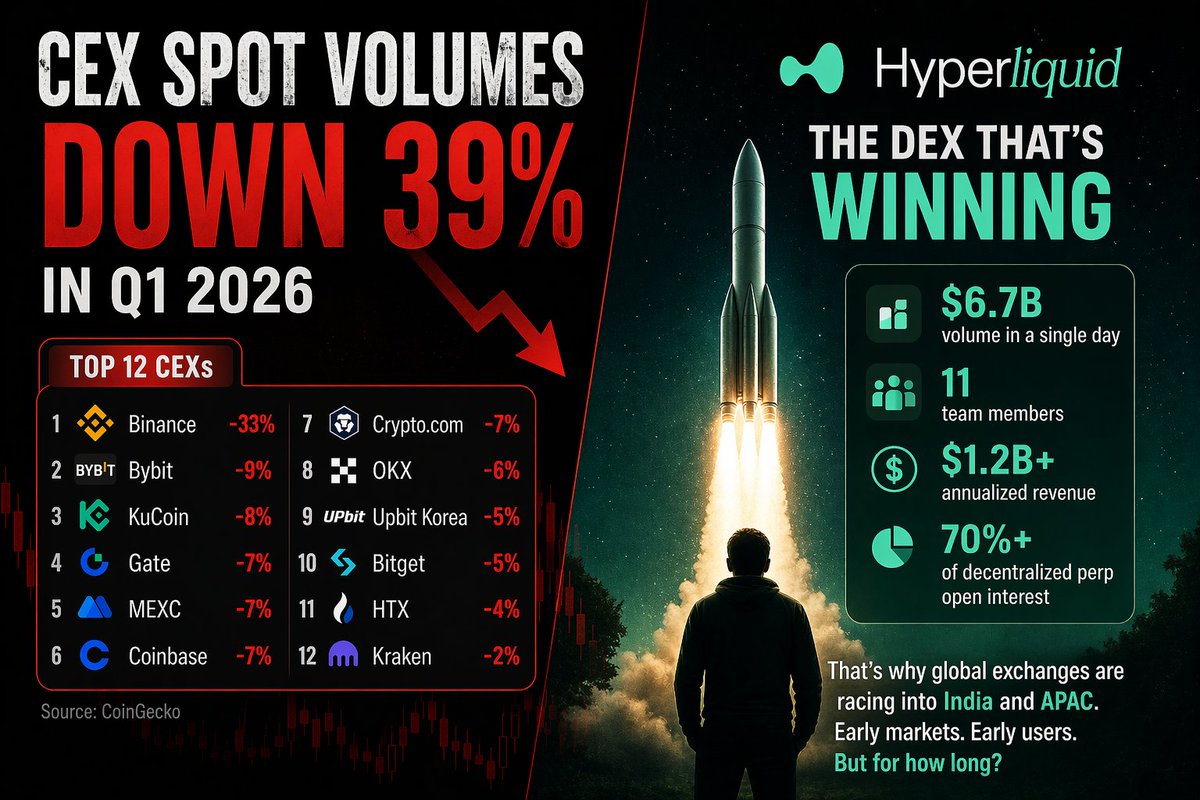
CEX spot trading volumes drop 39% in Q1 2026.
Top 12 CEXs by Spot Trading Volume (Source: CoinGecko)
1. @binance - 33%
2. @Bybit_Official - 9%
3. @kucoincom - 8%
4. @Gate - 7%
5. @MEXC - 7%
6. @CoinbaseIndia - 7%
7. https://t.co/o1egUWKnrd - 7%
8. @okx - 6%
9. @Official_Upbit - 5%
10. @bitget - 5%
11. @HTXFutures - 4%
12. @krakenfx - 2%
You might think it's alright considering the geo-political tension and the global market meltdown. But zoom out, and a different narrative is forming.
While CEX volumes decline, #Hyperliquid is accelerating:
- $6.7B traded in a single day
- ~11 team members
- $1.2B+ annualized revenue
- 70%+ share of decentralized perpetual open interest
That’s why major exchanges are doubling down on India and broader APAC. Markets where users are still early in their journey, still comfortable with CEX rails, and not fully native to #DeFi yet.
India’s #2 crypto exchange spot is WIDE OPEN. But most will mess it up.
India's crypto community is weird. It's unlike the rest of the world.
First, it's not just 20-something degens anymore. Plenty of older folks are entering the market and they’re going beyond #Bitcoin. Also, I'm monitoring a few Indian family offices that are now extremely keen on entering the crypto market. Why now? Not sure. War uncertainty? Upcoming Tax reforms? Needs to be seen.
And this is just one of many reasons why India is one of the most high-potential #cryptomarkets today.
@CoinDCX is clearly leading, and post-WazirX debacle, the #2 spot is completely up for grabs. That's where global exchanges like @coinbase, @krakenfx, @Bybit_Official & @bitget can actually win.
But it's not so easy.. Yes, Indians trust global brands. But they still want them to feel local. (and no, a celebrity face won’t cut it.)
This isn’t about branding. "Feeling local" means knowing what the Indian crypto community is thinking, talking about & planning next.
Most global players get this wrong: they bring strong operational leads who have zero/low domain-level pedigree. In crypto, you simply can't run a 24/7 market with someone who clocks out at 7 PM.
You need someone who lives in the crypto trenches. Someone who's tracking Crypto Twitter at 3 AM, in sync with ground-level sentiment, follows conversations around TG groups, Discord servers & subreddits. Someone who breathes this stuff every second.
Trust me, no amount of crypto news or newsletters can replace what I just described.
So, that’s step one ➡️ Put someone crypto-native in charge. Everything else flows from there.
Next:
- Launch a freaking awesome referral program that's a true win-win.
- Soft launch it through micro-influencers (<2.5K followers). Avoid big names.
- Amplify through offline #Web3 events. But be smart about it. Bigger isn’t always better.
- Your social media vibe can’t miss (hint: not boring for Gen Z, not too casual for the rest).
Some exchanges have cracked the code, like @MEXC with events. A great case study if you're interested.
But again, all of this "only" works if the person leading knows the space deeply. Get that one thing right, and the upside is massive.
Well.. that’s my two satoshis on global #cryptoexchanges entering India, the crux of what I could say without boring you! And no, this isn’t AI (just the thumbnail is).
The internet is starting to see a new kind of user.
Not humans. Not traditional bots.
But AI agents. 🤖
Got a few DMs asking whether #AI will dethrone crypto (in scope) or merge with it into an “agentic economy.”
Here’s how I see it. But first, a quick backstory in case you’re new to AI agents:
These agents are very different from the chatbots we’re used to. Instead of just responding to prompts, they can take a goal, figure out the steps, and actually execute tasks on their own.
That could mean booking flights, managing a portfolio, purchasing services, or even negotiating prices.
In simple terms, it’s like giving your AI assistant both a wallet and a job.
Now imagine this at scale, with millions of agents interacting online. Agents talking to apps, transacting with other agents, and operating autonomously. This is what many are starting to call the “#AgenticEconomy.”
And this is where crypto starts to become relevant. If these agents are going to participate in an economy, they need ways to:
- make payments
- establish identity
- own assets
- coordinate with others
#Crypto infrastructure already enables much of this through wallets, smart contracts, and onchain identity systems.
Several projects are already building in this direction, including:
- @Fetch_ai
- @SingularityNET
- @virtuals_io
- @bittensor
- @oceanprotocol
While big tech is focused on building the intelligence layer for AI, crypto may end up providing the economic layer that allows these #agents to function independently.
How I personally see this is: the internet began as a network of computers and then evolved into a network of people.
Now, the next phase could very well be a network of agents working on behalf of people (not replacing them).
The internet is starting to see a new kind of user.
Not humans. Not traditional bots.
But AI agents. 🤖
Got a few DMs asking whether #AI will dethrone crypto (in scope) or merge with it into an “agentic economy.”
Here’s how I see it. But first, a quick backstory in case you’re new to AI agents:
These agents are very different from the chatbots we’re used to. Instead of just responding to prompts, they can take a goal, figure out the steps, and actually execute tasks on their own.
That could mean booking flights, managing a portfolio, purchasing services, or even negotiating prices.
In simple terms, it’s like giving your AI assistant both a wallet and a job.
Now imagine this at scale, with millions of agents interacting online. Agents talking to apps, transacting with other agents, and operating autonomously. This is what many are starting to call the “#AgenticEconomy.”
And this is where crypto starts to become relevant. If these agents are going to participate in an economy, they need ways to:
- make payments
- establish identity
- own assets
- coordinate with others
#Crypto infrastructure already enables much of this through wallets, smart contracts, and onchain identity systems.
Several projects are already building in this direction, including:
- @Fetch_ai
- @SingularityNET
- @virtuals_io
- @bittensor
- @oceanprotocol
While big tech is focused on building the intelligence layer for AI, crypto may end up providing the economic layer that allows these #agents to function independently.
How I personally see this is: the internet began as a network of computers and then evolved into a network of people.
Now, the next phase could very well be a network of agents working on behalf of people (not replacing them).
Tokenization changes everything.
Oil. Gold. Silver. Stocks. Bonds. ETFs.
The most important assets are coming onchain, making access global by default.
@SevNightingale dont go into partnerships or mere developments on the chain. check for revenue and fees the chain is generating. and dont consider internal/wash trades.
Under Biden, companies were forced offshore.
Under @realDonaldTrump, they're welcome back in America.
Insane regulation by Dems: require licenses, refuse to give them out. They literally couldn't operate in America. https://t.co/TbpA4c4jNf
Under President Trump, that's changed. The DOJ is no longer indicting entire industries.
For years, all the liquid prediction markets were offshore because of this; now they're opening up to Americans. Same with crypto.
Dems increased corporate taxes, moving companies offshore, and created loopholes so companies kept all their money offshore, too.
President Trump expanded business tax breaks, pulling investment back to the U.S.
i am back. good time spent in stonks & metals. Spidey sense tells me crypto is coming to that "sweet spot" to enter (again).
Which ones are cooking lately?