Run Docker inside Vercel Sandbox.
▪︎ Build and run containers in full isolation
▪︎ Persist installs and images across sessions
▪︎ Run databases, test suites, or full apps
https://t.co/jEatpDslcC
How to make your engineering job application stand out (from the perspective of someone looking at hundreds of resumes):
1. Your resume should be one page. If you really need more space, link to a website. You don't need 10+ bullets for each job.
2. You will immediately stand out >90% of applications if you link a personal website that has some intentionality behind it.
3. If you are going to link your X, you might want to clean up your posts? Seems obvious but... people post some wild stuff.
4. You should link your GitHub. Please avoid doing a profile README that looks like a MySpace profile with the badges and images. I'm trying to look at code and your ability to build interesting ideas.
5. You should try to customize your application to the company. If you're applying to a startup, the courses you took in college probably don't matter as much. Maybe more if you're trying to make it through the ATS screening for FAANG.
6. I'm seeing a surprising number of resumes which don't talk about AI or agents at all. Software engineering is changing and it's a pretty fair assumption that you will be expected to learn or understand coding with AI for your job. That should be reflected on your resume and projects (and I'm not just saying this because I'm at Cursor).
7. Take your LinkedIn seriously. Most devs are here hanging out on X but surprisingly still most people will send around your LinkedIn internally.
8. Find ways to show your unique strengths/tastes/interests. It's nice to see people are smart, well-rounded, and thoughtful. Maybe this is a collection of books you enjoyed and why. Or some writing you've done. Or films you liked. At the end of the day, people want to work with other people they like and respect. If nothing else, it will be a good conversation starter ("oh I love [book] as well!").
9. Do not use AI to write your cover letter or resume text. It's incredibly obvious, especially if you are applying to an AI company. You can still use it to ideate on ideas or phrases, but write it by hand (don't fall victim to the overused in-the-distribution-AI-phrases). See: /humanizer skill.
10. No photos on resumes. Save those for whatever you link out to.
11. Quality over quantity. 3 really good, thoughtful, detailed, interesting projects versus a wall of 27 AI-slop ones.
Remember that hiring managers / recruiters are getting hundreds or thousands of applications for a role. They're not going to spend 20 minutes on every single application. You need to cut the cruft and get to the point. I hope this helps you stand out!
Fun Fact: Stripe does logging differently. They take a super interesting approach to log processing, something that helps them debug production issues faster, cheaper, and with far less complexity.
Logging data belonging to one request is typically dumped across multiple lines. Stitching together these fragmented logs became a pain as they scaled. So what they do is emit a single, comprehensive log line at the end of every request, and they call it the Canonical Log Line.
I just published a video dissecting their entire process and the exact steps they took to implement canonical log lines without breaking their existing log processing systems.
Give it a watch.
It is a pretty short video, but interesting and fun. Something you can implement at your workplace right away.
The migration story for @nextjs cacheComponents: flip a global switch to break everything, then 'use cache' your way back to sanity one function at a time... classic
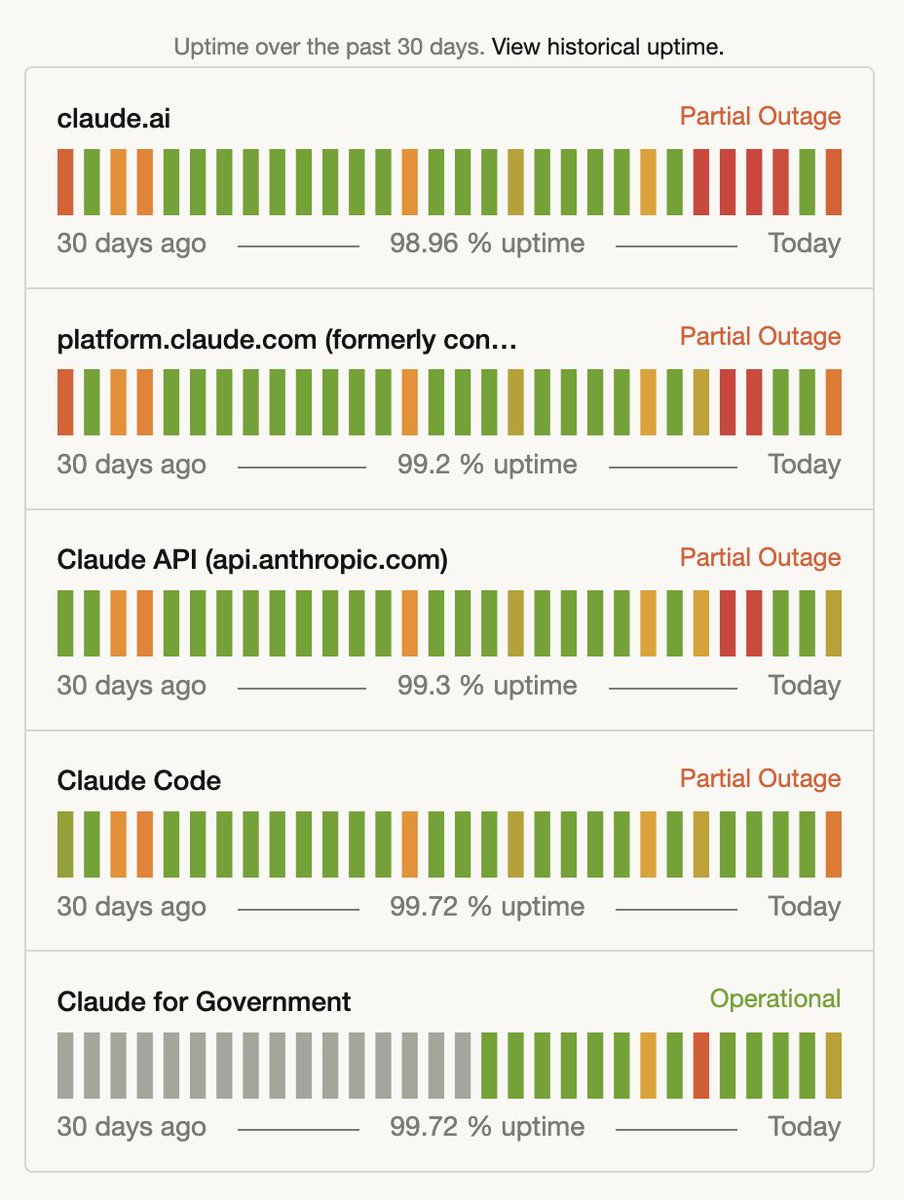
On one end, the Anthropic team is a massive user of AI to write code (80%+ of all code deployed is written by Claude Code). They ship amazingly fast.
On the other hand, seeing these beyond terrible reliability numbers suggests there might be a downside to all this speed:
months of building with coding agents has taught me that these agents shouldn't read library docs. They should instead read library source code (e.g., node_modules).