#WATCH | Delhi: During interaction with CEOs and Founders of Space Startups, Prime Minister Narendra Modi said, "...I believe we should create an aura where people from all over the world feel that if they want to build a life in this field, they should come to India—join an Indian startup or the Indian space agency. I am convinced that we can attract this entire talent pool like a magnet, and it can become a tremendous strength for us...We are highly cost-competitive. There is no question regarding the quality of talent, and since the people of our country naturally possess a high capacity for risk-taking, we can rapidly carve out a niche for ourselves."
(Source: DD)
Some of the greatest scientists in history were also wrong about important aspects of heat and thermodynamics.
Antoine Lavoisier and Pierre-Simon Laplace supported the caloric theory of heat, which treated heat as a subtle fluid-like substance that flowed from hotter to colder bodies.
Sadi Carnot, who was one of the pioneers of thermodynamics, believed heat itself was conserved during engine operation.
Isaac Newton assumed that the rate of cooling was proportional to the temperature difference, an approximation that works in limited regimes but is not universally valid because convection is nonlinear and the heat-transfer coefficient changes with conditions.
James Clerk Maxwell and other classical physicists could not reconcile classical electromagnetic theory with the observed spectrum of blackbody radiation.
Even Lord Kelvin, one of the giants of thermodynamics, made incorrect estimates and assumptions about the age and thermal history of Earth because he treated the planet as a cooling body without accounting for internal radioactive heating.
Science works on doubts and hypothesis. Even greatest scientists have been wrong, and were later corrected. Accepting mistakes have never made any scientist small.
Saurav, you are neither a scientist nor an engineer. You made fun of a right statement. It was fine. But then you were corrected by multiple accounts. Instead of admitting that you were wrong and deleting the tweet, you continued to promote a wrong fact. That’s because your ego is not permitting you to accept that you can be wrong.
Bro, if you want the condition of education to improve in India, but when it comes to you, you can’t accept that you can be wrong.
IIT Mumbai sets new record for PhD awarded. The institute has fixed a 6 year limit for the completion. Earlier there was no deadline to complete a PhD programme. These are seemingly small - but critical reforms - to create high quality research capacity for India. Well done @iitbombay 👍
https://t.co/ZCkaamYl6Z
Congratulations to everyone who believed that India can manufacture at scale.
To every entrepreneur who set up mobile manufacturing units, to the hands on the factory floors, to our consumers - you have helped India become the world's second-largest mobile manufacturer.
We will continue to rise and build in India for the world!
#MakeInIndia
Meet the IIT Bombay engineer who turned down ISRO to build Rs 1,000 crore Atomberg
@iitbombay alumnus Manoj Meena had an ISRO job waiting after graduation. Instead, he chose entrepreneurship and spent four years searching for a scalable idea. A breakthrough in energy-efficient motors eventually led to Atomberg, which crossed Rs 1,000 crore in total income in FY25.
https://t.co/FIl2UkOqLs
@atomberg_tech@IITBAA_Official@DeanACRIITB
"You have a war going on in Ukraine for 5 years. It's not a T20 match. People thought the war in the Gulf would be a T20 game. It has turned about to be more of a test series," says S Jaishankar using his cricketing analogy at the ET World Leaders Forum
India today gets 52% of its electricity from non-fossil sources. That means more than half of every unit of power generated now comes from the sun, wind, water, or nuclear, a fundamental shift in how India powers its growth.
For a deeper analysis of how India is moving from energy scarcity to energy abundance, read our $ubstack👇
https://t.co/SOmQ2wGmAQ
Q: Are you worried about the Pakistan-Saudi-Turkey defence pact?
Dr. Jaishankar: You think about it. There are live military situations that each of the three countries is facing. What has this pact done in response to that?
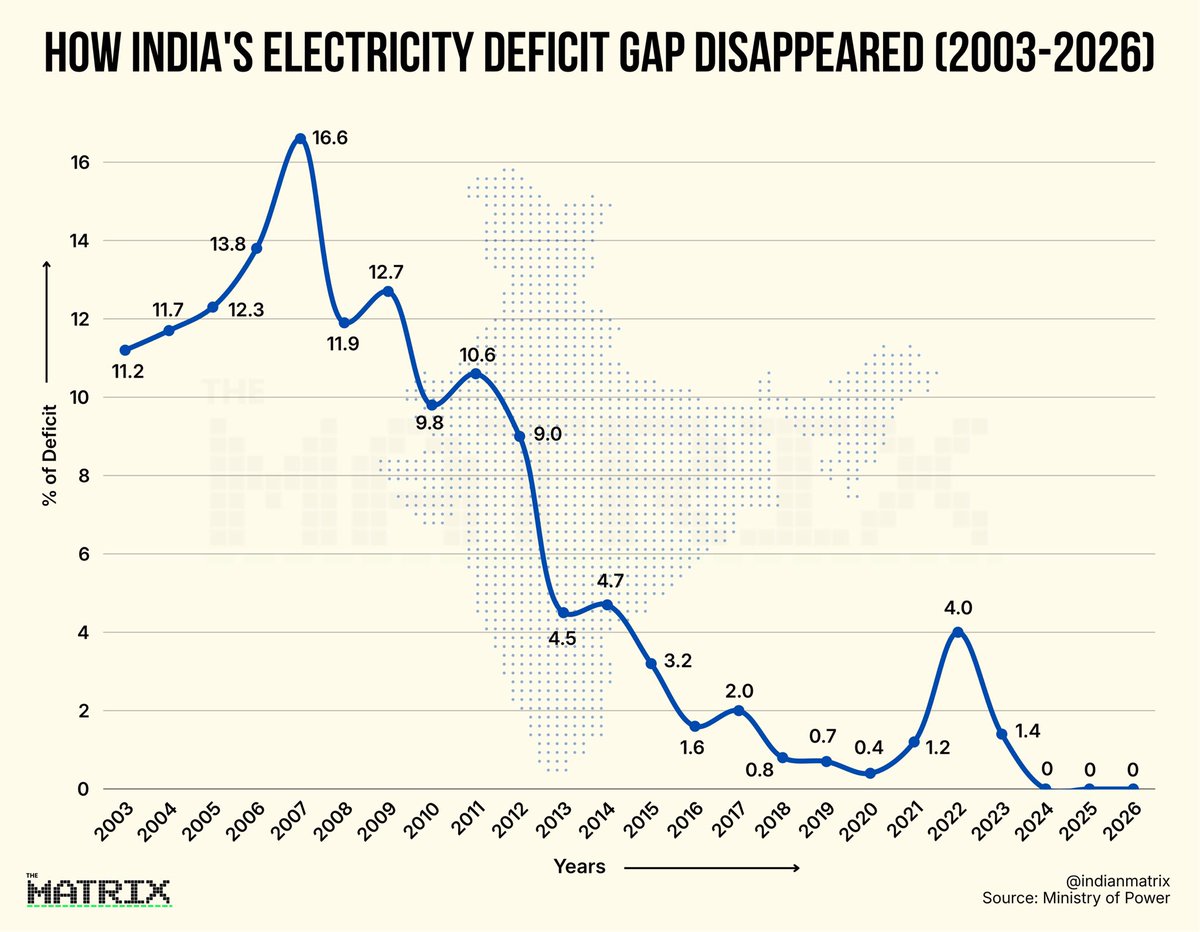
In 2005, India couldn’t meet 12.3% of its own peak demand. By 2007, the shortfall had widened to nearly 16.6%, and close to 18,000 megawatts were unavailable.
India today draws 52% of its electricity from non-fossil sources. More than half of every unit generated comes from the sun, water, wind, or nuclear.
The deficit percentage, which once sat stubbornly above 10%, has now collapsed. Since 2024, it has been effectively zero.
Electricity reliability is, in the end, a quiet form of equity. When the grid is unreliable, those with money buy backup. Those without simply go without. India's closing of its power deficit means that the gap no longer falls along economic lines.
The country that once rationed darkness now delivers light on demand, at the moment of highest need, to everyone connected to the grid.
Can GIFT City become India’s answer to Dubai, Singapore, Hong Kong, London or New York?
A little over a decade ago, much of where GIFT City now stands was barren, riverine land. Today, it is India’s big attempt to build a global financial hub.
For this week’s Walk The Talk, I spoke to the regulator, the people building the ecosystem, bankers and money managers about what’s working, what isn’t — and what GIFT City still needs to do to compete with the world’s leading financial centres.
For more, watch Walk The Talk on NDTV.
#GIFTCity #WalkTheTalk #NDTV
"It was a pleasure to brief Hon'ble Prime Minister @narendramodi ji on how Digantara is serving our Armed Forces through comprehensive SSA technology suite - ground sensors, space sensors, high resolution imagery and military SSA C2 center, and on our upcoming missile-tracking satellite constellation — inspired by his vision of Sudarshan Chakra. 🇮🇳🛰️"
Proud moment for team @Digantarahq@anirudhnsharma
#sudarshanchakra
#NSpD2026
The PM has beautifully differentiated between industrial policy today and under Indira Gandhi. PLP vs PLI. Production Linked Punishment vs Production Linked Incentives.
The key difference was and is the approach to scale. Industrial policy with an anti-scale approach was the worst of both worlds.
SCALE is key, and Modinomics gets it.
Dear @nsitharaman, please read this excellent op-ed carefully.
If your finance ministry bureaucrats still insist on even a small MDR charge on #UPI, it will count as the worst financial decision since Pranab Mukherjee’s retrospective taxation.
Govt sources say India will soon approve a $1.2-billion scheme to boost domestic manufacturing of tunnel boring machines, elevators & other high-tech construction gear. Aims to attract $1.8 bn investment over 7 years & cut China dependence. Local value-addition targets included. Potential boost for BEML, L&T & others.
https://t.co/QDloac2ze4
If you see any uninformed person in India parroting propaganda, without using their brains, that "India only assembles phones" tell them China too doesn't manufacture phones with over 80% of parts of, say an iPhone, coming from outside China, including from India, but still they proudly call it "Made in China."
Tell them, in a globalized world, even a sensitive tech like F-35 is assembled from many parts sourced from outside its home country. Tell them not to be seen as a low IQ person who falls for this silly propaganda that has been planted to mock Made in India and demean ourselves.
Make them understand that, today, not even a semiconductor and electronics powerhouse like Taiwan can manufacture a phone 100% on its own. Even if it has processors and circuit boards, it may still need to source displays from Korea, the glass for the displays from India, the OS from US, and cameras from Japan.
It is indeed true that only a low-IQ, self loathing, slave minded person in India will knowingly parrot such silly propaganda planted from outside India to demean India and India's manufacturing rise. Only a colonized, politicized, programmed, ignorant mind will say "China manufactures phones, while India only assembles."
If you see any such comment anywhere in social media, paste this post's link as the reply. And ask them to get well soon and do something to help improve India on their own.
The founder of Addverb, one of India’s largest and most successful robotics startups, is from Bihar.
The founder of Euler Motors, one of India’s largest and fastest-growing electric commercial vehicle companies, is also from Bihar.
Tsuyo Manufacturing, which is doing some amazing work in electric vehicle powertrains and components, has Bihari founders.
Raphe mPhibr, one of India’s leading drone companies, is again led by Bihari founders.
Inverted is also doing its bit in the battery and energy storage space
A good number of new-age startups in manufacturing, robotics, AI, drones, EVs, and deep tech are being built by people from Bihar. These entrepreneurs have the capability, experience, and resources to contribute to the development and industrial growth of Bihar.
Got the opportunity to meet the Hon’ble Chief Minister of Bihar and hear him speak about his vision for building a strong technology and engineering ecosystem in Bihar.
His clarity of thoughts for creating an environment where technology, tourism, culture and innovation can thrive in the state is much better than what I gathered from social media.
I also had the opportunity to present him with our comics - "The Ghost of IIT BHU", an Engineering Comic created by our team to inspire young people to look at engineering not just as a career, but as a way to solve real-world problems.
I believe it will be.. In the long run, we need to Overhaul our ticketing system to European model, so that we can simply book the ticket and instantly board the next available train, instead of booking months in advance.. For this we need VBs to run on high volume routes after interval of every hour or so. This can be made possible with smartly integrating multimodal systems consisting VBs, RRTS and HSR..
Eventually the railway system must provide a cheaper yet fast enough alternative to Airlines for domestic travel.