What this is:
Stories about how money actually moves. The products that won, the ones that died, the accidents in between.
Every one comes from primary sources - the engineer's memoir, the original blog post, the filing, the person who was in the room. Told in scenes, not summaries.
First few:
- The Square Cash app that was designed in an art museum
- The contract an economist invented in 1993 that crypto made real 23 years later
- How a red envelope feature in one app pulled a billion bank cards onto a chat app
One of these a week. Follow if you like a good story that happens to be true.
@maxhodak_ the equity-market version of this already runs. venues pay a rebate to whoever posts the quote - maker-taker pricing, born with the electronic networks in the late nineties.
Every commodity people trade got a public price at some point. Compute's only arrived this year - Ornn's index averages verified H100 rental deals into a going rate anyone can look up, no hyperscaler contract required.
Nobody reprices your laptop. Apple sets the MacBook's sticker price at launch and it sits there until the next model. GPU time lives at the other end of the spectrum, where an H100 hour reprices with every trade.
@carmenli@CMEGroup CME has opened a market like this before. The first financial futures anywhere were its currency contracts, May 1972, the year after Bretton Woods broke.
A prediction market is an order book where a share pays out $1 if the thing happens and nothing if it does not, so the price doubles as the crowd's probability. Polymarket runs this today, and the University of Iowa has run one on elections since 1988. The machine does not care what the question is about.
Airlines learned long ago to lock in fuel prices years ahead - Southwest ran that playbook for a decade. Compute just got the same plumbing: ICE announced GPU futures in May and CME's start trading in October.
@jonah_b the check version of this is E-13B. banks and the machine makers agreed on one magnetic font back in the fifties and it still runs along the bottom of every US check.
@naval MIT's first Apollo order for Fairchild's Micrologic gates was in February 1962, at $43.50 a chip. The reorder two months later cost $29.10. A year after that, the program was consuming most of the world's chip supply.
@immad The rail itself has been live since November 2017, when The Clearing House called it the first new US payment system in forty years. BNY Mellon sent the first payment.
Phil Brandenberger of Philadelphia bought a Sting CD from a website called NetMarket on August 11, 1994. The New York Times called it apparently the first secure retail transaction on the internet. The CD was Ten Summoner's Tales.
@tobi In 1993 Europay, MasterCard and Visa each had their own chip-card spec. They met in a hotel by O'Hare, agreed to write one together, and named it EMV, alphabetical, so nobody's letters came first.
A vending machine in Finland was the first place you could pay with a phone. In 1997, you sent a text to a Coca-Cola machine, it dropped a can, and the charge showed up on your phone bill.
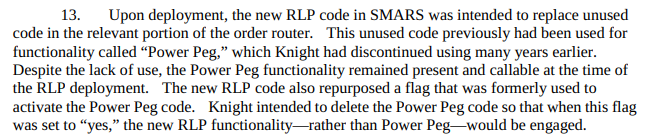
Knight Capital had a piece of code called Power Peg. It stopped routing orders once a parent order was filled, and Knight stopped using it in 2003.
In 2005 an engineer moved the function that counted filled shares to an earlier point in the sequence. Power Peg was dead code by then, so nobody retested it against the move. The counter it depended on was now somewhere else.
Seven years later Knight deployed new code for a retail liquidity program, and reused the flag that used to switch Power Peg on. A technician copied the new code to seven of eight servers.
On the morning of August 1 2012 the flag went live. On the eighth server it woke Power Peg, which sent child orders and never saw the counter that told it to stop. Four million executions in 154 stocks, 397 million shares, about forty-five minutes. Knight ended the morning long $3.5 billion of stock it did not want and short $3.15 billion of other stock, and lost more than $460 million unwinding it.
The SEC's order spends its first pages on the deployment checklist Knight did not have, before it gets anywhere near the money.
@OrnnExchange Selling compute by the hour goes back to the sixties. Tymshare started renting time on its SDS 940 in 1966 - you dialed in from a teletype and paid for the minutes.
On the morning of June 26, 1974, at the Marsh supermarket in Troy, Ohio, a cashier named Sharon Buchanan slid a pack of Wrigley's gum across a new kind of scanner. It was the first barcode ever read at a store checkout. That pack of gum is in the Smithsonian now.