Introducing: GhostKatz! 🐱
A Cobalt Strike BOF that lets you dump LSASS via exploitation of vulnerable drivers that offer physical memory read primitives.
Written by @EricEsquivel123 and I!! :)
https://t.co/tmuksIKvj8
I just published ida-ttd - an IDA Pro plugin that allows you to navigate TTD traces in a debugger session and MUCH more (too much to explain in a Xitter post). Pretty much every TTD analysis technique I've got is baked into it.
https://t.co/kDByiz3d9t
@InvokeReversing I’ve been curious about this. I feel like it may not be effective since an LLM would treat this as external output and not part of an original prompt (e.g. output of IDA MCP tool calling), and would therefore ignore it.
@papadelospapas_ Nice! I also think people care less and less about AI development. Who's gonna sit there and write all of this + a semi-decent ImGui menu by hand? Maybe someone on UnknownCheats LOL.
Let’s set the record straight: @lcfr_hax was the first to discover php2shell and develop a working exploit. See his August 5 tweet: https://t.co/I88EQFrUHa
His work convinced the PHP Foundation to invest in fixing this entire bug class. He then worked around the clock to review, test, and retest the patches.
@Salsa12__ If you’re trying to use ROP to mess with SMEP/SMAP, beware of the hypervisor you are using. New versions of vmware did not let me achieve this. Not sure about bare metal, but these are hardware mitigations. I try to stay away from control registers 🤣
The TTD tech tree has advanced a level!
- ttd-capa-cpp: reimplementation of ttd-capa that supports code scanning
- capa-cpp: C++ reimplementation of capa with added IDA Pro plugin
Shoutout to Xusheng (@CrackmesOne) for his help!
https://t.co/gAiJS4CnCS
https://t.co/Cu8JAoUQxM
The report is a really good read. My belief is that not a lot of people are in university "to learn." At the end of the day, they want the degree which unlocks job potential. Of course, this is not the case for every degree program.
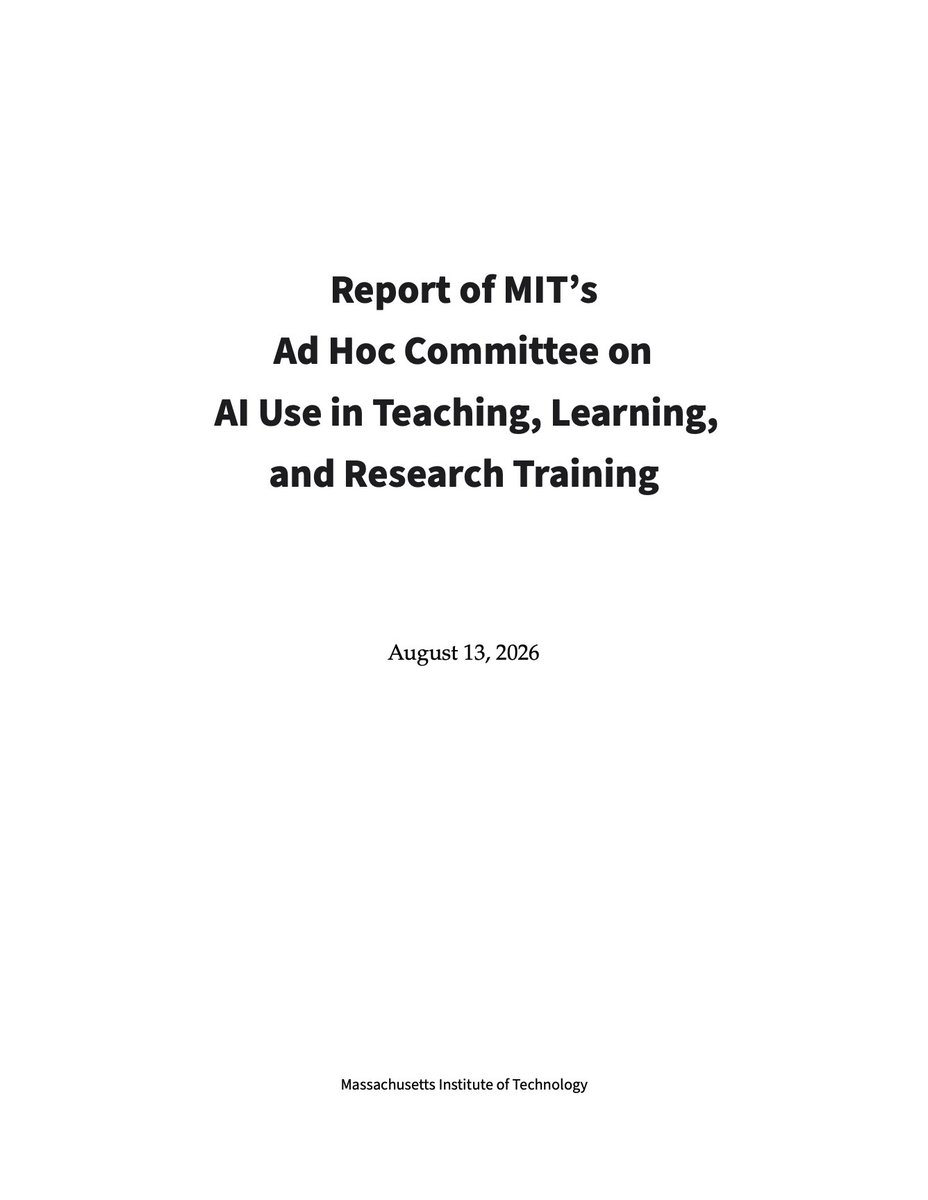
MIT published a brutally honest report on what AI is doing to students.
A committee of professors and students spent five months studying how AI changed learning on campus, and the findings read like a warning to every university on the planet.
Study groups are disappearing. Office hours are emptying out. Problem sets and take-home exams no longer prove anything, because AI can produce credible solutions to almost any written assignment in the undergraduate curriculum. Students who lean on chatbots lose mastery and confidence, and some slip into what the report calls cognitive surrender, reaching for AI at the first hint of struggle.
The numbers are rough. 46 percent of surveyed MIT undergrads use LLMs daily. 90 percent worry about their own overreliance. Undergrads who feel AI makes them replaceable now outnumber those who feel it makes them capable.
The committee's answer surprised me. They refused to fight AI with surveillance. The report calls AI detectors unreliable, says lockdown browsers feel like spying, and warns that policing students builds a classroom atmosphere of mutual distrust.
Instead, MIT wants to rebuild education around the things AI can't replace. That means oral exams, semester portfolios, in-person project work, and a required social component in every subject. The report even floats the idea of rethinking grades entirely, since without a GPA to optimize, much of the incentive to cheat with AI evaporates.
The committee warns professors against replacing undergrad research assistants with AI agents just because they're cheaper, because a university exists to grow people, not output.
The most famous tech school on earth admitted the machines broke its way of teaching. Its answer is more humans, not more software.
@mrgretzky Employers want someone "with a degree" but HR doesn't really care, or ask, how that degree was obtained. Person A cheating through everything and Person B not cheating both get the same piece of paper. The incentive "to learn" is not there.