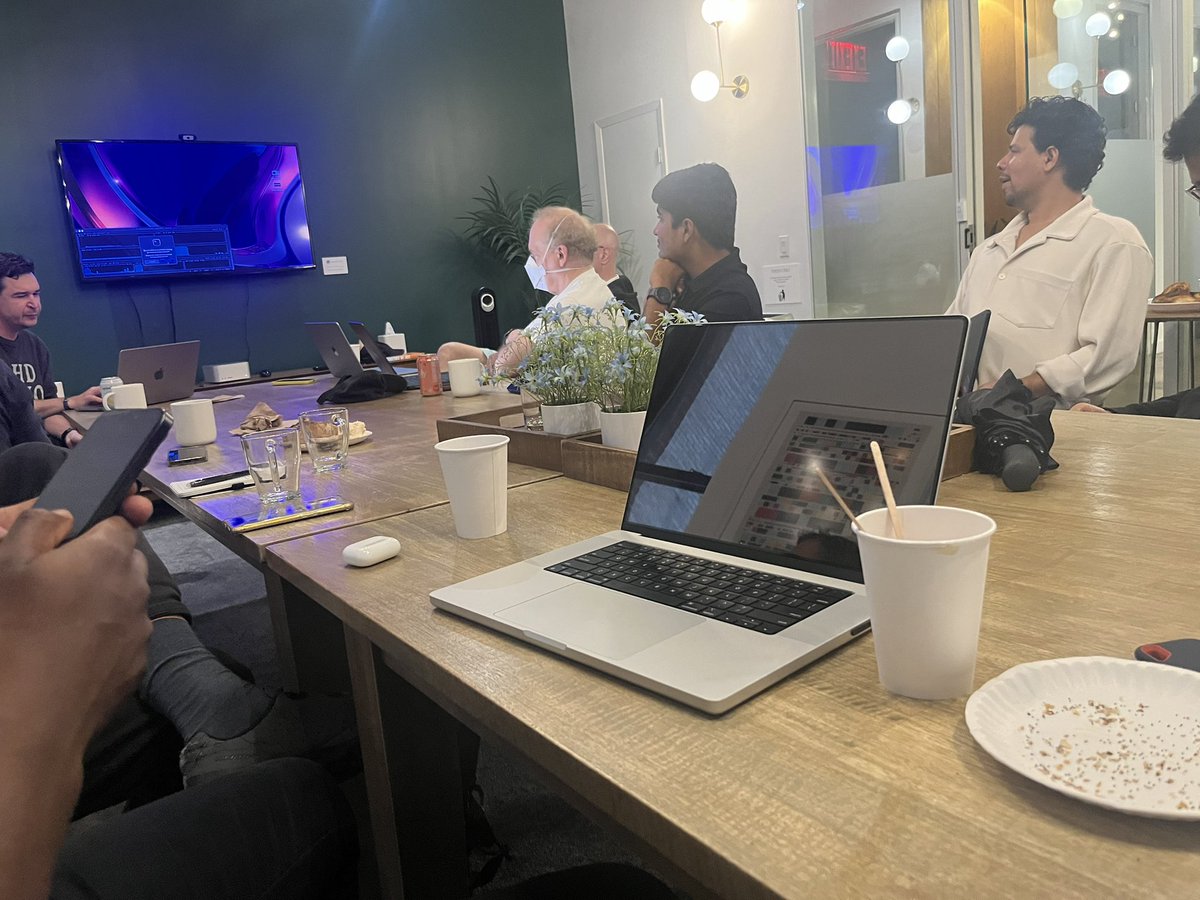
There is a certain side of running a business that these AI hypes are missing.
Always running at capacity leaves no room for really thinking about what is important
Sure the AI is "letting you do more than ever," but those same people stopped dreaming and are always executing.
Feels like a tragedy
The best way to use AI is an interface to information that lets you deepen and improve your own knowledge and mental models. The worst way to use AI is as a crutch to outsource and forsake your own cognition
Oh, you're writing CUDA kernels? Everyone's on Triton now. Just kidding, we're all on Mojo. We're using cuTile. We're using ROCm. We have an in-house DSL compiler targeting the NVGPU MLIR dialect but wait, Tile IR just dropped so we're going to target that instead. Our PM is on TileLang. The team lead was on CuTe but now she's back to handwriting PTX. If you're not on Pallas, you're ngmi. Our intern is building on TT-Metalium for our Wormholes. Our CFO approved an order for some big chungus wafer-scale chips so now we're porting our kernels to CSL. Our CTO is working on a kernel-less graph compiler so we won't need to write kernels anymore. Our CEO thinks we're talking about the Linux kernel. We're building Claude for dogs.
Thrilled to announce we're open-sourcing the CUDA Tile dialect and bytecode! https://t.co/wpy2BoybAk
What's included:
• CUDA Tile MLIR dialect
• Bytecode serialization/deserialization support
• MLIR Python bindings for programmatic IR construction
• Conformance test suite
For developers: You can now integrate CUDA Tile directly into your projects using MLIR and generate CUDA Tile dialect or bytecode natively!
Learn more about CUDA Tile:
• NVIDIA Developer: https://t.co/vjf6KnrMMU
• CUDA Tile Specification: https://t.co/QJiF8QVd2i
This project represents the collaborative effort of multiple teams across NVIDIA. A huge thanks to everyone who made this possible!
It has been a privilege to be involved.
"NVIDIA will continue to develop and distribute Slurm as open-source, vendor-neutral software" but it will run super-hyper-crazy fast on Nvidia chips 🐒
Video diffusion models have strong implicit representations of 3D shape, material, and lighting, but controlling them with language is cumbersome, and control is critical for artists and animators.
GenLit connects these implicit representations with a continuous 5D control signal describing the direction and intensity of a point light source.
This enables single-image near-field relighting of an image using a video diffusion model. We use a ControlNet-like approach and show that, with a small amount of synthetic data, GenLit generalizes to complex real-world images.
Given a single image and the 5D lighting signal, GenLit creates a video of a moving light source that is inside the scene. It moves around and behind scene objects, producing effects such as shading, cast shadows, secularities, and interreflections with a realism that is hard to obtain with traditional inverse rendering methods.
GenLit shows that it is possible to get continuous control over implicit physical processes within a video model. I think this is just the beginning and promises to make such models much more practical for creators.
@sbharadwaj__ will present today at SIGGRAPH Asia Room: S423/S424, Level 4 @ 13:50 on 15 of Dec.
https://t.co/8fvLm8QUU7
Attended my first AI by hand talk for fun.
The choice of using Excel to demonstrate parallel computations is surprisingly intuitive. Great explanations by Prof Yeh in today's talk.
also TIL you can trace graphs between variables created using formulas in excel.
@ssahoo_@GMartius@volokuleshov Congratulations! I have found your papers on diffusion language models to be some of the best ways to understand diffusion language modeling.
Title: Advice for a young investigator in the first and last days of the Anthropocene
Abstract: Within just a few years, it is likely that we will create AI systems that outperform the best humans on all intellectual tasks. This will have implications for your research and career! I will give practical advice, and concrete criteria to consider, when choosing research projects, and making professional decisions, in these last few years before AGI.
This is my current go-to academic talk. It's mostly targeted at early career scientists. It gets diverse and strong reactions. Let's try it here. Posting slides with speaker notes...
--
The title is a play on a very opinionated and pragmatic book by the nobel prize winner ramon y cajal, who is one of the founders of modern neuroscience.
To get you in the right mindset, on the right we have a plot of GDP vs time.
That is you, standing precariously on the top of that curve.
You are thinking to yourself -- I live in a pretty normal world.
Some things are going to change, but the future is going to look mostly like a linear extrapolation of the present.
And the plot should suggest that this may not be the right perspective on the future.
This plot by the way looks surprisingly similar even if you plot it on a log scale. We didn't stabilize on our current rate of growth until around 1950.
Agents for experimental research != agents for software development.
This is a key lesson we've learned after several months refining agentic workflows!
More takeaways on effectively using experimenter agents + a key tool we're open-sourcing to enable them: 🧵
Love the product https://t.co/Swh9rUOSCP is building!
I contributed to an initial version of supporting pi0 in the phosphobot platform: https://t.co/LgL4yynm5y
Try pi-05 from @physical_int today on your robot.
One click fine-tuning and inference from phosphobot.
No code and no GPU required.
-> docs .phospho .ai
Excited to release a preview of Moondream 3.
A 9B param, 2B active MoE vision language model that makes no compromises; offering state-of-the-art visual reasoning while still retaining an efficient and deployment-friendly form factor.
Introducing checkpoint-engine: our open-source, lightweight middleware for efficient, in-place weight updates in LLM inference engines, especially effective for RL.
✅ Update a 1T model on thousands of GPUs in ~20s
✅ Supports both broadcast (sync) & P2P (dynamic) updates
✅ Optimized pipeline with overlapped communication and copy
✅ Lightweight & flexible for large-scale deployment
Check out our work on GitHub: https://t.co/L4c1oUAB6p
a good exercise would be to use the probe classifier scores to guide reasoning traces in small language models and compare it to KD from reasoning model traces.