The Youth Who "Downloaded" Everything
At 12 yrs old, Śvetaketu was sent away to a traditional gurukul to study the Vedas, logic, grammar & formal sciences. He spent 12 yrs memorizing the entire canon of ancient knowledge, essentially building a massive, human-database equivalent of an LLM in his head.
When he returned home at 24, he did not walk in with humility. The text explicitly describes him as:
स्तब्ध एयाय महामना अनूचानमानी
Stabdha eyāya mahāmanā anūcānamānī
He returned arrogant, highly opinionated, proud of his vast learning & convinced he knew everything there was to know.
Śvetaketu had instant access to every text, rule, formula & debate structure. He was, for all practical purposes, a walking search engine.
His father, Uddālaka, saw through his son’s surface-level confidence. He did not test him on rote recitation / facts.
Instead, he asked a single, deceptive question that shattered Śvetaketu’s pride:
"Śvetaketu, my dear boy, since you are so proud, so well-read & so confident in your knowledge... did you ask your teachers for that instruction by which the unheard becomes heard, the unthought becomes thought & the unknown becomes known?"
Śvetaketu froze.
He had memorized 1000s of rules, texts & definitions. But he had no idea what his father was talking about. How could a single principle explain the unseen core of everything?
Confused & humbled, Śvetaketu replied: "How can there be such an instruction, father? My venerable teachers surely did not know this, for if they had known it, why would they not have taught it to me? Please, father, tell me about it."
In that single moment, his entire "I know everything" syndrome collapsed. He realized he had gathered data (jñāna), but lacked insight (vijñāna).
To teach him, Uddālaka did not hand him another book. He brought him a tiny fruit from a banyan tree (Nyagrodha) & asked him to perform a physical experiment:
"Break open the fruit."
Śvetaketu broke it: "It is broken, father."
"What do you see inside?"
Śvetaketu looked: "Extremely tiny seeds, father."
"Break 1 of those tiny seeds."
Śvetaketu crushed it: "It is broken, father."
"What do you see inside the crushed seed?"
Śvetaketu peered closely & said: "Nothing at all, father."
Uddālaka then said words that carry a terrifying resonance in the age of AI: My son, from that subtle essence inside the seed which you claim is 'nothing', this entire massive, sprawling banyan tree arises and stands.
You can count the leaves, measure the branches & memorize the bark. But if you do not know the invisible, unquantifiable essence that creates the tree, your knowledge is only of the surface.
Uddālaka then delivered the immortal Mahāvākya:
"Tat Tvam Asi"
We live in a time where anyone with a prompt can generate a 1000 word essay, write code in languages they never learned / summarize 50 books in secs. It creates a psychological trap: confusing retrieval speed with personal depth.
Śvetaketu represents the modern AI user: Armed with instant outputs, convinced that possessing access to answers is the same as understanding reality.
The Seed represents the limits of computation: AI can analyze every branch, leaf & pattern of human thought (the external banyan tree), but it cannot supply the silent, conscious, lived reality from which true insight springs.
Accessing a library of 100 million texts does not make us a sage, just as downloading an entire database did not save Śvetaketu from his own ignorance.
Picture a roaring, icy river slicing through the isolated Spiti Valley in 1972. The local villagers are completely cut off by a mountain collapse. The military says a traditional concrete/riveted steel bridge will take yrs to bring heavy machinery up the treacherous cliffs.
Then, a young woman steps out onto the frozen mud wearing a hard hat, carrying a set of rolled up blueprints under her arm.
She does not have bulldozers. She does not have massive cranes. Instead, she brings trucks loaded with small, lightweight steel components, like a adult-sized structural Lego set. In just 4 months, w/o a single piece of heavy machinery, her team hand-assembles a rock-solid, load-bearing steel bridge across the gorge.
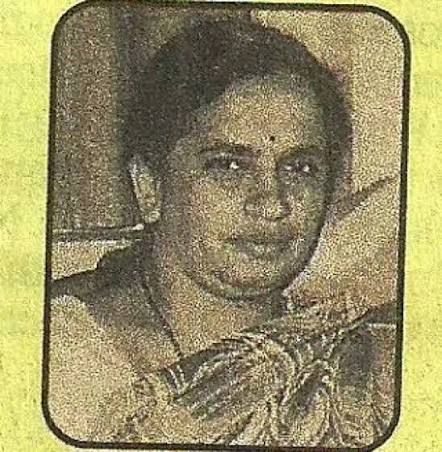
Her name was Shakuntala Bhagat & she was changing the rules of civil engineering forever.
Born in 1933, Shakuntala was the daughter of S.B. Joshi, a legendary figure known as the "Father of Bridge Engineering in India". While other young girls of the 1940s were expected to follow quiet, traditional paths, Shakuntala spent her childhood staring at bridge trusses & stress diagrams.
In 1949, she walked into the classrooms of VJTI in Bombay. The lecture hall went dead silent. Dozens of male students turned to stare at the only woman in the room. In 1953, at just 20 yrs old, she walked out with a degree, making history as India’s 1st female civil engineer.
She flew to the United States, earned her Master's in Structural Engineering from Penn & trained across Germany & the UK.
When she returned home in the 1960s, she joined IIT Bombay as an Assistant Prof, taking charge as the Head of the Heavy Structures Lab.
At IIT Bombay, Prof. Shakuntala was obsessed with a single problem: Why did Indian infra take so long to build?Traditional steel bridges relied on slow, dangerous, on-site welding & heavy riveting. If a flood wiped out a road in Arunachal Pradesh/Kashmir, cut-off communities had to wait yrs for a replacement bridge.
In the late 1960s, turning her small Bombay apartment into a late night workshop littered with steel prototypes & stress formulas, Shakuntala & her engineer husband, Anirudh Bhagat, cracked the code.
They invented & patented the Quadricon Modular Bridge System & the Bhagat Unishear Connector.
Instead of custom-casting a bridge for every river, their system used mass-produced, interchangeable, lightweight steel modules. They could be packed onto small trucks, hauled up narrow mountain tracks & assembled on-site using simple hand tools, reducing bridge construction time from yrs to weeks.
Yet, when they took this revolutionary idea to institutional investors & govt departments for R&D funding, they were met with cold skepticism.
"If advanced Western nations have not developed a total-system modular steel bridge like this, how can an Indian couple do it?"
The establishment refused to back them. She & her husband took massive personal financial risks, mortgaging their own assets to build & test the prototypes themselves. In 1972, the Invention Promotion Board awarded them the highest honor for the Unishear connector.
The skeptics were forced to eat their words.
Shahkuntala Bhagat went on to design & oversee the construction of 200+ Quadricon steel bridges worldwide, including 69 vital superstructures across India’s most dangerous border terrains, from the high passes of Kashmir to the dense forests of Arunachal Pradesh, as well as projects in the US, the UK & Germany.
In 1993, she was named Woman Engineer of the Year.
When she passed away in 2012 at the age of 79, she left behind an army of students & a country connected by her steel.
We celebrate the famous monuments of concrete and glass in our metros, yet few history books mention the woman in a hard hat who stood on freezing riverbeds to connect India's most forgotten corners.
The next time you travel through a remote mountain pass in the Himalayas & your vehicle rolls smoothly over a steel bridge spanning a deadly gorge, look closely at the steel joints beneath you. You are driving across the indestructible genius of Shakuntala Bhagat.
For those who want to know the true reality of Punjab during terrorism, role of KPS Gill, activism of Khalra—watch https://t.co/6eJlBpkh2x
I don’t do many—almost any—interviews now so don’t miss it. Everything is argued from first principles & buttressed by contemporaneous facts.
If you actually want to understand what Punjab terrorism was like - in raw honesty & nuance - brutality of Khalistanis & excesses of police with ordinary Punjabi stuck in middle - watch this one interview. I believe it’s a great feat in Indian journalism.
An Indonesian YouTube channel called Albumology has built a fascinating library of retro Hindi classics, reimagined in Reggae/Ska.
Using local Indonesian session musicians and vocalists, they’ve given these songs an entirely new cultural texture.
I came across this rendition of Neele Gagan Ke Tale in a post by @SHEKARSUSHEEL
I couldn’t stop playing it on loop.
It’s now downloaded and will become a permanent part of my road trip playlist.
The original, in the immortal voice of Mahendra Kapoor, is, of course, beyond comparison.
But this arrangement gives the song a universal feel. It’ll make you tap your feet, no matter where you come from.
And listening to the lyrics again, I was struck by how beautifully they celebrate the natural world. Long before sustainability became a global movement, this song was already reminding us of our bond with the planet. Perhaps it deserves to be an anthem for that cause.
#SundayWanderer
And who gave you the freedoms as a woman to speak your mind, dress in modern clothes, ride your motorcycle through Punjab? Your father or some document in Delhi? NO! It was the sacrifice the KPS Gill inspired from his men & their women & children for Desh & Dharma.
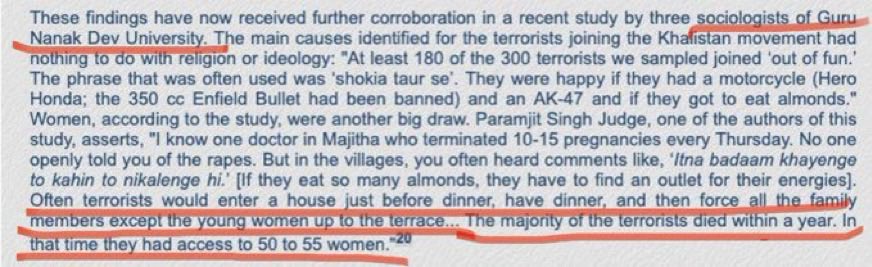
Did you not hear how after the Hindus had been kicked out of villages, the Khalistanis went after Sikh girls? This was not some rumor or a canard. Everyone from Capt Amarinder to sociologists of Punjab’s premier university to contemporaneous sober reportages testified to it. Hell even Bhindranwale’s nephew & top Khalistani politician of the time confessed to it when memories were fresh & space to brainwash & bullshit was much less!
How Britain Engineered History’s Greatest Financial Heist
By @shreehistory
I. The Stroke of Midnight
At the stroke of midnight on August 14, 1947, as the world watched the Union Jack descend over New Delhi and the saffron, white, and green of a new nation unfurl, history recorded a triumph of self-determination. The British Empire, exhausted by war and weakened by the inexorable tide of nationalism, was relinquishing its crown jewel. The romanticized narrative of the 20th century tells us that Britain granted India its freedom, an act of political magnanimity marking the end of colonial dominion.
But beneath the pageantry of lowering flags, the soaring rhetoric of Jawaharlal Nehru’s "Tryst with Destiny," and the chaotic tragedy of Partition, a very different kind of transfer was taking place. It was not a transfer of political power, but of financial liability.
In the quiet, wood-paneled chambers of the British Treasury and the Reserve Bank of India, a ledger was being closed. To the accountants and chancellors in London, Indian independence was less a geopolitical retreat and more a Chapter 11 bankruptcy filing, a meticulously orchestrated maneuver by which Britain effectively declared independence from its own creditor.
The colonizer owed the colonized a staggering fortune. And the colonizer was broke.
II. The First Extraction and the Silencing
To understand the audacity of the financial maneuvering of 1947, one must look back to the blueprint drafted three decades earlier, during the First World War. The great financial heist of the mid-century was not an anomaly; it was the perfection of a formula born in the trenches of Europe, paid for in the fields of Bengal.
When the First World War erupted in 1914, Britain found itself in desperate need of men, material, and money. It turned to its empire. India was coerced into contributing hundreds of millions of pounds to the British war effort, alongside the lives of over a million Indian soldiers. To finance this, the British Raj effectively commandeered India’s export earnings and heavily increased taxation, flooding the domestic economy with paper currency while draining its physical gold reserves. Britain abandoned the gold standard, but India was forced to maintain it, absorbing the inflationary shock.
By the war's end, the economic strain on the Indian populace was immense. Prices of essential goods had skyrocketed, and the returns on the capital extracted for the war were nowhere to be seen. As the Indian public began to realize the scale of this economic theft, dissent began to boil. Nationalist leaders pointed to the economic drain, exposing the arithmetic of imperial exploitation.
London’s response was not to remedy the extraction, but to legislate silence. In 1919, the British government passed the Anarchical and Revolutionary Crimes Act, widely known as the Rowlatt Act. The Act allowed for the incarceration of suspects without trial and curbed the free press, specifically targeting the dissemination of seditious materials, which in practice meant anyone explaining how the British were bankrupting the country. When protests erupted against this silencing, the British military responded with the Jallianwala Bagh massacre in Amritsar, killing hundreds of unarmed civilians.
The message was unequivocal: the colony would pay, and it would suffer in silence. The economic truth was to be suppressed by force. It was a precedent that would prove vital 28 years later, when the sums involved would be exponentially larger.
III. The Blank Check of World War II
By the time the Second World War began, the British Empire was already financially strained. The defense of the Middle East, Southeast Asia, and the British Isles required capital that London simply did not possess. Once again, the British turned to the vast, seemingly bottomless reservoir of the Indian economy.
To fund the massive mobilization of troops, the provisioning of armies, and the purchase of raw materials, the British Raj essentially wrote itself a blank check against the Indian taxpayer. India was declared a "non-self-governing territory" contributing to the war effort, but instead of paying India in hard currency for the goods and labor extracted, Britain credited the Reserve Bank of India with pounds sterling. These were not transferable funds; they were essentially IOUs, piling up in London as "Sterling Balances."
The human cost of this capital extraction was catastrophic. The most visceral manifestation of this economic drain was the Bengal Famine of 1943. While the British Treasury accumulated sterling balances, the diversion of grain and the financial extraction policies led to the starvation of an estimated two to three million people in Bengal. The Indian taxpayer was literally funding the survival of the British Empire with their lives and their livelihoods.
By 1945, the sheer scale of this extraction was breathtaking. Britain owed India roughly £1.3 billion. To comprehend the magnitude of this sum, one must view it not through the lens of modern consumer inflation, but as a share of the economy. In 1947, £1.3 billion represented roughly 13.5 percent of Britain’s entire Gross Domestic Product. If the British Treasury were forced to write a check for that proportion of its economy today, it would need to find approximately £350 billion.
It was a sum so massive that paying it in full would have instantly bankrupted post-war Britain, a nation that was, at that very moment, surviving on American Marshall Plan aid and rationed bread. The colonizer owed the colonized. And the colonizer had no intention of paying in full.
IV. The Safety Valve and the Negotiation
Facing the prospect of domestic economic collapse, the British government executed an audacious maneuver. The transfer of power in 1947 was not merely a political act; it was a financial release valve.
There is a historical curiosity, often unspoken in popular narratives, that complicates the story of India’s independence. The Indian National Congress (INC), the primary vehicle of Indian nationalism and independence, was not born from a grassroots peasant uprising, but was initially floated by a British colonial official, Allan Octavian Hume, in 1885. Historians have long debated the "safety valve" theory: the idea that Hume and the Viceroy engineered the creation of the INC to provide a controlled, institutional outlet for the rising frustrations of the Western-educated Indian elite, preventing a violent, uncontrollable rebellion.
While the INC evolved into a formidable force for independence under Mahatma Gandhi and Nehru, the institutional DNA of the organization was steeped in British legal and political frameworks. When it came time to negotiate the financial settlement of 1947, the lingering effects of this "safety valve" dynamic became apparent.
The negotiations over the Sterling Balances were brutal, conducted behind closed doors by the British Labour government’s Chancellor of the Exchequer, Sir Stafford Cripps, and the Indian delegation led by Nehru and Sardar Vallabhbhai Patel. Britain argued that a sudden withdrawal of £1.3 billion would crash the pound sterling, bankrupt the Sterling Area, and trigger a global financial crisis. The threat was explicit: if India demanded its money, the ensuing chaos would ensure India received nothing.
India was in a state of profound vulnerability. The subcontinent was engulfed in the horrific trauma of Partition; millions of refugees were on the move, and the new government was struggling to establish basic administrative continuity. In this moment of existential crisis, the Indian leadership accepted terms that effectively castrated its own wealth.
The 1947 agreement dictated that the vast majority of the £1.3 billion would be "blocked." Only a fraction was immediately released; the remaining £1.15 billion was locked in London, to be doled out in agonizingly slow installments over a decade or more. Worse, the agreement stipulated that these blocked balances would earn little to no interest. By accepting this compromise, the post-colonial government effectively agreed to a structural haircut on the asset, surrendering the real-time economic utility of the money to save the British economy from default.
The safety valve had, once again, operated exactly as designed.
V. The Alchemy of Devaluation
With India's massive claim successfully trapped in the vaults of the Bank of England, Britain weaponized the only tool it had left: the currency itself.
Having forced India to accept deferred payments, Britain engineered a stealth default through the alchemy of foreign exchange. On September 18, 1949, just over two years after Indian independence, the British government unilaterally announced a massive devaluation of the pound sterling. The pound’s value against the US dollar was slashed overnight from $4.03 to $2.80, a devaluation of 30.5 percent.
Because India’s sterling balances were, by the very terms of the 1947 agreement, denominated in pounds, this overnight maneuver was an economic earthquake. It instantly vaporized almost one-third of the purchasing power of the money owed to India. If India wanted to use those sterling balances to buy American machinery, Canadian wheat, or Swiss capital goods, they would find that nearly a third of their money had vanished into the ether.
Britain, on the other hand, enjoyed a sudden, massive windfall. The real value of the debt owed to India was slashed by a third with the stroke of a pen. India was bound by the Sterling Area agreement and had to devalue the rupee proportionately, tying its currency to the declining fortunes of the British pound and further devastating its import capacity. It was a financial ambush, executed with the cold precision of an actuary.
VI. The Central Bank’s Quiet Payout
As if this financial evisceration was not sufficient, the final insult was administered at the very heart of India’s financial system.
The Reserve Bank of India (RBI), the nation's central bank, had been established in 1935 under British colonial rule as a privately owned entity. Its shareholders were a mix of private banks, financiers, and investors, a group that included substantial British and colonial-era capital.
Just after independence, the Indian government recognized the strategic necessity of nationalizing the central bank. The RBI (Transfer to Public Ownership) Act was passed in 1948, and the bank was officially nationalized on January 1, 1949.
The terms of this nationalization reveal a profound asymmetry in the post-colonial transition. When the Indian government took ownership of the RBI, it did not simply seize the assets. It compensated the private shareholders handsomely. Under Section 4 of the 1948 Act, the compensation was calculated not at a discounted state rate but based on the average market price of the shares on the Bombay Stock Exchange during the months preceding the Act. Because RBI shares, with a face value of one hundred rupees, were trading at a premium of roughly fifty percent on the open market, the total payout from the Indian exchequer to the 500,000 private shares was approximately 7.5 crores.
But the generosity of the settlement did not end with a cash buyout. Under Section 4(2) of the Act, the shareholders were given the option to take their compensation in Government of India promissory notes bearing a guaranteed interest rate of three percent per annum. This was a staggering mechanism of financial alchemy. The British and colonial-era investors were effectively allowed to convert their equity in India's central bank into risk-free sovereign debt backed by the newly independent Indian taxpayer. They could hold these 3 percent government papers and collect a perpetual stream of interest, ensuring that the extraction of wealth from the subcontinent continued long after the political transfer of power.
The juxtaposition is staggering, bordering on the absurd. Private shareholders of India’s central bank were paid out in full, at peak market valuations, and handed guaranteed interest-bearing bonds. Meanwhile, the Indian public, who had already paid for Britain’s survival in two world wars through forced extraction and inflation, was left holding devalued, blocked IOUs that had just lost a third of their value in the currency markets.
The private investors were made whole. The Indian public was made paupers.
VII. The Durgapur Paradigm: The Empire Strikes Back
The long shadow of this financial subjugation played out in the subsequent decades, dictating the trajectory of the newly independent nation’s development.
By the late 1950s, India had launched its Second Five-Year Plan, an ambitious push to industrialize. But the country was facing a severe balance-of-payments crisis. The sterling balances had been largely drawn down to pay for essential imports, and the country was running out of foreign exchange. India needed to build three major steel plants to fuel its industrialization. The Soviet Union stepped in to fund the Bhilai Steel Plant; West Germany funded the Rourkela plant. Britain, eager to maintain its commercial foothold, wanted the contract for the Durgapur Steel Plant.
Rather than releasing any lingering goodwill or acknowledging the massive debt still technically being dribbled out, Britain offered a new arrangement. In 1958, the UK government extended a fresh £100 million loan, a "new" line of sterling credit, to India.
This was not a repayment of the wartime debt; it was fresh financing. The British government essentially told India: We will lend you this new money, but you must use it to buy British goods. The money flowed straight back into the pockets of a British consortium of steelmakers, subsidizing the post-war British heavy engineering industry.
The Indian taxpayer, who had already funded the British war machine, was now taking on new debt to buy British machinery, because the money they were originally owed had been blocked, devalued, and structurally dismantled. The cycle of financial dependency had been perfectly preserved.
VIII. Amnesia and the True Cost of the Union Jack
Today, the historical amnesia surrounding these events is profound. The narrative of 1947 is frozen in the amber of political triumph: the lowering of the flag, the end of empire, the dawn of a new era. Mainstream histories focus on the geopolitical maneuvering, the tragedy of Partition, and the drafting of a constitution. The great financial heist remains obscured in the shadows of central bank archives and Treasury minutes.
The Indian population has been kept largely in the dark about the arithmetic of their own subjugation. The textbooks speak of the political transfer of power, but rarely of the transfer of financial liability. The £350 billion equivalent that was extracted, blocked, devalued, and systematically stripped of its value is a phantom limb in the national memory.
When the viceroys departed, Britain did not just walk away from the subcontinent; it walked away from an invoice it could not afford to pay. It declared independence from its own empire. Through a masterclass in financial engineering, leveraging the Rowlatt-era instinct for suppression, the "safety valve" of institutional compromise by a party supposedly fought for freedom and did deals behind the doors, the blunt instrument of currency devaluation, and the quiet payouts of risk-free bonds to colonial shareholders, Britain managed to offload the cost of its own survival onto the very people it had colonized.
Independence was not a gift. It was a getaway car. And the true price of the Union Jack's descent was paid not by the British taxpayer, but by the millions of Indians whose sweat and starvation funded an empire, only to be handed a worthless IOU in return.
References and Further Reading
Bhattacharya, S. (1997). The Colonial State and the Monetary System in India. Oxford University Press.
Bhowani, B. R. (1965). India's Sterling Balances. International Monetary Fund (IMF) Staff Papers, Vol. 12, No. 1, pp. 1-42.
Chandavarkar, A. (1989). The Imperial Bank of India and the Reserve Bank of India: A Study in Central Banking Transition. Oxford University Press.
Datta, B. (1949). The Devaluation of the Rupee. The Indian Economic Journal, Vol. 1, No. 1, pp. 1-12.
Hume, A. O. (1885). The Indian National Congress: A Retrospect.
Keynes, J. M. (1946). The Balance of Payments of the United Kingdom.
Mukerjee, M. (2010). Churchill's Secret War: The British Empire and the Ravaging of India during World War II. Basic Books.
Reserve Bank of India. (1948). The Reserve Bank of India (Transfer to Public Ownership) Act, 1948. RBI Historical Archives.
Sarkar, S. (1989). Modern India: 1885-1947. Macmillan.
Tomlinson, B. R. (1979). The Political Economy of the Raj 1914–1947: The Economics of Decolonization in India. Macmillan.
(All rights reserved. You must get written permission if you want to republish)
Twitter users can share, repost, like, comment but please provide attribution to @shreehistory who did all this research.
Their names were Aneesh Awadhiya and Ashwini Koshta.
They were from Madhya Pradesh. They worked in Pune.
On the night of May 19 2024 they were riding a motorcycle in Kalyani Nagar when a Porsche Taycan hit them at high speed. Both died.
The driver was 17 years old. His name was Vedant Agarwal. His father Vishal Agarwal is one of Pune’s wealthiest builders.
He had spent the evening at a restaurant in Koregaon Park celebrating his Class 12 board exam results.
The restaurant served the group of minors alcohol until midnight. He paid Rs 48,000 for the drinks using his grandfather’s credit card.
He was drunk when he got behind the wheel of an unregistered Porsche worth over Rs 2.4 crore.
The initial order from a juvenile court asked him to write a 300 word essay on road accidents.
The country was furious.
His father Vishal Agarwal was arrested for attempting to obstruct justice.
His grandfather and two doctors were arrested for allegedly attempting to swap the juvenile’s blood sample at a hospital to conceal evidence of alcohol consumption.
The restaurant that served alcohol to minors was investigated. Police officers who handled the initial case were suspended.
The juvenile was eventually sent to a remand home.
Vishal Agarwal spent 22 months in jail before the Supreme Court granted him bail in March 2026.
Aneesh Awadhiya and Ashwini Koshta were cremated in Madhya Pradesh.
Their families are still waiting for the trial to conclude.
A 17 year old in an unregistered luxury car killed two working people on a night out.
His family spent months trying to make it go away.
Repost this. Some stories must not be allowed to disappear.
This is an extremely important thread for the Indian Gen Z.
1 Why is the Cockroach Janta Party a threat to national security?
Why are they operating from the USA?
Who is behind Abhijit Dipke and his party?
Keep reading this thread for the complete answer.
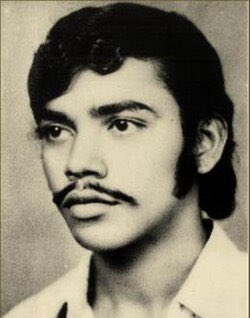
His name was Rajan.
He was a final year engineering student at the Regional Engineering College in Calicut, Kerala. His father, T V Eachara Varier, was a Hindi professor at the Government Arts and Science College in the same city.
On the morning of March 1 1976 the police came to the college campus and took Rajan away.
India was under Emergency. Civil liberties were suspended. Courts had effectively turned away.
His father found out the next day from the college principal.
He went to every police station in the district. No one admitted to having his son.
He met the Home Minister of Kerala, K Karunakaran, directly.
He sent petitions to the Home Secretary of the Government of Kerala three times. Not a single reply or acknowledgement came.
He wrote to the President of India and the Home Minister of the central government, with copies to every Member of Parliament from Kerala.
Nothing.
What Eachara Varier did not know at the time was that his son had been taken to an illegal police interrogation camp at Kakkayam.
He was tortured.
A practice called uruttal was used, where a heavy wooden log is rolled over the body of the victim.
Rajan died from his injuries. His body was disposed of by the police and was never found.
When the Emergency ended in 1977 Eachara Varier filed a habeas corpus petition in the Kerala High Court.
It was the first such petition filed in Kerala after the Emergency.
He did it without legal training, without political backing, without money.
He had spent everything searching for his son.
The court case slowly unravelled the truth.
It forced K Karunakaran to resign as Chief Minister of Kerala in 1978 when the adverse judgment came.
Rajan’s mother became mentally unstable from the grief. She died in 2000 still not knowing where her son was.
Eachara Varier wrote his memoir, Memories of a Father, which won the Kerala Sahitya Akademi Award in 2004.
In its final lines he wrote, “I don’t close the door. Let the rain lash inside and drench me. Let at least my invisible son know that his father never shut the door.”
He died on April 13 2006. He never found his son’s body.
Rajan was picked up from his college campus on a March morning in 1976. He was never seen again.
Repost this. Some stories must not be allowed to disappear.
What you just learned:
✦ Diabetes → +29% PD risk
✦ IBD → +46% PD risk (13.4M patients)
✦ H. Pylori → +65% PD risk (and it's curable)
✦ TBI → +62% PD risk
✦ Sleep apnea → +45% PD risk
✦ Bipolar disorder → 4× PD risk
Parkinson's doesn't just happen. The science shows a 10–20 year warning window.
If you found this valuable — RT the first tweet.
Someone you know needs to see this. 🔁
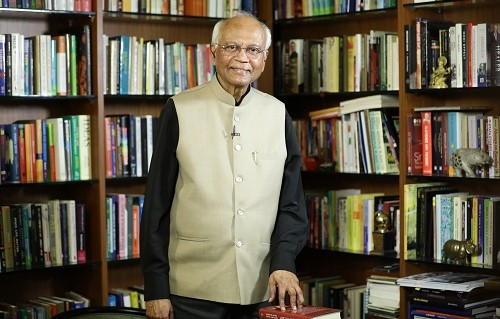
In the 1990s, India was facing a Biological Colonization. If Dr. R.A. Mashelkar had not stepped in, we might have ended up paying a royalty to a US corporation every time we used turmeric on a wound/exported Basmati rice.
In 1997, a Texas-based company called RiceTec was granted a patent by the USPTO (US Patent & Trademark Office) for Basmati Rice lines & grains. They claimed they had invented a superior strain of rice. Mashelkar realized that if this patent stood, Indian farmers would be barred from selling their own rice under the name Basmati in the US. It was a theft of Geographical Intellectual Property.
He did not just shout Injustice. He assembled a team to find Genetic Fingerprints. They proved that the new rice was actually derived from Indian germplasm that had existed for centuries. The USPTO was forced to strike down the majority of the claims.
2 researchers at the University of Mississippi were granted a patent for the use of turmeric in healing wounds. To a Western patent officer, this was a novel invention. To an Indian, it was something their grandmother did every day. Mashelkar produced an ancient Sanskrit text as Prior Art. The USPTO demanded a translation. He provided evidence from the Journal of the Indian Medical Association dating back to 1953 + ancient Ayurvedic texts.
This was the 1st time in history that a patent granted to a US entity was successfully challenged & revoked based on the Traditional Knowledge of a developing country.
Mashelkar also realized that India could not fight 10000 legal battles every yr. He needed a Scalable Solution. Patent officers in the West were not malicious; they were just Data Blind. They could not read Sanskrit/Tamil/Persian. If a discovery was not in an English journal, it did not exist in their system.
He hired 100s of experts (Ayurveda practitioners, IT engineers, & Patent lawyers). They took 500000+ formulations & converted them into a digitized Shloka to Code format. The data was rendered in English, French, German, Japanese, & Spanish.
Today, India has signed agreements with the USPTO, the European Patent Office, & others. Before an officer grants a patent, they run a TKDL Scan. If the herb/method is in the library, the patent is rejected instantly.
In Navy SEAL training, students who failed daily had to do two extra hours of punishment.
They called it “circus.”
Those students should have burned out first.
Instead, they got stronger than everyone else.
Admiral McRaven spent 20 minutes explaining the 10 lessons SEAL training taught him:
Lesson 1: Make your bed.
Every morning, the first thing instructors inspected was your bed. Corners square. Covers tight. Pillow centered.
"It seemed ridiculous at the time. We were aspiring to be real warriors."
"But if you make your bed every morning, you will have accomplished the first task of the day. It will encourage you to do another task, and another, and another."
"And if by chance you have a miserable day, you will come home to a bed that is made. That you made."
Lesson 2: Find someone to help you paddle.
Students were broken into boat crews. Seven men paddling through 8 to 10 foot surf.
"Every paddle must be synchronized. Everyone must exert equal effort or the boat will be dumped back on the beach."
"You can't change the world alone."
Lesson 3: Measure a person by the size of their heart, not their flippers.
The best boat crew was "the munchkin crew." No one over five-foot-five.
"They out-paddled, out-ran, and out-swam all the other boat crews."
"The big men would make fun of the tiny little flippers the munchkins put on their tiny little feet. But these little guys always had the last laugh."
"SEAL training was a great equalizer. Nothing mattered but your will to succeed."
Lesson 4: Get over being a sugar cookie.
Several times a week, uniform inspections. Hat perfectly starched. Belt buckle shiny.
"No matter how much effort you put in, it wasn't good enough. The instructors would find something wrong."
Fail the inspection, you ran into the surf. Then rolled in sand until covered head to toe. "Sugar cookie."
"Many students couldn't accept that all their efforts were in vain. Those students didn't make it through training."
"Sometimes no matter how well you prepare or perform, you still end up as a sugar cookie. It's just the way life is sometimes."
Lesson 5: Don't be afraid of the circus.
Fail to meet standards, your name went on a list. End of day: "circus." Two hours of extra calisthenics designed to break you.
"No one wanted a circus. More fatigue meant the following day would be more difficult."
"But everyone made the circus list. And an interesting thing happened. Over time, those students got stronger and stronger."
"Life is filled with circuses. You will fail often. It will test you to your very core."
Lesson 6: Sometimes you have to slide down the obstacle head first.
The obstacle course record had stood for years. Seemed unbeatable.
Until one student went down the slide for life head first. Mounted the top of the rope instead of swinging underneath.
"Dangerous. Seemingly foolish. Fraught with risk."
"Instead of several minutes, it took him half that time. He broke the record."
Lesson 7: Don't back down from the sharks.
The waters off San Clemente are breeding grounds for great white sharks. Night swims were mandatory.
"If a shark begins to circle your position, stand your ground. Do not swim away. Do not act afraid."
"If the shark darts towards you, summon all your strength and punch him in the snout. He will turn and swim away."
"There are a lot of sharks in the world."
Lesson 8: Be your very best in the darkest moments.
Underwater ship attacks. Divers swim over two miles to the target. As you approach, the steel structure blocks all light.
"The keel is the darkest part of the ship. You cannot see your hand in front of your face. The noise is deafening. You can easily become disoriented."
"At the darkest moment of the mission is when you must be calm. When all your inner strength must be brought to bear."
Lesson 9: Start singing when you're up to your neck in mud.
Hell Week. Six days of no sleep. Constant harassment.
His class was ordered into the mud flats. "The mud consumed each man until there was nothing visible but our heads."
Eight hours until sunrise. Instructors said five men could quit and everyone could leave.
"Then one voice began to echo through the night. Terribly out of tune. Sung with great enthusiasm."
"One voice became two. Two became three. Before long everyone was singing."
"Somehow the mud seemed warmer, the wind a little tamer, and the dawn not so far away."
"If I have learned anything, it is the power of hope. One person can change the world by giving people hope."
Lesson 10: Don't ever, ever ring the bell.
A brass bell hangs in the center of the compound.
"All you have to do to quit is ring the bell."
"Ring the bell and you no longer have to wake up at 5 o'clock. No longer have to do the freezing cold swims. No longer have to endure the hardships."
"Don't ever, ever ring the bell."
This 20 minute speech will teach you more about discipline, resilience, and hope than every self-help book combined.
Bookmark & give it 20 minutes today, no matter what.
Just because security person is not father of a police officer…
FIR gets registered with wrong CAR Number, inspite of mentioning correct number in complaint and giving photo of CAR with number plate…
Accused not gets arrested even on 3rd day from date of incident inspite of victim getting treatment in ICU…
Without the consent of victim or family members or any other, bills paid by strangers to frame case compromised….
When Case has to be dealt with humanitarian grounds, Gachibowli Inspector defends with legalities…
Ghanshyam, aged 50, security guard gets brutally assaulted for informing not to park illegally as parking is reserved only for bank, suffered injuries on head and chest, when his wife reached Hospital, Husband was unconscious & later reported lost memory & brain injury.
#Shameless
Most people don't know there's a right order to file health insurance claims when you have multiple policies.
Getting it wrong = leaving money on the table.
Here's how to do it:
1. Start with the policy that covers your hospital (best network, fewest exclusions). Employer group cover usually goes first.
2. Collect Form-64 (Claim Settlement Summary) from insurer #1. This is your proof for the next claim.
3. Use Form-64 + remaining docs to claim the unpaid balance from insurer #2.
For multiple individual policies, the order matters too: — Claim first from the policy where NCB is low — Keep the unlimited restoration policy for last — Keep the zero co-pay policy for last
One ₹70L claim, ₹0 out of pocket — entirely possible if you stack a group cover + individual plan + super top-up correctly.
Full breakdown in the infographic and story by @PuranikIra https://t.co/2IMTziBi4P
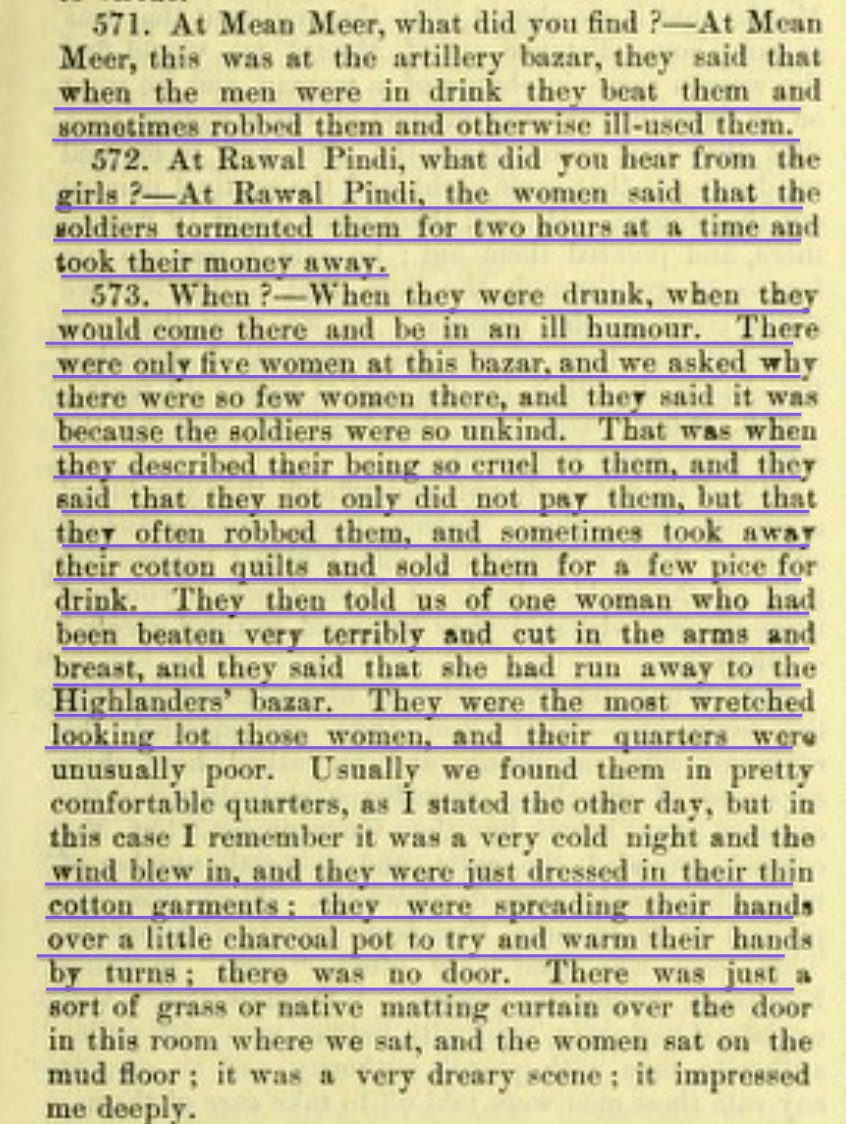
The 1889 Government of India report on British cantonment prostitution documents a horrifying colonial system that didn't just force Indian women into sexual slavery - it shows that even little girls as young as 9-10 years old were not spared by the British soldiers.
A Chakla was a state-regulated brothel attached to a military cantonment where women were registered by colonial authorities & made "available" to British soldiers stationed in the cantonments. Under the Contagious Diseases Act, the "prostitutes" were subjected to brutal medical examinations to detect venereal disease and if infected, were thrown out on the street, to starve and die from the disease.
In 1891, Elizabeth Wheeler Andrew, a British investigative journalist and Kate Bushnell, a U.S.-trained medical doctor, personally visited the British cantonments to interview Indian women in Chaklas and recorded their experiences as firsthand evidence. They testified in In April 1893 during debates to finally abolish the Contagious Diseases Act, because of growing condemnation by women's rights groups.
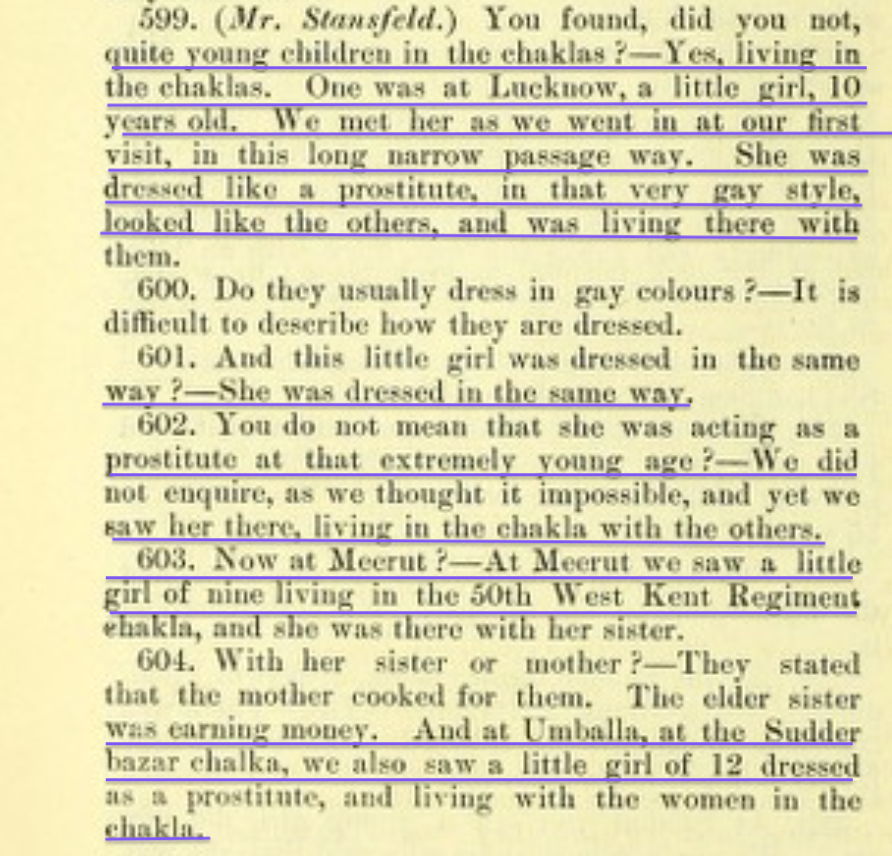
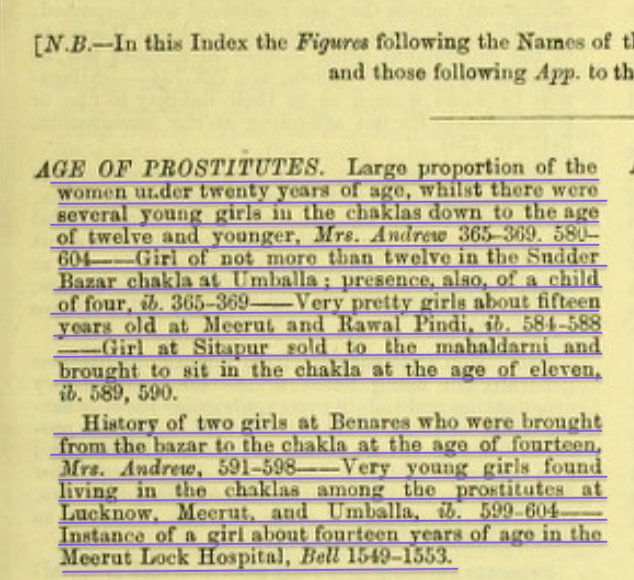
Their testimony is incredibly disturbing because it records the presence of several young girls in the Chaklas down to the age of 11-12 and shockingly even one little girl who was only 4 years old. These young children are described as decked up like prostitutes. Teenage girls ranging from 14-17 were common, and the overwhelming majority of girls were less than 20 years old.
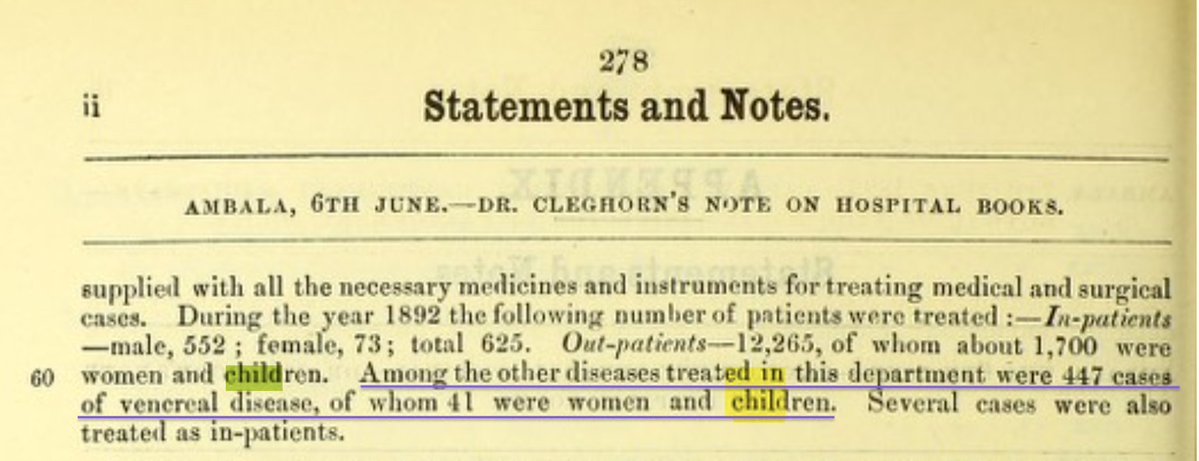
This horrifying abuse of underage children is further corroborated by the British doctor's reports about the number of cases infected by venereal diseases in the Chaklas. The report from Ambala cantonment during the year 1892 showed 447 cases of venereal disease, out of whom 41 were women and children. The explicit mention of “children” here among venereal disease cases is very disturbing, because it indicates that young children were also being exposed to transmission of sexually transmitted diseases in these cantonment brothels.
What's even more harrowing is that these victims lived in wretched conditions. Not only were they not paid for their "prostitution services", the British soldiers would rob them of their money or property and torture them physically. Often the British soldiers would get drunk and violently abuse the females, beating them up, & inflicting physical horrors like cutting their arms & breasts. They lived in pathetic conditions and suffered greatly during the winter without warm clothes or even doors to survive the freezing temperatures,
They were humiliated and forced to exist in a framework aimed only at managing the soldiers’ health not theirs. Compulsory medical inspections and confinement in “lock hospitals” for those diagnosed with disease were terrifying, as speculums were inserted into their bodies to "inspect" for signs of venereal disease, while the girls were chained to chairs, with their feet restricted by screws so that they could not escape.
Epstein Files pales in comparison to the unforgivable crimes that the British committed against Indian women and children with their cantonment prostitution policy. The most vulnerable and weakest sections of our society were violated & exploited barbarically due to their helplessness in such exploitative environments.
Time may forget such inhuman brutality but Karma never will
Source: Secretary of State for India. (1889). Report of the committee appointed to inquire into the rules, regulations, and practice in the Indian cantonments and elsewhere in India, with regard to prostitution and the treatment of venereal disease; together with minutes of evidence and appendices. London: Her Majesty’s Stationery Office.
APPROACH 2 — Mass General Hospital (New England Journal of Medicine, 2024):
A completely different CAR-T design. Same target: glioblastoma.
Their CARv3-TEAM-E cells hit EGFRvIII as a homing beacon — then release a bispecific antibody that recruits MORE immune cells to attack the rest of the tumor.
Result: Tumors began shrinking within DAYS of a single infusion.
One patient's tumor shrank 60% over two months.