Today marks *ten years* since *Brahmaswarup Pramukh Swami Maharaj*, the revered President of BAPS, *departed for Akshardham.*
Through a life devoted to Bhagwan Swaminarayan and humanity, he *transformed millions* of lives. His immense contributions to education, healthcare, disaster relief, character-building and spirituality brought hope, peace and upliftment to society.
Even after ten years, his divine memories, compassion and teachings remain as alive and inspiring as ever. *His timeless message—“In the joy of others lies our own”—* continues to inspire the world.
We offer our most reverent *tributes at his holy feet.*
@BAPS_PubAffairs@BAPSCharities@BAPS@AbuDhabiMandir
What 35 Years in the Market Taught Me?
A few lessons from my conversation with @kushallodha548
1) Experience is a great teacher, but she sends terrific bills. I have paid quite a few. The mistakes have taught me more than many of my winners. My costliest mistakes weren’t bad purchases. They were premature sales.
2) A great business is not always a great investment. Price remains part of the compounding equation. “Buy at any price” often means avoiding the uncomfortable valuation question. Price is part of the compounding equation, and you can’t remove the starting valuation and still reach the destination.
3) Numbers alone are also not enough. I like to triangulate every investment through:
Narrative + Numbers + Accounting.
Touch only one part of the elephant, and you’ll confidently describe the whole animal wrong.
4) A great story without cash flows is dangerous. Reported profits can also mislead if you do not understand where the cash and net worth went.
5) History is perhaps the most underrated investing tool. The catalyst changes from railways and automobiles to renewable energy and AI.
6) Human behaviour does not. Greed, fear and stupidity continue to drive asset prices. That is why one can invest bottom-up, but must always worry top-down.
7) Skill matters. Choices matter. Luck matters far more than successful people admit. The best response is to increase your surface area of luck through curiosity, hard work, good people and reputation.
8) Learn from everyone, but blindly copy no one. Your capital, temperament and time horizon are your own.
9) Don’t ask “What is this company worth?” Ask “What must this company deliver for today’s price to make sense?” Reverse DCF turns valuation into interrogation.
10) Buy and hold is a strategy which works when things don't change much, not a religion. Your holding period should match the rate of change in the industry, not your ego.
11) Before you invest, assume it failed badly in five years. Write down exactly why. When reality shows up, you won’t freeze or rationalise.
12) At 80 or 90, which decisions would you regret? Use inversion now. Experience’s real job is to stop you from paying the same bill twice.
Full conversation:
https://t.co/nfG2KZ6HnP
Thanks, @shrishtie, for the opportunity. The problem with many large portfolios in India is simple:
Too many products.
Too many cooks.
Too little clarity.
A little bit of everything thrown in.
What looks diversified often becomes a junk warehouse — passive-like exposure, active fees, subpar outcomes. A portfolio should be a curated museum, not a storage room. No wonder the aggregate outcome often trails the comparable index benchmarks.
Investors don’t need more products. They need better architecture, discipline, and judgment. Hope the conversation helps investors think about the right long-term portfolio construct.
https://t.co/7GJkXFtV8l
Shout out to @MadAboutStocks_
Nice infographics
AI story till now. It is still unfolding.
AI is a very useful technology and will change life transformationally in next few years and decades. It will generate substantial productivity gains in most areas like electricity, telecom or IT did.
In AI, Large US companies and Government of US tried to project it as a matter of large investments rather than use of brains. Extremely Costly hardware, trillion dollar models etc were to some extent part of the hype, awe and shock model US adopts to control most new technologies to keep small countries and small companies out.
In last 3 years since ChatGPT started, it was a constant reminder every day that countries like China are enemies because they also have AI capabilities they built over last twenty years using government planning and coordination.
It was also projected that Countries like India are losers is AI field - because they are neither like US which can spend trillions of USD or are like china where government capabilities of to direct investments and efforts are immense.
AI field has been changing fast and becoming democratised every day. Democratisation of technology brings down costs of new technologies with each passing day. The AI tech waves are coming faster at a pace that no one is able to control or even comprehend let alone own.
Last few weeks have proved that much more effective hundreds of open weight AI models coming out of China and other countries don’t require large compute also that has been projected by US AI groups. These Chinese models are being proved to be equal or better in their effectiveness for purpose.
Broadly, the hype, shock and awe part of the US AI story has been punctured substantially in last few weeks. Repercussions will be felt over next several years.
User countries like India would be the beneficiaries. For example, over last 60 years, India didn’t invent computer chips, most computer languages, databases, network equipments etc. Despite that India has been one of the winners of the IT race in the world over last several decades.
I am becoming more confident that India will be the biggest winner of AI race as the most adaptive country for Informarion technology in next 20-30 years. Indian policy makers, organisations and individuals will have to work hard, coordinate and make the best out of this extremely fast evolving situation.
Next race is already building up. Robotics between US and China. How do we get prepared and how do we combine Robotics with AI to be the biggest beneficiaries of this new fast moving race needs to be thought through.
Celebrating 30 years of Neasden Temple!
Earlier today, The King and Queen visited Europe’s first traditional Hindu stone temple.
During today’s engagement, Their Majesties met worshippers and representatives from community and social impact initiatives supported by the Temple, including The Felix Project and Women of the World (WoW).
It was a privilege to visit the iconic @akshardham_usa temple last night. I’m grateful for the warm welcome from Hindu leaders gathered from across the country, the Robbinsville Mayor and council members, and thousands gathered for a special evening of prayer, fellowship, and unity. #Akshardham
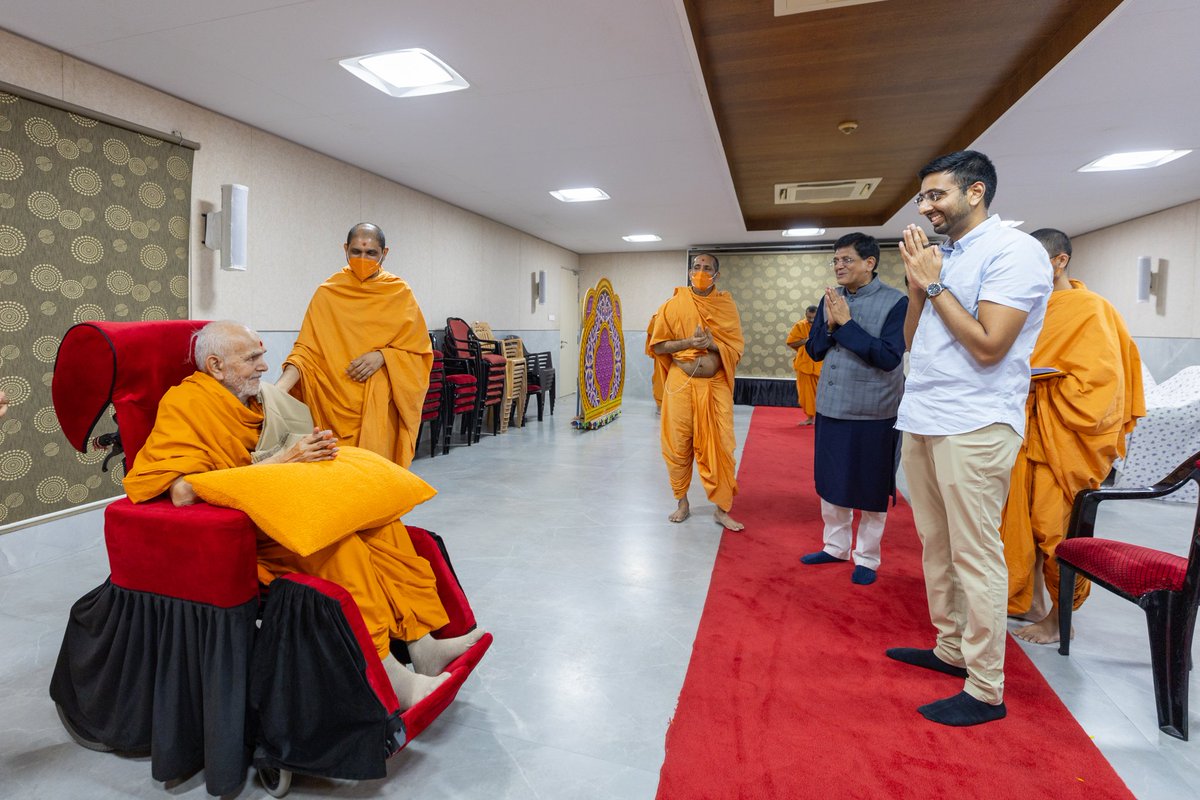
कल BAPS प्रमुख पूज्य महंत स्वामी महाराज जी के 91वें जन्मदिवस पर उन्हें प्रणाम कर आशीर्वाद पाने का सौभाग्य मिला।
मुझे आज भी वर्ष 1995 का वो समय याद आता है जब तत्कालीन प्रमुख स्वामी महाराज जी के 75वें जन्मदिवस के अवसर पर चूनाभट्टी, सायन में आयोजित 37 दिवसीय अमृत महोत्सव का मैं हिस्सा बना था। यह संस्था धर्म जागरण के साथ ही समाज कल्याण के क्षेत्र में निरंतर सर्वोत्तम कार्य करती आ रही है।
उन पुरानी यादों को लेकर लंबी चर्चा से मन प्रसन्नचित्त हो गया। मैं आज भी देश-विदेश में अपनी यात्रा के दौरान समय निकालकर BAPS मंदिर जाकर आशीर्वाद ग्रहण करता हूँ। यहां स्वामीजी के दर्शन लाभ से मुझमें दिव्य ऊर्जा का संचार हुआ है। ये क्षण मेरे लिए अद्भुत है।
@MTPHereToHelp@AndheriLOCA@AmeetSatam The same junction has another design fault creating traffic jams. The traffic coming from Gokhale Bridge flyover going left collides with traffic coming from Road beneath and going right.
@MTPHereToHelp@AndheriLOCA@AmeetSatam This is Junction of Gokhale Bridge flyover and Wester Express Hwy. Traffic police itself is blocking three lanes in critical junction creating traffic chaos. One Porta Cabin plus two rows of Bikes.