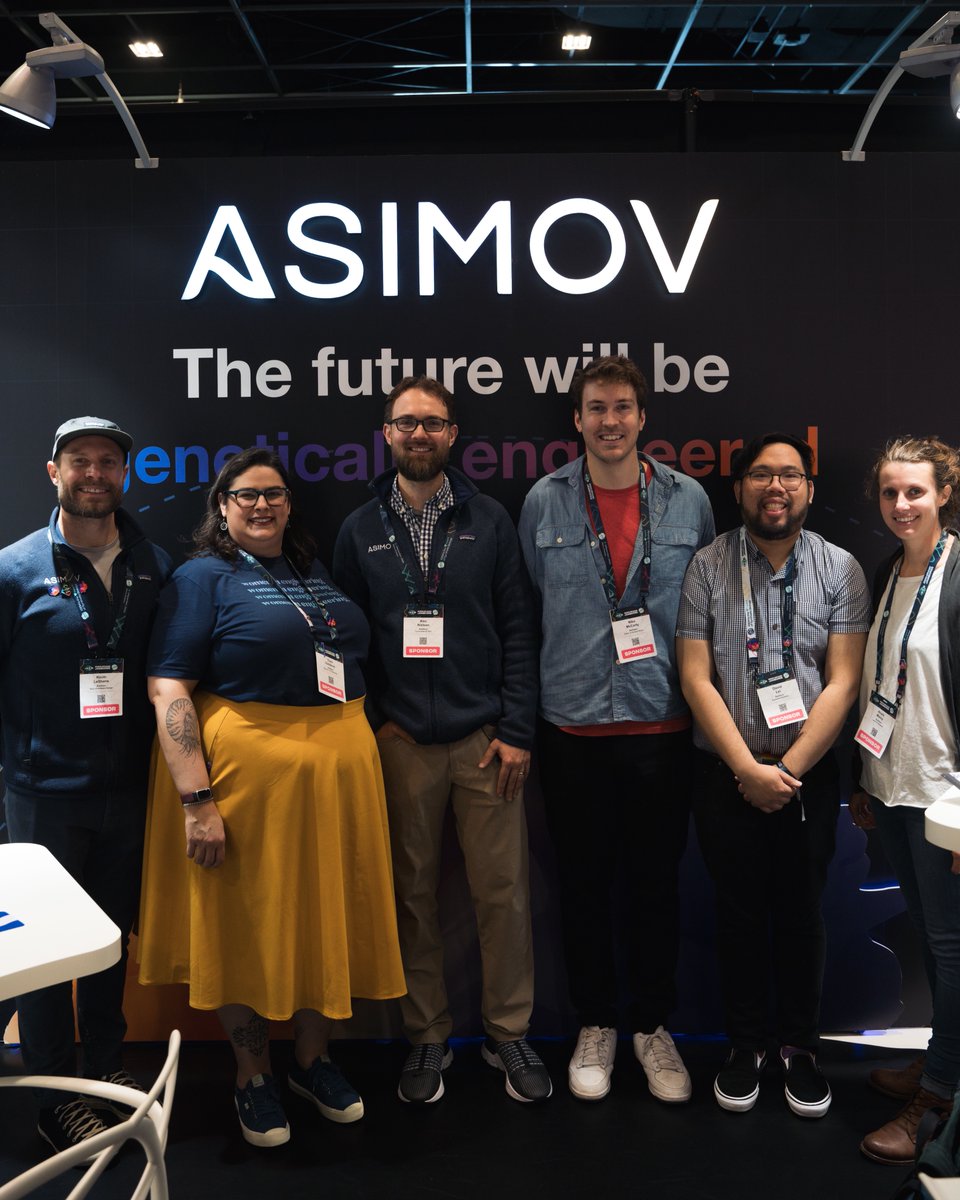
Beyond excited to announce our deal with Novo Nordisk! Proud of our team who made this possible.
The market and molecular complexity of biologics are both growing. Cell engineering tech needs to keep pace to support production of next-gen biologics at global scale.
Our second book is now available for pre-order. 🎉
Embracing the book's technology theme, we did something special:
We encoded the entire book into DNA & packaged it into stainless steel capsules, where it will live for tens of thousands of years.
1,000 copies were made... 🧵
Today we're announcing AAV Edge, our AI-powered suite of tools for gene therapy design and manufacturing.
It's the first comprehensive platform for AAV manufacturing that enables end-to-end optimization, from payload design to tissue-specific control of gene expression to model-guided process development.
With dozens of gene therapies now approved by the FDA, and more than 500 more in the pipeline, it's time to solve challenges in safety, manufacturability, and cost so that these treatments can reach more patients.
AAV Edge includes:
- Our AI-designed & animal-validated tissue-specific promoters.
- DNA optimization tools to boost expression levels in vivo.
- Silencing of genes of interest during production to minimize toxicity.
- GMP-banked HEK293 host cell line.
- An optimized two-plasmid system that is compatible across many different capsids.
The platform achieves unconcentrated bioreactor titers up to E12 viral genomes per milliliter.
Learn more & contact us to get access: https://t.co/PlsqPtuW5p
Yesterday we announced our Genetic Compiler. We have built a Compiler that automatically designs vectors to optimize antibody expression in CHO cells.
Here's a video with more details. This Compiler boosts typical antibody titers to 5-11 g/L before bioreactor optimization.
We're building software for genetic design. It's called Kernel.
Kernel comes pre-loaded with 600,000+ searchable sequences. These sequences can be dragged and dropped to design plasmids.
You can also filter sequences based on "type," such as promoters, terminators, and so on.
The F.D.A. has approved dozens of cell therapies, nearly half of which are engineered. They work by taking a person's cells, engineering them to express a new gene, and then placing those "re-wired" cells back into the body to attack cancer cells or treat sickle-cell disease.
Engineered cell therapies are typically made by packaging the transgene (such as a CAR, for CAR-T therapies) into a lentivirus, and then using that virus to deliver it into the patient's cells. But there's a problem: It's costly and complicated to make lentivirus at scale. A typical CAR-T therapy costs a patient anywhere from $375,000 and $1,000,000 for a single infusion, and manufacturing is a headache.
We recently released our LV Edge system. It's a suite of engineered cell lines and computational tools to streamline and lower the costs of lentivirus manufacturing. LV Edge does away with the need for plasmid transfections to make lentivirus, and still routinely achieves titers of 1E8 TU/mL and higher. We think it's an important step toward making cell therapies cheaper and more widely available.
In our latest blog, we explain the science behind our latest tools. Read it by clicking the link below.
An F1 car is built from 14,500 individual parts. Every screw, and every system, is modeled and simulated before the car is pieced together. We should do the same for biology.
In this blog post, we describe our metabolic simulator for CHO cells. This simulator can reveal metabolic tradeoffs, and predict how molecules like lactate, glucose, and amino acids shift and change during the course of a bioreactor experiment.
We’ve used this simulator to select additives (nutrients added to a bioreactor) that can boost antibody production by 25%.
Read: https://t.co/P6prmhB2Ge
CHO cells were derived from hamsters smuggled out of China in 1949. Today, they make about 70 percent of all F.D.A. approved biologics sold.
This latest blog describes the synthetic biology and computational tools we've developed to explore “genetic design space” and optimize the amount of medicine CHO cells can make.
Our tech stack is called “CHO Edge.” We've used it to routinely achieve titers between 6 and 10 grams of antibody (a type of biologic) per liter. In one case, we achieved 11 grams per liter for a 3-chain bispecific antibody, with 85 percent heterodimerization (one measure of quality.)
Learn more about hamsters and antibodies:
https://t.co/TfN2OkiyOY
Excited to finally announce... The MIT-Broad Foundry has joined Asimov!!
The team and infrastructure are now embedded at our Boston HQ. We're also changing the name to Asimov Labs (inspired by Bell Labs) to reimagine the tech tree for genetic design.
What's the backstory? 🧵
Today, we announced that the MIT-Broad Foundry team has joined Asimov and set up shop in our main office.
We are retiring the name "Foundry" and switching to Asimov Labs.
Our moonshot, as a team, is to solve genetic design.
Here's what that means...
https://t.co/eqRLJShvD6
*****
We think of genetic design as applying biophysical insight to compose and layer genetically-encoded functions to achieve a cellular behavior.
It means working backwards from, say, synthetic photosynthesis or the eradication of a cancerous cell in the body to a DNA sequence that encodes all the biochemistry to make it happen.
We'd like to do this with zero implementation risk. And Asimov Labs will help us get there.
Asimov Labs is taking all the capabilities of a typical biofoundry — the robots, people, and high-throughput tools — and applying them to the genetic design moonshot. The team collects multi-modal measurements on transcription and translation rates, protein folding, protein-protein interactions, and energy consumption across different cell types for thousands of different DNA sequences.
These data are then used to build biophysical cell simulations, which incorporate into generative design algorithms: think of it as a "compiler" that can automatically design multi-gene plasmids. We’re also training deep-learning models to predict DNA functions from sequences in vivo. As these models mature, we’ll give them to scientists via Kernel, our software to design, simulate, and optimize biological systems.
This will be difficult, of course, but our ability to design biology is improving quickly.
As one example: Asimov Labs has used AI models and simulations to make tissue-specific promoters for gene therapies (https://t.co/vzaIE4w5Q4). We did not do any screening for that work. We give additional examples in the blog.
In short: We’re fusing experimental data with biophysical models to design biology in silico. Come join us!
We want to make better, more precise gene therapies.
So we used a transformer model to design synthetic DNA sequences that only switch "on" in specific tissues. One promoter was up to 120x more active in heart vs. liver.
Our latest blog explains how.🔻
https://t.co/Eg6qDrCihN
Custom DNA, packed into viral vectors, can treat genetic disorders. And progress is swift.
But some gene therapies have off-target expression or safety concerns. Here's how companies are searching for solutions.
Part I of II: AAV Foundations
Read: https://t.co/PnuIpkwUM6
Calling all #iGEM2023 teams!
The @AsimovBio team grant is now open for @iGEM teams: You submit mammalian part designs and Asimov will build and characterize those parts for you! Interested in applying? Details (deadline is May 19):
https://t.co/LM5lXHIJMB
Professional news:
I recently joined @AsimovBio to work on writing, creative, and education projects.
I'm sold on their vision for data-driven biology & "full-stack" genetic design that fuses software, biophysical models & -omics.
More details and projects to come soon!
.@iGEM hosts the largest synthetic biology student competition; teams design, build, test + measure their systems
@AsimovBio to provide teams access to software, genetic parts + lab services
Kids these days have no idea how good they have it…
💻🧬🧫 🏗️
https://t.co/zUe55QrtLE
We're proud to announce a partnership between Asimov and iGEM to support the next generation of synthetic biologists!
iGEM is the premier synbio student competition, and we will be providing 2023 teams with software, genetic parts, and lab services.
https://t.co/GwpKd2eCdq
@CBM_CDMO At Asimov, we're developing full-stack tools to advance therapeutics manufacturing, from host cells, to optimized genetic systems, to bioreactor process models. This partnership aligns with our goal to increase access to cell and gene therapies.
@CBM_CDMO CBM is well known for its commitment to its clients and, most importantly, to the patients those clients serve, and we are delighted to work with them as the need for therapeutic viral vectors continues to rise.