Nifty 50 SIP Returns (2005–2024): 6.7% CAGR
SIP Sales Pitch: Returns @ 12-15% CAGR. The Reality: Returns @ 6.7% CAGR in Nifty 50 SIP over the last 20 years. 9.65 crore active SIP contributing Indians should know the facts.
SIPs: Myth vs. Reality
a. Last week's JP Morgan report said SIPs are now the MF industry’s demand anchor, contributing 77% of equity MF & hybrid MF net inflows. Monthly SIP inflows in May 2026 were up 48% YoY.
b. Brokers sell SIPs showing a past track record of 12-15% CAGR annualized returns. In reality, the actual 20-year Nifty 50 SIP CAGR, pre-tax, pre-fees was only 6.68%. (Source: Peer-reviewed Arxiv study, 2005–2024, available online).
c. When a Mutual Fund reports "10-yr return of 15%", that 15% applies only to the investor who invested a lump sum 10 years ago and never touched it.
But the average SIP investor tops up during rallies and stops during declines. So, actual return (XIRR) is much lower in the real world.
d. In other words, the 15% return only works for the SIP investor who entered in a bear market, never panicked, never switched from one fund to another, invested through every crash, and held until the exact date the broker did his calculations for 15% CAGR.
Why Real-World Returns are Low?
a. A 2026 FundsIndia study published in the mainstream financial media analyzed Nifty 50 TRI (total return index) returns from 1999 to 2026.
b. If you invested a lump sump in Nifty 50 TRI in 1999 and remained invested till 2026 (YTD), you would earn 13.3% CAGR over 27 years.
c. But if you missed just 15 best trading days in the last 27 years, your portfolio lost 2/3rd of its value. (You only earned 8.8% CAGR).
If you missed 30 best days, your portfolio lost 85% of its value. (You earned 5.7% CAGR – lower than FD returns and not even beating inflation).
If you missed 50 best days, your portfolio lost 94% of its value. (You earned 2.3% CAGR over 27 years.)
d. 7 of the 10 best days occurred within two weeks of the 10 worst days. This means investors who panic during crashes usually miss the strongest rebounds.
For example, if you panicked and stopped SIP during Covid, you would have missed some of the “best trading days” in Nifty history that followed when market rebounded.
e. SIPs Destroy SIPs: SIPs are designed to gain from market corrections. At market lows, an SIP buys more units for the same amount (rupee-cost averaging).
But when there is a flood of SIP liquidity, market volatility is removed systematically. SIPs lose their natural advantage.
That’s why Charlie Munger says passive investing works best when relatively few people are doing it.
Where are Rich SIP Investors?
a. Anurag Singh @anuragsingh_as who has extensively written on the SIP “illusion” asked in a 2024 article in ET: “Why isn’t the previous generation rich if SIPs delivered such fantastic returns?”
b. When old SIPs keep closing and new SIPs keep opening, only the broker makes money. Even if investors switch from one fund to another, it still kills the compounding as soon as you stop one fund.
c. In 2024, Anurag said: “Small-cap SIPs jumped nearly 4X after FY21, and are currently 50% more than large-cap SIPs. (Large-cap money was switched to small-caps.) What kind of SIP education brokers are giving to investors?”
d. SIP Stoppage Ratio is a metric that tells how many SIPs are stopped or switched every month (and thereby lose the compounding effect). It is the ratio of SIPs discontinued to new SIPs started in a given month.
SIP Stoppage Ratio in early to mid 2024 ranged from 50% to 60%. Market was rising, and more SIP accounts were being opened at peak prices. Stoppages increased in 2025 as prices declined.
SIP Stoppage Ratio in 2026:
Jan: 74.8%
Feb: 75.6%
Mar: 101.06%
Apr: 101.1%
May: 95.5%
Stoppage ratio trend shows SIP investors follow this cycle:
Market Rises: Start SIPs
Market Falls: Stop SIPs
Market Recovers: Those who stopped miss the rebound.
Market Peaks: Those who stopped return to make new SIPs.
When there is deep pessimism in the markets, it is the worst time to stop SIPs. But human mind is not wired to handle extreme pain of loss. Most investors simply give up, cut their losses, and move on with their life.
Endquote
“If investing weren’t hard, everyone would be rich.” – Charlie Munger
@arabicatrader
All these requirements are for lowly souls like us, once I enquired of a SBI officer who insisted on my wife visiting branch for KYC, she was recuperating from leg surgery, that tomorrow if Mukesh Ambani's KYC is due would u insist on his personal appearance, he had no answer
My mamaji is on ventilator. He had all his life’s savings within PSU bank in FDs. All his accounts have been sealed as due to being bed ridden he could not do re-KYC in person. His kids asked bank to take humane view. Bank said if he cannot come in person, accounts will not open.
FDs in PSU banks can be useless in time of need due to KYC regulations.
@narendramodi@RBI this KYC mess is draconian. Please help in this time of need
Attempting answers to some FAQs on the Womens Reservation Bill AND the Delimitation:
Question: If every census was done in the first year of the decade (1901 to 2011), why was 2021 census not conducted in 2021?
Answer: Severe COVID until Oct-2021!
Question: But things got back to normal in 2022, no?
Answer: Things only got back to normal in mid-2022. Conducting a census broadly takes about 2 years (from planning to publishing of the report). So can't do it in 2023 because of scheduled elections in 2024. Earliest to start was 2025. Govt announced beginning of census process in 2025!
Question: Why was women's reservation bill passed in Sept. 2023, not implemented in 2024?
Answer: The ACT said that the reservation will be effective after the census conducted after the commencement of the ACT. The earliest the first census data will be available will be late-2027 or early 2028.
Question: So by the original act itself, we could have implemented it in 2029?
Answer: No! Because a delimitation commission has to be appointed and it will take another 1-2 years to finalize delimitation based on that census. So 2029 is also out of picture.
Question: So by the original act, when was the earliest the womens reservation bill would be implemented.
Answer: 2034!
Question: Then what changed now, that the government decided to use 2011 census?
Answer: The only way to implement Women's reservation bill for 2029, is to use the 2011 census for delimitation of constituencies. The government decided to use this approach for faster implementation of the ACT.
Question: Wait, where did all this delimitation come into the picture?!
Answer: Delimitation is an exercise that is supposed to take place after EVERY census. Delimitation does two things - increase number of seats; redraw boundaries of seats.
Question: Did it take place after every census?
Answer: No. Indira Gandhi, during the emergency in 1976, imposed a FREEZE on any further delimitation for 25 years.
Question: What was the population to seats ratio when she froze it?
Answer: Approximately 1 MP for 10 lakhs population (see the table attached - all regions were broadly aligned).
Question: Then what happened in 2001 (25 years after 1976)
Answer: Though Vajpayee was willing, many supporting parties (Regional parties, Congress party etc) were not ready for an increase in seats. So they put another freeze for 25 more years!
Question: Did the freeze also include not redrawing the boundaries?
Answer: The redrawing of boundaries DID TAKE PLACE by a Delimitation commission, for the 2009 elections. The census data for 2001 was used. Boundaries of both Parliamentary and Legislatures were redrawn, while the total remained the same.
Question: So why increase now? Why can't we simply redraw the boundaries again?
Answer: Please look at the attached table. On an average, an MP now caters to 20 to 25 lakh population. In some cases, the size of population is even 45 lakhs! A similar proportional statistic is applicable to Assembly constituencies also. As a country, we NEED more representatives, not less. A representative can perform better if the population he/she is responsible for, is broadly same for everyone.
Question: Does that mean states that implemented population control measures will lose out on representation?
Answer: Yes, they will
Question: Oops, then is it fair?
Answer: Nope, it isn't. Hence the prime minister guaranteed on the floor of the house that there will be a flat 50% increase for all states, thereby preserving the sanctity of the current proportion.
Question: Is it true that Rahul Gandhi's Chief Minister in Telangana proposed a hybrid model - 50% population & 50% GDP
Answer: Yep, he basically said that if you are rich you should get more seats!
Question: Is there a table where I can understand this better?
Answer: Yep, please see 2nd table in this post - compares the Modi proposal, Indira's formula and Rahul/Revanth's formula. You can see which formula suits best for our country.
Question: Ok - all this is fine - now what is the link between delimitation and women's reservation?
Answer: Our country needs both - increased MPs/MLAs and 33% womens reservation. Either of them, or both of them can ONLY happen with a delimitation commission.
It is MANDATORY to conduct a delimitation exercise after 2026. The Constitution says so.
Now, do we, as a country, really want another meaningless 25 year freeze? Or do we, as a country unfreeze and boldly move ahead?
We move ahead.
The smart way therefore, is to use 2011 census for a delimitation, increase the seats (and therefore redraw the boundaries too), AND reserve 33% for women. A delimitation exercise will anyway again happen after 10 years - so any corrections that have to be made can always be made!
Question: Why make it this complicated? Why not use 2011 census and simply reserve 33% seats in existing 543 seats?
Answer: The opposition is making it sound simple, as if it can done in a day. A delimitation commission is the only way to decide which 33% will be reserved in 2029, 2034, and 2039. It needs atleast 1-2 years to finish its job (another reason why this couldn't be done in 2024)
Think about it, why exactly should we not let the delimitation commission do it's full job, instead of patch work? Don't we, the people of India, deserve better representation in our law making bodies? How much more longer will we continue this policy of "Freeze for 25 more years"? For whose benefit?
Question: So no single state loses out of proportional representation?
Answer: Again, no :)
Question: Some opposition wants caste quota within womens quota.
Answer: SC & ST quota will be included in the womens quota. Regarding the other castes, like the Prime Minister has said - let the women first (aane tho do!). Let them also deliberate and decide to make changes if any. How fair is it to debate and debate and debate, and not allow them into the house?
Question: Then why is Rahul Gandhi saying Democracy is in danger?
Answer: That answer, only Rahul Gandhi can give!
Much is being made of Pakistan emerging as a U.S.–Iran interlocutor.
This is not new. Pakistan has often been used as a conduit when direct engagement becomes difficult.
But a conduit carries messages. It does not define outcomes. Geography helps Pakistan. That is all.
India’s challenge is not to compete for that role, but to preserve something more valuable: credibility across divides. Power is measured by the ability to speak to all sides without being owned by anyone. We are not chasing visibility here. Let us aim at shaping the context.
Modi's silence on Iran an "abdication."
His Israel visit a "betrayal of India's values."
Modi a "compromised PM."
Adorable.
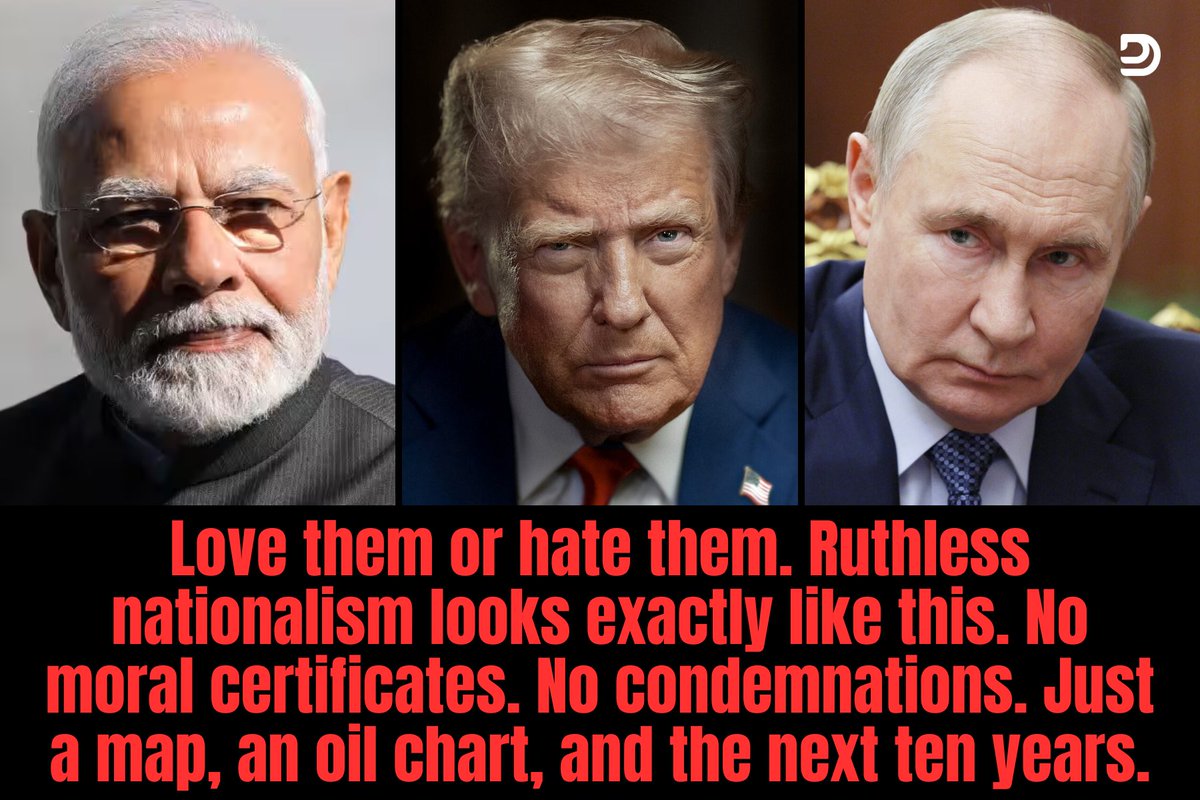
While people were writing moral certificates,
Three men were on a conference call.
Modi.
Trump.
Putin.
No press release.
No condemnation.
No feelings.
Just a map, an oil price chart,
And the next ten years of the world.
Before you call this BJP propaganda,
Let me stop you right there.
BJP won't dare write this.
This is about a cold-blooded, ruthless politician,
Who does not care what you think.
He is not your Doordarshan diplomat.
He is not handing out love letters at the UN.
He is not interested in your certificate.
So let me tell you what actually happened.
Before the first missile was fired,
Trump, Putin, and Modi knew.
They knew when Iran would be hit.
They knew Hormuz would close.
They knew 20% of global oil supply disappears overnight.
They knew the new benchmark.
And they positioned accordingly.
While liberals demanded a strongly worded statement,
These three men already knew the punchline.
Russia.
Selling crude at $10-13 below benchmark.
Sanctions had gutted them since 2020.
Today?
$4-5 above benchmark.
That is an $18 swing. Overnight.
Without firing a single missile into Middle East.
Putin had Ukraine on one hand.
And $18 per barrel on the other.
He chose both.
United States.
Oil at $114 per barrel.
Biggest weekly gain in US crude since 1983.
American energy companies are not celebrating.
They are doing something far more obscene.
They are counting.
The world is ruthless.
Leave your morality at the door.
We are talking about power.
India.
This is where the liberals went completely wrong.
Third largest oil importer on the planet.
80% crude imported.
Nearly half from the Gulf.
Every $10 rise adds $13-14 billion to the import bill.
Liberals read that number.
Wrote a tweet.
Felt very good about themselves.
What they forgot to read was the second page.
The US quietly told India two things.
One. Keep buying Russian oil.
Two. Exchange it at sea.
The shadow fleet.
No Russian flag.
Straight into Indian tankers.
India is also the world's largest exporter of refined petroleum products.
Buy Russian crude cheap.
Refine it in India.
Sell into a world screaming for fuel at $114.
And nobody told you this part:
During this entire war,
India maintained active relationships with
the US, Russia, Israel, Iraq, Iran,
and every Gulf state.
Simultaneously.
You think oil only travels the routes on printed maps?
That is genuinely cute.
Today India is a corridor.
A refinery.
A backchannel.
A neutral ground.
This is called the Goldilocks position.
Keep calling India's silence an abdication.
That silence was a $13 billion arbitrage opportunity.
In every major conflict in history,
The countries that profit most are never the ones fighting.
They sit at the chokepoints.
Selling what a desperate world needs.
To all sides.
With zero apology.
Wars don't just create losers.
They create architects.
Pointedly refraining from endorsing US President @realDonaldTrump’s claim that India has promised to reduce its buying of Russian oil, Prime Minister @narendramodi has confirmed that there’s a deal done with Washington to lower American tariffs to 18 percent from the earlier punitive additional 25 percent slapped on India.
This climbdown by President Trump is an unmistakable vindication of the steely & sober diplomatic strategy of the Narendra Modi Government.
The Prime Minister has shown exemplary courage & vision in handling the grave provocation that India faced due to the abrasive belligerence of the US these last several months.
The strategy that Delhi adopted in response to the situation was admirable. Free trade agreements were signed with several key countries, including the high profile agreement with the EU which demonstrated India is a major economic power, sought after by other major powers.
It required nerves of steel to wait out this difficult period & to refuse to be provoked by internal opposition & the prospect of isolation. Hats off to the Prime Minister @narendramodi & his colleagues who pulled off the impossible!
Conclusion of the India-EU Free Trade Agreement today marks a significant milestone in our relations. I thank all the leaders of Europe over the years for their constructive spirit and commitment in making this possible. This agreement will deepen economic ties, create opportunities for our people and strengthen the India-Europe partnership for a prosperous future.
For decades, the global silver market operated on a simple assumption:
Nobody would actually demand delivery of the metal they owned on paper.
That assumption just collapsed.
In the first seven days of January, 33.45 million ounces of silver were physically withdrawn from COMEX for delivery.
That's 26% of COMEX's registered inventory gone in a single week.
Traders who had March futures contracts were paying premiums to ROLL BACKWARDS to January, demanding immediate delivery weeks early.
They weren't willing to wait. They wanted metal in hand.
Here's the China problem you have to understand if you're buying silver:
On January 1, 2026, Beijing implemented export controls that fundamentally changed global silver supply.
This wasn't a minor tweak. They reclassified silver as a strategic material, putting it in the same category as rare earths.
To export silver from China now, companies need government licenses. Only 44 firms qualified.
They must have annual refining capacity of 80+ tonnes and credit lines exceeding $30 million.
Why does this matter? China controls 60-70% of global refined silver exports.
The world's dominant refining hub just effectively ring-fenced its supply for domestic use.
The physical-paper divergence:
Here's where it gets uncomfortable...
In Shanghai, physical silver trades at 12-13% premiums over Western paper prices.
In Dubai, premiums hit 40%.
In Japan, secondary market premiums reached 60%.
Meanwhile, the paper-to-physical ratio on COMEX sits at 356:1.
For every one ounce of deliverable silver, there are 356 ounces of paper claims.
The system worked because nobody called the bluff. But now they're calling it.
The supply deficit reality:
The silver market has been in structural deficit for five consecutive years.
Cumulative shortfalls from 2021-2025 total roughly 820 million ounces. Nearly an entire year of global mine production.
Mine production peaked in 2016. Roughly 71% of mined silver comes as a byproduct from gold, copper, lead, and zinc mines.
So even if silver prices double, miners can't easily ramp production. Their operations are driven by base-metal economics, not silver prices.
The industrial demand trap:
Unlike gold, silver isn't primarily a monetary metal. Industrial demand now represents 59% of total consumption.
Solar panels. EVs. AI data centers. Semiconductors.
This demand is price-inelastic.
Factories don't stop production because silver got expensive... They pay whatever it takes to keep lines running.
So what does this mean?
Silver is now in backwardation. Spot prices above futures prices.
That's rare. And it's significant.
Backwardation tells you buyers want metal NOW, not paper promises for later.
The last time silver showed this kind of sustained backwardation was before the 2011 spike to $49.
The gold-silver ratio has compressed from over 100:1 in recent years to around 50:1 now.
Historically, that ratio has traded as low as 15-20:1 in extreme moves.
If gold holds and the ratio compresses further, silver will go beyond $150.
It's math.
My take:
Silver is no longer just an industrial metal with monetary characteristics.
It's becoming a triple-identity asset: industrial input, monetary metal, and strategic material.
When China weaponizes export controls, when Western inventories drain, when paper claims vastly exceed physical supply, and when industrial demand is non-negotiable, you get exactly what we're seeing...
A structural repricing.
Pullbacks will be sharp. The CME has already raised margin requirements.
But the underlying dynamics aren't speculation. They're geology, geopolitics, and supply-demand math.
Physical silver in your possession has no counterparty risk.
Paper claims on silver that may or may not exist? That's a different bet entirely.
If you don't hold it, you don't own it.
Placement of RSS branches > IIM, IIT
President
Prime Minister
Home Minister
Vice President
Speaker of the Lok Sabha
And...
18 Chief Ministers
29 Governors,
100,000 branches,
150 million volunteers,
200,000 Saraswati Vidya Mandirs,
500,000 teachers,
10 million students,
20 million members of Bharatiya Mazdoor Sangh,
10 million ABVP workers,
150 million BJP members,
1,200 publishing houses,
9,000 full-time workers,
10 million members of the VHP, Vishwa Hindu Parishad (worldwide),
3 million Bajrang Dal workers,
700,000 members of the Ex-Servicemen Council,
150,000 service projects,
Governments in 18 states,
283 Members of Parliament (Lok Sabha),
58 Members of Parliament (Rajya Sabha),
1,460 MLAs.
Organizations:
Vanvasi Kalyan Ashram,
Vanbandhu Parishad,
Sanskar Bharati,
Vigyan Bharati,
Laghu Udyog Bharati,
Seva Sahyog,
Seva International,
Rashtriya Sevika Samiti,
Arogya Bharati,
Durga Vahini,
Samajik Samrasta Manch,
Organizer,
Panchajanya,
Shri Ram Janmabhoomi Mandir Nirman Trust,
Deendayal Research Institute,
Bharatiya Vichar Sadhana,
Sanskrit Bharati,
Bharat Vikas Parishad,
Jammu & Kashmir Study Circle,
Drishti Sansthan,
Hindu Helpline,
Hindu Swayamsevak Sangh,
Hindu Munnani,
Akhil Bharatiya Sahitya Parishad,
Bharatiya Kisan Sangh,
Vivekananda Kendra,
Tarun Bharat,
Akhil Bharatiya Grahak Panchayat,
Hindustan Samachar,
Vishva Samvad Kendra,
Jankalyan Blood Bank,
Itihas Sankalan Samiti,
Rashtra Sevika Samiti,
Sthree Shakti Jagran,
Ekal Vidyalaya,
Dharm Jagran,
Bharat Bharati,
Savarkar Adhyasan,
Shivaji Adhyasan,
Patit Pawan Sangathan,
Hindu Ekta,
…and countless more.
This is the RSS, dear friends…!
This is not the Congress or the Communist Party, whose roots can be shaken so easily. Many great warriors dreamt of an India without RSS, but left this world instead.
A 100-year-old RSS will continue to serve Bharat for thousands of years to come.
Parama Vaibhavam Netume Tat Swarashtram!
(May our nation attain the highest glory!)
Please do share this about the RSS with your family and friends.
- via social media
31-12-2025
Happy to receive my son today who is back home after 7 days from RSS Camp.
Prathmik Shiksha Varg
For the first time for 7 days I didn’t know where he is staying , what he ate, when he slept,how is health and more.
I didn’t try to contact him and neither he didn’t contact me on all these days.
Feeling proud he spent his holidays without using Mobile and Watching TV
Happy to know he is happy about his camp fully charged.
#RSS
#RSS100Years
@RSSorg@friendsofrss@BJP4TamilNadu@narendramodi@AmitShah@blsanthosh@NainarBJP@KesavaVinayakan@supersanghid
Silver Crosses 2.5L/Kg, Sparks Volatility | Nagpur News - The Times of India https://t.co/QcLR3nGIIl
TIMES of India QUOTES ME IN TODAY'S NAGPUR EDITION
#Silver#SilverSqueeze
The US Treasury is officially valuing its gold at $42.22/oz. 🤯
Market Price: ~$3,000
Gov Price: $42
They are technically sitting on a "hidden" ~$750 BILLION windfall that they refuse to touch.
Why? Because updating the price is a legal trap that could actually destroy the Dollar.
Here is the 50-year-old secret you weren't taught in school... 🧵👇
#Gold #Economy #Finance #History #USA
#SILVER 🔥🔥🔥
#China is calling Uncle Sam's Bluff
They had an easy ride for a long time, now they are in for a shock
Come Monday Morning and US Banks shall run for MARGIN CALLS
DRASTIC TIME FOR SHORT SELLER
JP Morgan is F*CKED! Physical delivery of silver is required. In China, silver is at $85 per oz, whereas in the U.S. fraud paper market, silver is at $79. Physical delivery is going to pull the fraud paper markets price higher & higher. All the big banks that have been holding the paper silver price down for years will now go bankrupt. Now it’s just a matter of time.
Hiding one's weakness and ineptness behind the veil of #RSS & cursing them day in and day out shall not help CONgis.
No leadership, no programs, anti India, LEFTIST TO THE CORE, DESTRUCTIVE POLICY, MYOPIC VIEWS ET ALL HAVE DESTROYED THE PARTY
OBITUARY IS READY TO BE WRITTEN
An Interesting and educative article on Bretton Woods3 and how US is embroiled in its own so called supremacy and how China and Russia are managing their critical ASSETS
By @TheNavroopSingh https://t.co/mckOGTbrk7
Bretton Woods III Why Gold Is Rising and the Dollar Is Slowly Losing Ground.
In March 2022, when the G7 froze Russia’s foreign exchange reserves, most people saw it as just another sanctions headline. One economist immediately understood that something far deeper had changed. Zoltan Pozsar recognised that this was not just about Russia. It was about the credibility of the global monetary system itself.
His observation was simple and unsettling. Commodities are collateral, and collateral is money.
What this really meant was that dollars, bonds, and bank deposits are not neutral assets. They are liabilities issued by states and institutions. They work well in stable times, but they can be frozen or rendered useless when geopolitics intervenes. Once countries realise this, behaviour changes.
This moment marked the beginning of what Pozsar called Bretton Woods III.
For decades, the world functioned under a system where the US dollar sat at the centre of everything. Countries exported goods, earned dollars, parked those dollars in Western banks or US Treasuries, and trusted that these reserves would always remain accessible. That trust was the foundation of Bretton Woods II.
It broke in 2022.
When Russia’s reserves were frozen, policymakers around the world quietly asked a basic question. If this can happen to Russia, why not to us. The answer was uncomfortable but obvious. There was no protection.
From that point onward, central banks began acting logically. They did not issue dramatic statements. They simply started increasing gold purchases. Even as prices climbed, buying continued. This behaviour matters because it shows that gold is not being treated as a trade or a hedge. It is being treated as money.
The key distinction here is between inside money and outside money.
Inside money is someone else’s promise. Bank deposits, bonds, and reserve currencies fall into this category. Outside money has no issuer and no counterparty. Gold sits firmly in this category. It cannot be cancelled digitally and it does not depend on trust in another state.
That is why this gold rally is different from earlier cycles. It is driven by monetary demand, not speculation.
Silver moved for similar reasons, though with an added layer. It is both a monetary metal and an industrial input. Demand from solar energy, electronics, and data infrastructure has been rising, while supply has remained constrained. When investment demand joins this picture, price moves tend to be sharp.
Trade patterns are also changing. Russia and China now settle most of their trade in local currencies. India uses rupees and rubles for Russian energy imports. More bilateral settlement arrangements are appearing across regions.
Bretton Woods III is not a formal agreement. It is an adjustment to a world where finance is no longer neutral and money can be weaponised. In such a world, assets that sit outside the system gain importance.
The dollar is not disappearing. It remains powerful and widely used. But its unique position is weakening. Gold is rising because the world is adapting to this shift, not because markets are behaving irrationally.
Pozsar did not predict an outcome. He identified a change in incentives. What we are seeing in 2025 is the logical result of that change.
End.