India needs 8%+ sustained for two decades to hit "high income." No agency projects above 6.7% through 2030.
The math: 900mn working-age, only 330mn in non-farm jobs. 40% of youth (15-29) are unpaid family labour. 28mn educated youth actively job-hunting, 100mn have simply stopped looking.
The Lewisian transition (farm to non-farm work) reversed. Agriculture's employment share rose from 42% to 46% (2018-24) — the opposite of what development requires.
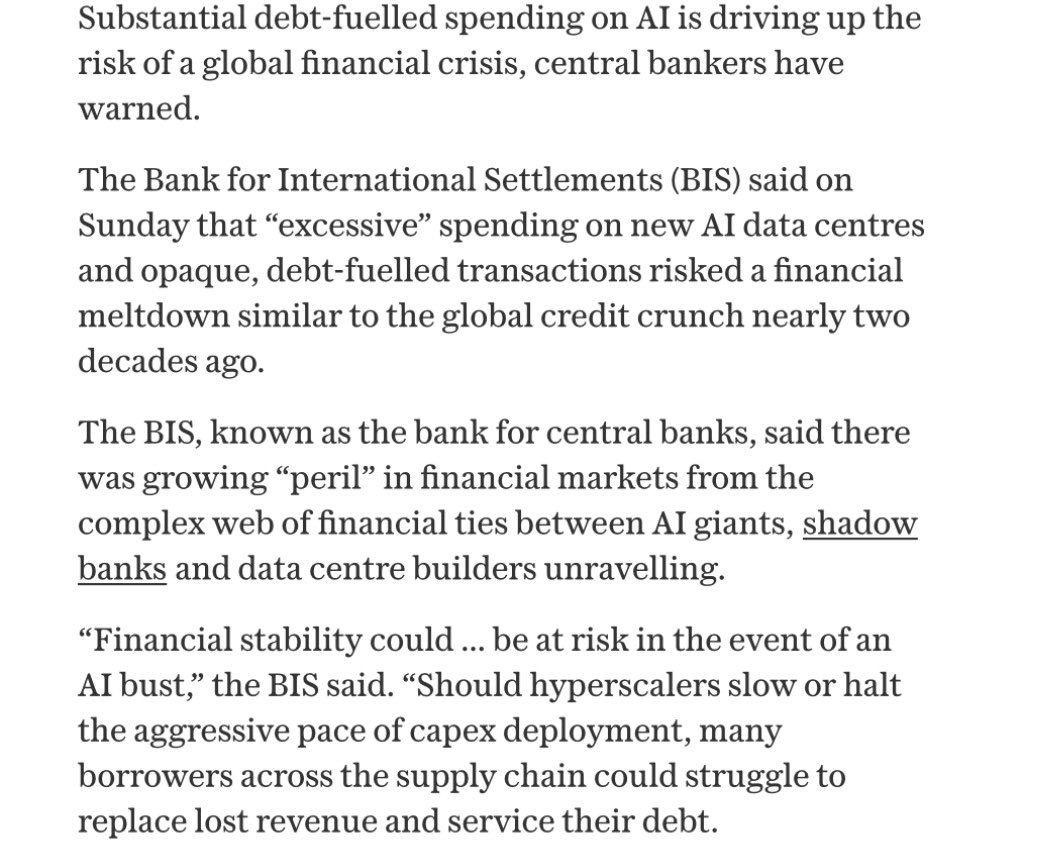
The central bank in question is the Bank for International Settlements (BIS) and is very important, they set the Basel Accords. To dismiss this as “FUD” or a “press release” is equal parts ridiculous and wrong!
https://t.co/LHa1xYLEt8
@bluewmist Life loses its colour when your inner child rots.
You must keep him healthy, happy and vibrant.
Revisit your curiosity.
Revisit your old hobbies.
Revisit joy before it needed a reason.
A life without your inner child survives but a life with your inner child flourishes.
India's Biggest Economic Challenge Is not Inflation, Oil, or War - It is an Unskilled Population Addicted to Distraction.
Every time oil prices rise, economists panic. Every time a war breaks out in the Middle East or Europe, television studios declare that India's economy is under threat. And yes, both matter. But neither represents India's greatest economic challenge. The real crisis is unfolding much closer to home.
It is a generation that spends more time consuming content than creating value. A workforce that debates geopolitics without mastering spreadsheets, artificial intelligence, coding, welding, precision manufacturing, sales, finance, communication, or even basic problem-solving. An economy where attention has become the most wasted national resource.
India is one of the youngest countries in the world. That should have been our greatest competitive advantage. Instead, we risk turning our demographic dividend into a demographic liability.
The Age of Endless Consumption
Never before has information been so accessible. Yet never before have so many people spent so much time learning so little. Hours disappear into political debates, celebrity gossip, cricket controversies, influencer reels, conspiracy theories, and outrage cycles that have absolutely no impact on an individual's earning potential. Ask someone how many hours they spent on social media last week. Then ask them how many hours they invested in acquiring a new professional skill. For many, the answer is uncomfortable. We have become experts at commenting on the economy while contributing very little to it.
Degrees Are Not Skills
India has no shortage of graduates. It has a shortage of employable graduates. Companies repeatedly report the same problem: vacancies exist, but suitable candidates are difficult to find. Not because people lack certificates. Because many lack practical skills. The world is rewarding competence, not credentials.
- Can you solve problems?
= Can you communicate effectively?
- Can you sell?
= Can you lead a team?
- Can you analyze data?
- Can you use AI to improve productivity instead of merely asking it amusing questions?
- Can you create something that another person is willing to pay for?
Those are the questions that determine economic success. Not the number of degrees hanging on a wall.
Attention Is the New Currency
The biggest theft today is not of money. It is of attention. Every notification fragments concentration. Every endless scroll delays mastery. Every hour spent consuming outrage is an hour not spent building expertise.
Modern economies reward deep work, specialized knowledge, creativity, and disciplined execution. Algorithms reward emotional reactions. Unfortunately, millions choose the algorithm.
The Coming Divide
Artificial intelligence is not replacing everyone. It is replacing people who refuse to learn. The future will belong to workers who continuously upgrade themselves. Those who combine human judgment with technological tools will become dramatically more productive. Those who stop learning will find themselves competing for fewer opportunities at lower wages. The divide will not be between rich and poor. It will increasingly be between skilled and unskilled.
National Growth Begins With Individual Discipline
Governments can build highways. Businesses can build factories. Universities can build campuses. But none of them can force an individual to develop skills. Economic transformation begins with personal responsibility. Spend one less hour arguing online. Spend one more hour learning. Read instead of scrolling. Build instead of complaining. Acquire one valuable skill every year. Become indispensable.
If millions of Indians made that simple choice, the country's economic trajectory would change more profoundly than any fiscal stimulus, any election promise, or any temporary fall in oil prices.
Wars will end. Oil prices will rise and fall. Markets will recover. But a nation that neglects skill development while surrendering its attention to endless distraction will struggle long after those headlines have disappeared.
The strongest economy is not built by the loudest voices. It is built by the most capable people.
#JaiHind
@axisbank NRI...Does it take more than 65 days to change Mobile Number of an Existing NRI Customer ????..She has sent 5/6 emails since 24th February.....Client is extremely upset & wants to close down their account.. @AxisBankSupport
Pls sort this ASAP
Washington’s India Turn: From Courtship to Containment
While coddling India’s two closely aligned, nuclear-armed neighbors, China and Pakistan, Trump has stepped up pressure on New Delhi, even seeking to extend U.S. oversight to its energy-import policy. The Indian government’s third waiver request since February for purchasing Russian energy underscores that shift.
Trump has also repeatedly hurled insults, calling India a “dead economy” and imperiously claiming he could end Modi’s political career (“I don’t want to destroy his political career,” he said patronizingly on October 15, 2025). Last month, his deputy secretary of state went further, warning from Indian soil: “We will not allow India’s market to grow so large that India can compete with us in the future.”
A rising India is no longer viewed in Washington primarily as a strategic partner to be cultivated, but as an economic rival to be constrained. https://t.co/sc9fcw5ixK
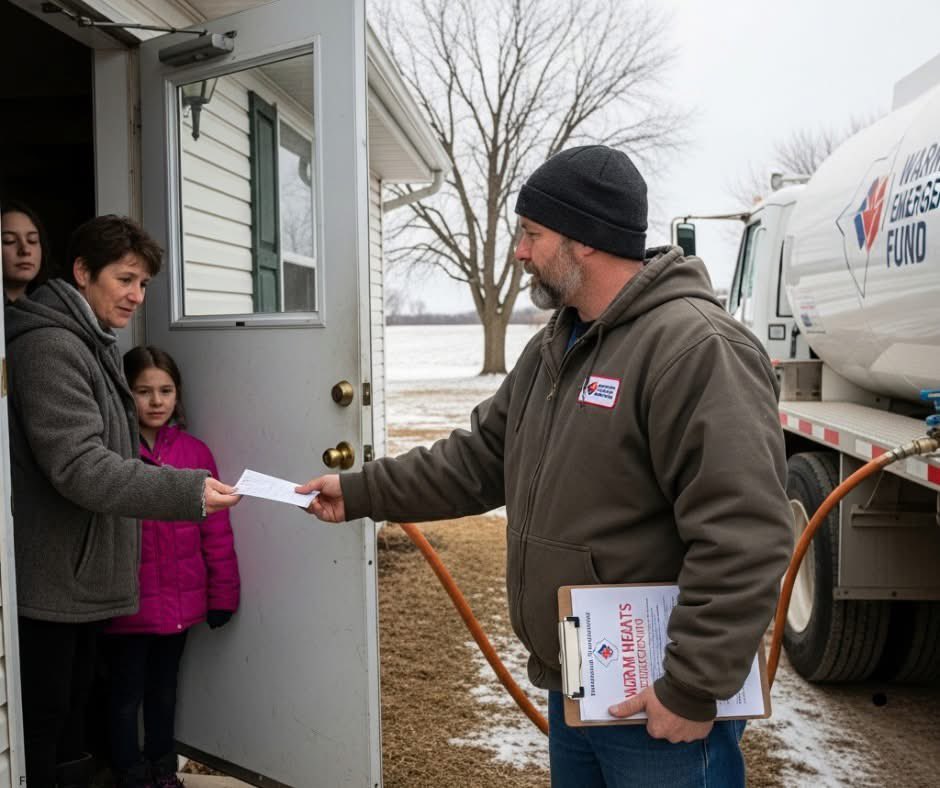
"My name's Hank. I'm 66. I deliver propane to homes. Rural routes, farms, folks off the grid. I fill their tanks, check connections, drive to the next house. Most customers just sign the slip, barely look up. I'm just the propane guy.
But last February, during that brutal cold snap, I noticed something at the Miller place.
Pulled up to fill their tank, gauge showed empty. Completely dry. In 15-degree weather.
I knocked on the door. Mrs. Miller answered, three kids bundled behind her in coats. Inside the house.
"Ma'am, your tank's bone dry. How long you been without heat?"
"Four days." Her voice was steady, but her hands shook. "Bill's due Friday. We're waiting on my husband's paycheck."
Four days. Three kids. Fifteen degrees.
"Ma'am, I'm filling it now."
"I can't pay until"
"I'll mark it as a delivery error. Computer glitch. Nobody'll know."
She started crying. "Why would you do this?"
"Because those kids are wearing coats inside."
I filled their tank. Checked the furnace. Made sure heat kicked on before I left.
Drove away thinking about what I'd seen. Kids doing homework in winter jackets. A mom choosing between heat and food.
Started paying attention different after that. The elderly veteran whose tank was at 10%, he was rationing, keeping one room warm. The single dad whose payment was two weeks late, he'd been burning firewood he couldn't really afford.
I started doing something I shouldn't. When I saw someone struggling, someone who'd run out, someone rationing heat—I'd add 50 gallons. Mark it as "meter calibration" or "pressure test residual."
Small amounts. Enough to get them through.
Did it eleven times that winter. My boss noticed the discrepancies. Called me in.
"Hank, we're showing extra gallons delivered but not billed."
I told him the truth. Everything.
He stared at me for a long time. Then said, "My daughter was a single mom once. Chose between heat and groceries every winter. I wished someone had helped her."
He didn't fire me. Instead, he created something, "Warm Hearts Emergency Fund." Customers could donate. We'd match it. Use it for families in crisis who couldn't afford propane.
But here's what broke me, Mrs. Miller came to our office in May. She'd gotten a better job, caught up on bills.
She handed me an envelope. Inside, $200.
"For the next family. The one you'll find in February, four days without heat, trying to be brave for their kids."
She grabbed my hands. "Hank, my youngest has asthma. Four more days in that cold... I don't know if..." She couldn't finish.
Last winter, the Warm Hearts Fund helped 23 families. Not with handouts, with heat when they had none. With dignity when they felt broken.
And here's the thing, other propane companies heard about it. Started their own programs. Now there are "emergency heat funds" in six states.
But the moment that destroyed me happened last month. Got a call to deliver to an address I recognized, the Miller place.
Mrs. Miller answered. "Hank! Come in, please."
Inside, warm, kids doing homework at the table, laughing. She handed me a check. Full payment, plus extra.
"For the fund. But also..." She pulled out a drawing her youngest had made. Stick figure man with a propane truck. Caption in crayon: "Mr. Hank, my hero."
"She asks about you every winter. 'Is Mr. Hank making sure people are warm?'"
I'm 66. I deliver propane to houses nobody notices.
But I learned this- Cold doesn't wait for paychecks. And no child should do homework in a winter coat inside their own home.
So if you deliver anything, oil, propane, firewood, and you see someone struggling, someone empty, someone rationing,
Find a way. Mark it wrong. Call your boss. Start a fund. Do something.
Because heat isn't a luxury. It's survival.
And the difference between freezing and living shouldn't be whether your paycheck arrived on time.
Be the reason someone stays warm."
.
Let this story reach more hearts....
.
Ai image is for Demonstration purpose only
.
Credit: Mary Nelson
🚨Inside Story of the Massive Crackdown on Anil Ambani
The spark: a resignation, a whisper, a target
Where the plot thickened? Naidu, media, and milk
Read only in @BWBusinessworld#AnilAmbani
https://t.co/u7vBI72w88
Central banks don’t care if gold goes up or down. They don’t look at it from an investor’s lens. For them it’s geopolitical – you don’t hold the debt of an adversary. The thing with gold is that it’s a neutral asset which sits outside the control of any single country.
( Martin Armstrong)
SEMICON INDIA CONFERENCE (Delhi, India) – HYPE or CALL TO ACTION?
A few months ago in Feb, when we attended the Gujarat Semiconductor Conference, we came away somewhat underwhelmed by the slow pace of progress. This time, however, the mood was very different. Backed by strong government initiatives through PLIs and DLIs, we saw several promising companies making meaningful strides—both in manufacturing and in designing.
The momentum in India’s semiconductor ecosystem is clearly picking up!
Several MOUs were announced to strengthen India’s design eco-system, underscoring the government’s focus on IP-led innovation and skilling. Many companies participated in the event, showcasing their offerings, and we engaged with as many of them as possible to gain deeper insights into the industry.
Lets dive into what we learnt from our conversations with 30+ companies…
CURRENT INDUSTRY LANDSCAPE
IP Licensors —> Design Architecture —> Wafer Mfg. (Fab) —> Assembly, Test, Marking & Package (ATMP) —> Distribution & Integration (Sales)
CAPITAL INTENSITY
- IP & Design is R&D intensive and the most crucial building block of the chip.
- FAB is capex intensive. Making 28-90nm chips Tata is spending ~90k crores. To mfg. 3nm chip will increase setup cost by 3-4x.
- ATP & OSAT is Labor intensive business
- OSAT is an outsourced, 3rd party service model for Semiconductor assembly and test. It is a form of ATMP offered as an external service
WHAT ARE COMPANIES FOCUSING ON?
- Majority of companies seemed to cater more heavily to OSAT currently in India alongwith few distinguished players attempting to build capabilities in IP & Design part (backed by industry veterans & technocrats)
- Tata Electronics is the only player working towards Wafer mfg. (Fab) as one of key offering & is putting 50,000 wafers/month facility for ~90k crs which will cater to 28nm to 90nm chips, typically used in Auto’s, Industrial electronics, Power management.
E.g., Cost breakup —> 28nm chip for Auto use —> ~15% Design; 60% Fab; 20% ATMP; and Sales 5%,
ANCILLARIES - KEY SUPPORT FOR THIS INDUSTRY
- Cleanrooms are basic requirements (Fabtech) as chips can get damanged even with slightest of impurities. Large players doing good work are already taken over by Japanese companies.
- Grinders, Substrates, Specialty Chemicals & Gases (InoxGFL), Bonders etc. are other such supporting blocks.
VIKRAM 32-bit PROCESSOR
Before going further, we must talk about Vikram 32-bit processor- India’s first fully indigenous chip developed by ISRO (Designed, Fabricated & Packaged in India). It is designed for harsh environmental conditions found in launch vehicles, making it ideal for space missions- With this India has joined the group of nations which can design and produce its own semi conductors for critical applications (Space, Defence, Aerospace etc)
KEY TAKEAWAYS FROM THE CONFERENCE
- Industry is in very nascent stage and with govt. support we are tapping heavily into OSAT/ATMP followed by Designing. Most of the companies we met are in the process of setting up their OSAT facilities (Assembly, Testing and Packaging). They are at least 1.5-2 years away from getting their plants production ready
- Existing OSAT players are currently focusing on foreign clients, given the higher margins compared to domestic customers. Indian clients remain highly price-sensitive and often rely on packaging and testing in more mature ecosystems like China. We believe government support, through subsidies, will be essential to make local OSAT players competitive.
- A Few design companies mentioned that packaging chips in India would be 30-50%more expensive (some companies cited even higher) than doing so in China. As a result, we could not clearly assess the potential ROCE from the upcoming OSAT facilities, since it ultimately depends on utilization levels
- China, Taiwan & SEA typically dominates ATP market. Govt. support is making OSAT expansion economically viable or else China OSAT is ~1/10th of India (too cheap).
- Smaller the chip size (3nm latest) implies more speed, power efficiency, less heat generated etc. But to mfg. these smaller chips, capex is 3-4x of what is currently being spent by Tata.
- We also engaged with a few design companies, and two in particular stood out—one developing its own analog chips and the other working on proprietary processor IP cores. While both are still at an early stage with a long road ahead, the design space holds significant potential. With the global shift towards ASICs (Application-Specific Integrated Circuits) across industries and applications, the opportunity for IP-driven design companies could be substantial
CONCLUSION
Semicon India 2025 highlighted the rapid progress of the country’s semiconductor ecosystem, supported by government initiatives and growing private participation. While OSAT remains a long-gestation, utilization-driven opportunity, the real long-term value creation could lie in IP-led design and ASIC-focused innovation, where Indian companies have the potential to build globally competitive niches.
OUR VIEW
Government interest in the success of this sector is crystal clear. We just don’t want to be a consumer but also a manufacturing hub. While challenges like high set up cost, skilled manpower & high capital-intensive infrastructure are prevalent at this stage, it will take atleast 5 years to develop the fully integrated value chain. We are at a stage where Solar sector was 5-7 years ago. With Govt focus, strong policy support & global technology tie-ups/collaboration – it appears as of now that we could be self-reliant by the turn of the decade.
As of now, we are betting on the entire value chain – lets roll the dice!
THIS TOO SHALL PASS - ft Donald J Trump
When an Eastern sage was desired by his Sultan to inscribe on a ring the sentiment which, amidst the perpetual change of human affairs, was most descriptive of their real tendency, he engraved on it the words: — "And this, too, shall pass away."
As an investor we are worrying about the following today:
1) THE BIGGEST ONE: The impact of US Tariffs on Indian GDP growth -> job losses -> cos shutting down -> consumer demand -> banking sector NPAs -> a spiral effect/impact that is tough to quantify
2) The overall slowdown of the Indian economy (fears are growth will falter below 6% aided by tariffs but largely due to fault within our own lines)
3) The seemingly high valuations vs other global and emerging economies
4) The re-start of FII selling ($5bn in July and August)
5) The slow grinding market esp small/mid caps (which are still trading far above historical valuations) - distribution or accumulation?
Here is what we know and believe could (will) happen!
(countering each of the 5 worries mentioned above)
1) Probability of a milder tariff version (hopefully soon)
2) We will treat present tariffs as an economic crisis and introduce a host of much needed reforms to "improve our long term competitiveness & strengthen the building blocks for delivering multi-decadal 7% growth" - as written by Akash Prakash in the much hyped/publisized article in BS - Why are FPIs selling?
3) As $$$ billions raised via private & capital markets over the past 3-4 years drive the private capex boom, a lot of companies will see multifold earnings growth starting 2HFY26, FY27 and FY28. So in 2 qtrs a lot of smaller MCap names will appear attractive on valuations - we are already building a portfolio mirroring this expectation
4) Well for the FIIs/FPIs making a comeback anytime soon? There is only one song that will describe the sentiment: aakhir tujhe aana hai, zara der lagegi (from the now forgotten movie Yalgaar)
5) Markets have now been grinding since 8 months (ever since DJT took oath!). When markets behave in a highly matured manner even when everything around is falling apart, it only means one thing - it is setting itself up for a large move (fingers crossed when I say a move on the upside pls)
BIGGEST RISK: In an event where tariffs remain, no new reforms are unleashed, GDP growth falls below 5-6%, FPIS continue to sell and we keep losing more and more money on our investments - All I would like to say is: THIS TOO SHALL PASS!