A century before modern AI, Andrey Markov manually counted 20k letters in a Pushkin poem to show that predictable patterns can emerge from sequences where each item depends on the one before it.
The core concept still lives on in today’s LLMs.
In 1930, a 19-year-old student sat on a steamship traveling from India to England, scribbling math equations in a notebook to pass the time.
By the time the ship reached port, the teenager had mathematically proven that the most massive stars in the universe do not die peacefully. Instead, they are destined to collapse into infinitely dense, terrifying monsters.
He had just discovered the mathematical trigger for black holes.
But when he arrived at Cambridge and presented his work, the leading astronomer of the Western world publicly mocked him, calling his mathematics a stellar joke.
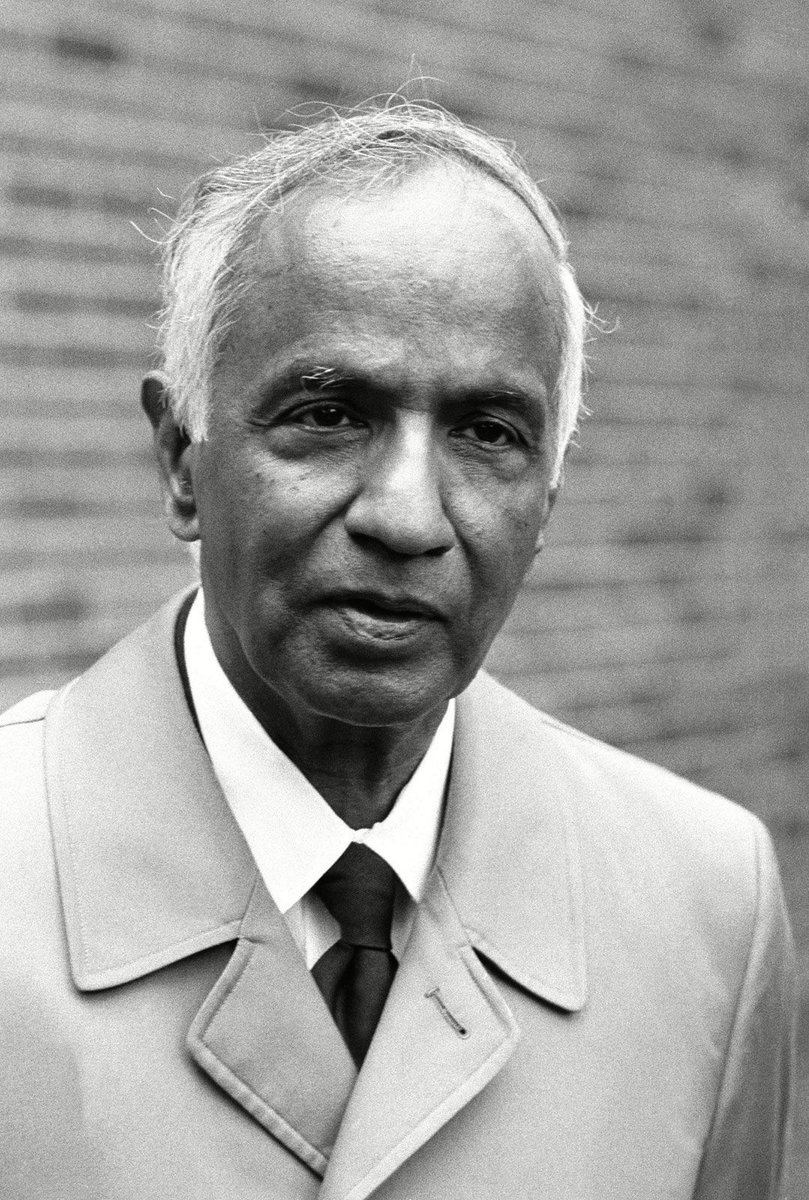
His name was Subrahmanyan Chandrasekhar.
It would take nearly 50 years for the scientific establishment to admit they were wrong and award him the Nobel Prize for the math he did on that ship when he was nineteen.
His struggle against scientific elitism is the ultimate lesson in what happens when rigid dogmas clash with undeniable mathematical reality.
In the early 20th century, astronomers believed they understood the life cycle of stars. They knew that when a star runs out of fuel, gravity tries to crush it. But quantum mechanics offered a beautiful safety net: a force called "electron degeneracy pressure" would push back against gravity.
The star would shrink into a stable, peaceful, glowing ember called a White Dwarf.
The entire scientific establishment agreed: every star, no matter how big, would eventually settle into this quiet retirement. It was a neat, comforting formula.
But on that ship, Chandra realized the establishment had left a massive variable out of their equations: Albert Einstein’s Special Relativity.
Chandra recalculated the math, factoring in what happens when the collapsing particles inside a dying star approach the speed of light.
What he found shattered the comforting consensus.
He proved that if a dying star is more than 1.44 times the mass of our Sun (a boundary now immortalized as the Chandrasekhar Limit), the quantum safety net snaps. The gravity becomes so intense that the electrons cannot push back.
The star cannot form a peaceful White Dwarf. There is no formula to stop it. It must keep collapsing, falling inward forever, crushing itself into a single point of infinite density.
When Chandra presented this at the Royal Astronomical Society, Sir Arthur Eddington,the most powerful physicist in Britain, literally stood up, tore Chandra’s paper to pieces, and ridiculed the idea of stars collapsing into nothingness. Eddington’s ego couldn't accept a universe with such violent, unpredictable geometry.
Chandra was completely isolated. The establishment closed ranks around Eddington.
Instead of fighting a toxic, biased system, Chandra quietly shifted his focus to other areas of physics, leaving his flawless math in the journals for a future generation to find. Decades later, when advanced telescopes finally spotted real neutron stars and black holes in deep space, the world realized the 19-year-old kid on the boat had been right all along.
The philosophical blueprint Chandrasekhar left behind is a vital truth for navigating gatekeepers and institutional pushback:
Comforting illusions will always be more popular than harsh, disruptive truths. Trust the math anyway.
Most of us approach our careers and projects seeking the validation of the current experts or the established guard. When we propose a radical new idea or try to change a broken system, and the authorities tell us we are wrong, our instinct is to assume our logic is flawed. We abandon our data to fit the consensus.
But Chandrasekhar’s legacy proves that institutional authority is not the same thing as truth.
Gatekeepers are human; they protect their own theories, their own legacies, and their own comfort.
What is an idea, a project, or a direction you’ve abandoned just because an expert or a boss told you it wouldn't work? What happens if you stop looking for their permission and trust the structural integrity of your own work?
In 1873, a painfully shy Yale professor published a series of dense, mathematical papers that practically no one in America could understand.
He was so obscure that his university didn't even bother to pay him a salary for the first nine years of his career.
Yet Albert Einstein later called him "the greatest mind in American history."
His name was J. Willard Gibbs.
He didn't invent a new machine or discover a new particle. Instead, he did something far more profound: he took the invisible, chaotic chaos of chemical reactions and turned it into a breathtaking geometric map.
In doing so, he quietly laid the foundation for modern chemistry, metallurgy, and the materials that built the 20th century.
In the late 19th century, chemistry was a mess of trial and error. Scientists knew that if you mixed certain elements together under heat and pressure, things happened. Sometimes they exploded. Sometimes they froze. Sometimes they morphed into entirely new substances.
But no one knew why. There was no universal formula to predict if a chemical reaction would happen spontaneously or require external energy.
The scientific establishment was trying to solve this by treating chemistry like a giant cookbook, memorizing thousands of individual recipes.
Gibbs looked at this chaotic kitchen and realized they were missing the underlying architecture.
He introduced a radical new concept that we now call Gibbs Free Energy. He proved that every chemical system has a hidden, mathematical bank account of energy available to do work.
But his true genius wasn't just the math; it was how he visualized it.
Gibbs realized that you could map a substance’s temperature, pressure, and energy onto a three-dimensional geometric surface.
Suddenly, the messy, unpredictable behavior of matter became a landscape.
A chemical reaction wasn’t a mysterious magical event anymore. It was just a ball rolling down a hill. If the geometric slope leaned downward, the reaction would happen naturally (spontaneous). If the slope went upward, the reaction was impossible without forcing it. Water turning to ice, iron turning to rust, coal turning to diamond, all of it was just matter navigating the hidden topography of Gibbs' geometry.
When Gibbs sent his work to Europe, the legendary physicist James Clerk Maxwell was so struck by its genius that he literally sculpted a 3D plaster model of Gibbs’ thermodynamic surface with his own hands and mailed it to Gibbs' house in Connecticut.
The philosophical blueprint Gibbs left behind is a game-changer for navigating complex decisions:
You cannot master a chaotic system by memorizing every possible outcome. You master it by mapping the terrain.
Most people approach their life decisions, their careers, investments, or habits like 19th-century chemists. They treat every new situation as an isolated recipe. They ask, "If I mix X and Y today, will it explode?" They look for specific formulas for specific moments.
But life, like chemistry, is governed by an underlying energetic terrain.
If you stop looking at individual events and start looking at the energetic slope of your choices, everything changes. Some habits have a downward geometric slope, they require almost zero effort to maintain once they start rolling, naturally producing massive results. Other goals have an impossible upward slope because you are fighting the natural friction of your environment.
Success isn't about forcing an explosion through sheer willpower. It’s about altering the geometry of your environment so that the outcomes you want become the path of least resistance.
What is a goal in your life right now that feels like an impossible, exhausting uphill battle? Stop trying to force the mixture to react. How can you change the pressure, the environment, or the underlying structure of your day so that success becomes a ball rolling down a hill?
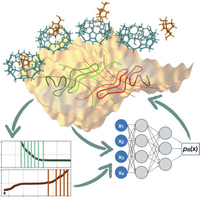
A novel path-finding sampling strategy combined with deep learning allows computation of the full committor function in complex systems to accurately learn the full reaction coordinate for a complex activated molecular transition https://t.co/NmaREt5YAJ
Flows of gravity-driven, shear-thickening fluids form a sharp, vertical front that advances at constant velocity independent of released volume, flow height, and slope https://t.co/3NH2AeXKHj
Motility-induced phase separation, a robust phenomenon typical of
active matter, can be destroyed in realistic fluid environments where
long-range many-body hydrodynamic interactions are present #CoolVideo
Letter: https://t.co/r32jQ6jMFh
Synopsis: https://t.co/f9IfnGRmLG
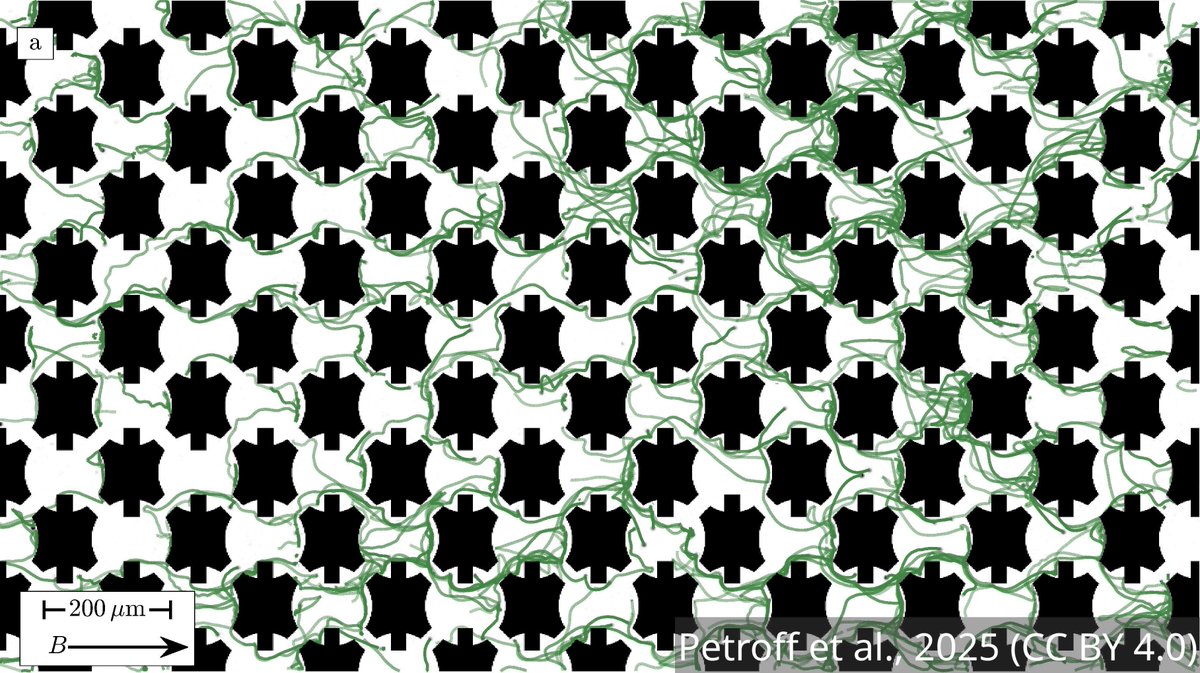
Magnetotactic bacteria swim along geomagnetic field lines to navigate sediments. Using microfluidics and simulations, this study shows their motility is optimised, revealing how evolution fine-tunes life for challenging environments.
https://t.co/pScwxJsw0h
In chaotic systems, the smallest fluctuations get amplified. As scientist Edward Lorenz put it in the 1960s and 70s, even a seagull flapping its wings might eventually make a big difference to the weather.
https://t.co/uL4Q0MYXMQ
In this collaborative work, we infer the activity of colloidal particles from the flow field created by them via deep learning. The work was led by my student Aditya Mohapatra and done in collaboration with Aditya Kumar, Mayurakshi Deb, and Siddharth Dhomkar @iitmadras
Our latest paper, "Inferring activity from the flow field around active colloidal particles using deep learning", has been published in @JFluidMech
https://t.co/fxduYhZEW7
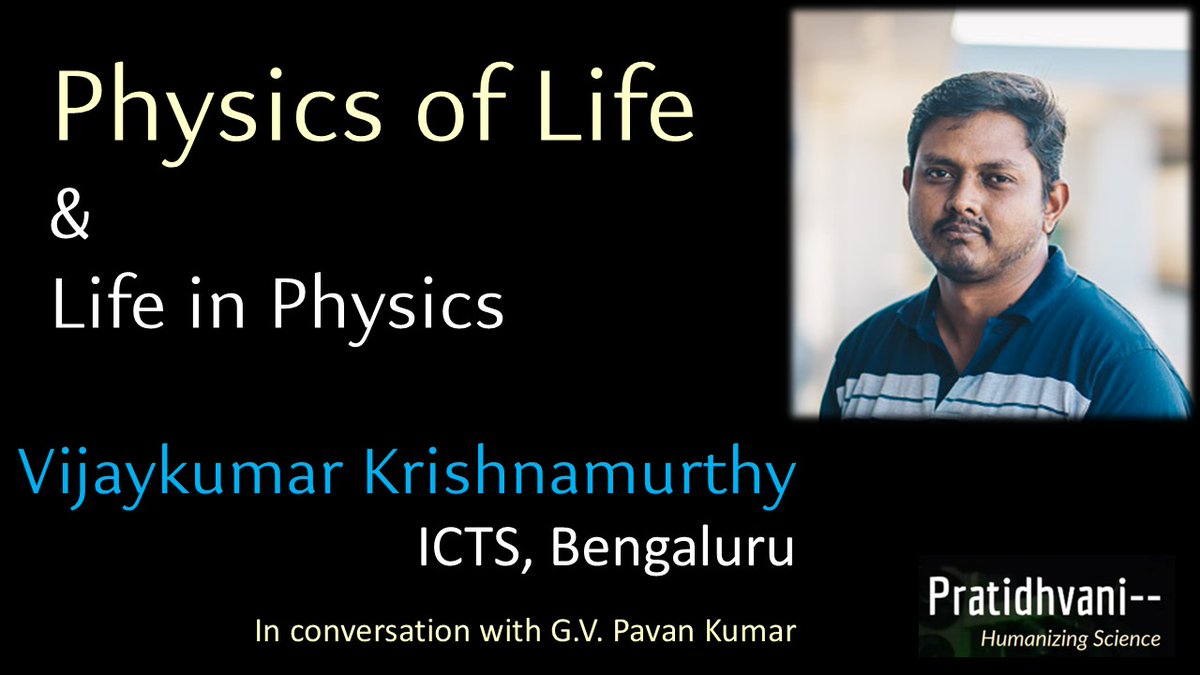
Episode 99 with @Vijay_K_Murthy
Vijay is a faculty member at ICTS-TIFR, Bengaluru, exploring PHYSICS OF LIFE !
He works at the interface of physics and biology, with a focus on mechanochemical pattern formation in development.
He is also the co-creator of Kaapi with Kuriosity, an outreach initiative by ICTS that fosters public engagement with science through conversations and community events.
In this episode, we explore “physics of life” and his life in physics with bits of ಕನ್ನಡ (Kannada)
Links in reply below
Crown shyness is a phenomenon where trees' uppermost branches avoid touching, forming a delicate web of natural negative space. This is thought to be a growth response to prevent ongoing abrasion damage and potential pest invasion.
📽:Dimitar Karanikolov
Emmy Noether showed that fundamental physical laws are really just a consequence of simple symmetries. A century later, her insights continue to shape physics. @shalmawegs reports: https://t.co/X5WbyIDsat