Tomorrow, @1x_tech is going to release an exciting update on our AI and Autonomy efforts. To give a hint as to what we're about to reveal, here are some of the autonomy videos we've shared in the last 1+ years of scaling up our data engine.
Every video in this thread is autonomous, 1X speed
One of the most magical classes in university should be the intro to computer architecture class
You're literally learning how to imbue rocks with a spirit that lets them think
Kinda crazy a lot of students can dread it (I did) because it seems so banal and technical
You need to unlearn the way you think of training data to get the most out of LLMs.
With tabular data/models, you need to get a relatively large (usually >1000 rows) dataset to train an ML model, since it has to learn the concept from scratch.
However, LLMs already know how to do most tasks. Finetuning is just the process of extracting specific behavior out of the model.
So how do you apply this?
1. Get some high-quality, labeled training data. Even 20 samples will do. (should take < 1 hour to label)
2. Fine-tune your model on that data (use LoRA, it's faster).
3. Generate new training data using that fine-tuned model.
4. Curate the best samples from the generated data.
5. Either continue to fine-tune that model on the curated data, or append that data to your starter dataset and fine-tune a model from scratch.
This pattern is relatively unfamiliar to many experienced data scientists. Try it out!
And this is as true today as it was 30 years ago. We don't really understand how LLMs generalize, we don't understand how to improve their (causal?) reasoning skills, we need means to prevent harm, . ...
(Besides... there is a whole word beyond language.) (7/8)
1) Caricature of an argument for GPT fans, explaining why we need a neural-symbolic-evolutionary cognitive architecture to get to human-level AGI : ...
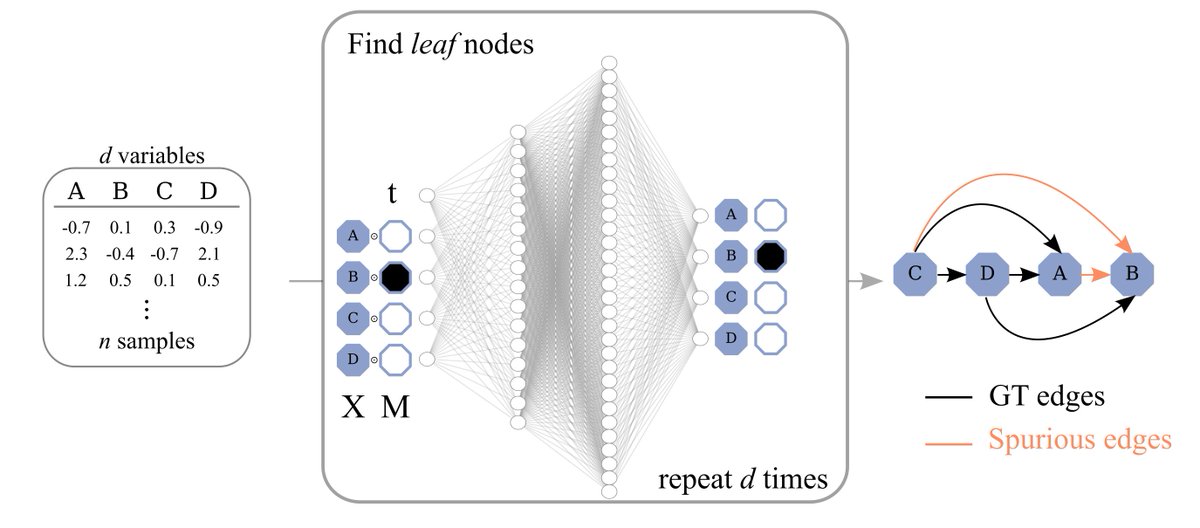
Diffusion models + causality?
Our new paper ACCEPTED to ICLR 2023 explores how to do causal discovery using diffusion models for topological ordering!
Go check it out!
https://t.co/ZATdUAK3jH
Code is available:
https://t.co/bXewm0lDEm
(main code is under 200 python lines)
Archerfish shoot their prey down with water droplets from their mouths. They are remarkably accurate and can bring down insects and other small animals up to 3 m above the water's surface
[📹 https://t.co/5ykjFnJrvd]
[read more: https://t.co/QZoxsCYijh]
Code is a liability, not an asset. So goal of software engineer is delivering the maximum amount of desired functionality at the cost of the least amount of code complexity, even as desired functionality evolves over time.
While developing multi-channel Lenia I was finding biological analogies like different cell types interacting with each other, now it seems possible to be applied to actual medical research!
Note that most important AI results (including backprop, GAN, transformer), came from individuals or small teams so far, with large teams mostly scaling them up, and there are still a few important breakthroughs waiting for individuals with the right ideas
I commit with CMD+Enter git shortcut, no commit messages, straight to production.
When I am coding I might be committing 3 times per minute or more etc. Uptime 99.99% no issues.
I'm a bit different though 😅
This isn't advice