JUST IN: Iran’s Foreign Minister posted five sentences on X on April 4 that should have stopped every government in the Gulf. “Israel-U.S. have bombed our Bushehr plant four times now. Radioactive fallout will end life in GCC capitals, not Tehran.” He compared it to Western outrage over Zaporizhzhia in Ukraine and accused the attackers of double standards. The IAEA confirmed the fourth strike: a projectile hit near the site, one guard killed, a support building damaged. No radiation increase was detected. The containment held. This time.
The physics of why the fallout would reach Riyadh and not Tehran is geography that no amount of diplomacy can change. Bushehr sits on the Persian Gulf coast at 28 degrees north. Tehran is 750 kilometres inland, shielded by the Zagros Mountains. The prevailing winter winds blow from the northwest to the southeast, directly across the Gulf toward the UAE, Qatar, Bahrain, and Saudi Arabia’s Eastern Province. The anticlockwise surface currents of the Gulf carry waterborne radionuclides westward and northwestward toward the head of the Gulf, reaching Kuwait and Bahrain within approximately 15 days according to peer-reviewed hydrodynamic simulations. Atmospheric dispersion models run 3,652 HYSPLIT simulations for a Bushehr release scenario and found that deposition exceeding relocation thresholds reached Gulf coastal areas with low but non-zero probability. The plume does not go north. It goes west. The reactor sits on Iran’s coast but the fallout belongs to the Gulf.
This matters because the Gulf states get their drinking water from the Gulf. Qatar relies on desalination for 99 percent of its supply. Kuwait and Bahrain for 90 percent. Saudi Arabia for 70. The UAE for 42. Desalination plants draw intake directly from the Gulf. If that water carries Caesium-137 or Iodine-131, the plants shut down or the output is contaminated. Gulf states maintain roughly one week of strategic water reserves. A Bushehr breach would not produce a Chernobyl explosion. It would produce something the models describe as worse for the region: a slow, invisible contamination of the water supply that 60 million people depend on, arriving by current over two weeks, with seven days of reserves to outlast it.
The countries that would be contaminated are the same countries hosting the forces conducting the strikes. Al Udeid Air Base in Qatar launches the sorties. Al Dhafra in the UAE stages the overflow troops sleeping in hotels. Bahrain’s 5th Fleet headquarters coordinates the naval component. Saudi Arabia’s Prince Sultan Air Base, where an E-3 AWACS was destroyed on the ground by Iranian fire on March 27, sits in the Eastern Province that the fallout models identify as a primary deposition zone. The allies are hosting the bombers. The bombers are hitting the reactor. The reactor sits on the coast of the water the allies drink. And the enemy is the one warning them.
Araghchi’s message was not aimed at Washington. It was aimed at Abu Dhabi, Riyadh, Doha, Manama, and Kuwait City. The subtext is not subtle: you are hosting the war that could poison your water. The IAEA says no radiation has been released. The containment has held through four strikes. But containment is engineering, not physics. Engineering can fail. And when Araghchi says “not Tehran,” he is stating a geographic fact that the Gulf Cooperation Council cannot dismiss regardless of how many times the IAEA says the readings are normal. The reactor is not near Tehran. It is near them.
https://t.co/dAOBBMsgDS
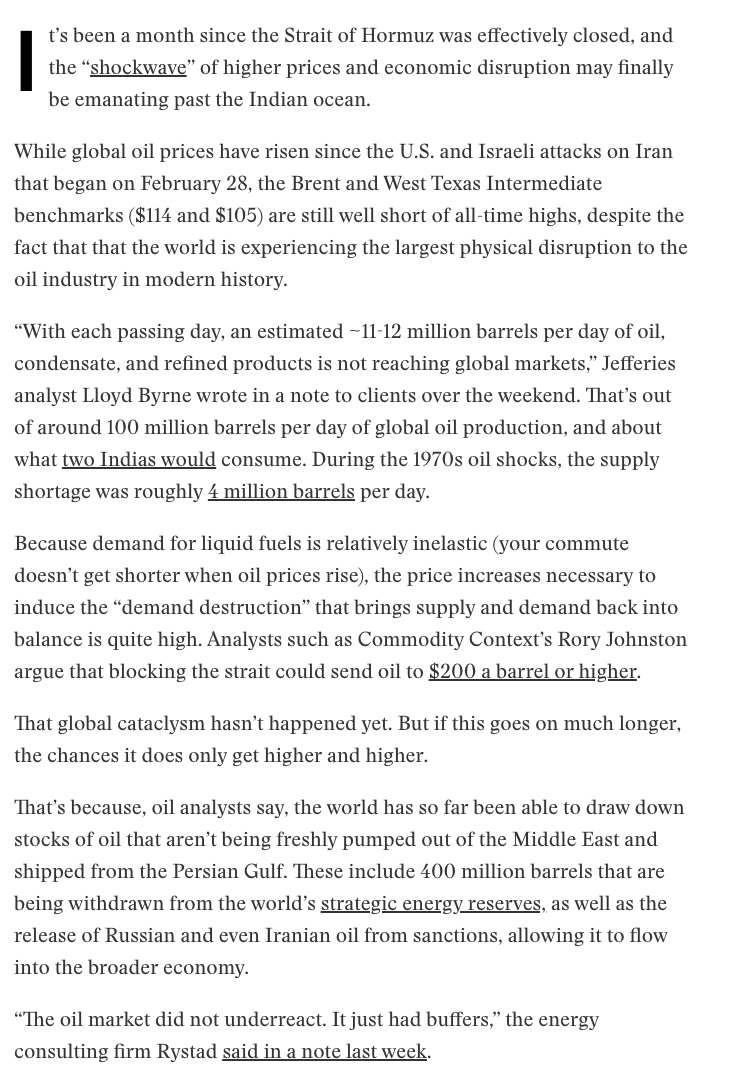
Between the strategic reserve releases and the unsanctioned oil, the oil market was able to buy about a month of time before the real high prices, shortages, and demand destruction begin...
🚨 THE DOMINOES ARE FALLING. IN MONTHS, NOT YEARS.
Powell just confirmed what bond traders have known for years:
The US debt spiral is UNSTOPPABLE without immediate action.
"It will not end well." — Jerome Powell, Fed Chair, 2026.
Here's the exact timeline of how this ends:
Step 1 ✅ Debt grows faster than economy — CONFIRMED TODAY by Powell
Step 2 ✅ Annual interest payments hit $1,000,000,000,000+ — ALREADY HAPPENED
Step 3 ✅ Two credit rating agencies (S&P, Fitch) already downgraded US debt
Step 4 ⏳ Congress deadlocks on spending cuts — HAPPENING NOW
Step 5 ⏳ Japan and China slow their Treasury purchases
Step 6 ⏳ Bond market vigilantes strike — 10-year yield spikes past 6%
Step 7 ⏳ Mortgage rates hit 9-10% — housing market freezes
Step 8 ⏳ Fed forced to choose: let yields spike OR monetize debt
Step 9 ⏳ Either path triggers a financial crisis
Step 10 ⏳ Social Security stress arrives years ahead of schedule
Step 11 ⏳ Dollar starts losing reserve currency status
Step 12 ⏳ The biggest debt crisis in human history arrives
Steps 1-3 already happened.
Steps 4-7 will happen within months.
Steps 8-12 by end of the decade.
When the Fed Chair says "it will not end well" — that's not a warning.
That's a forecast.
Bookmark this. Screenshot this. Come back in 90 days.
People are starting to realize how large of a crisis this oil, fertilizer & helium shock is to the global economy
It's basically 2020 lockdowns, 2008 credit bubble, 2001 tech bubble, 1970s oil shock all wrapped into one. The only comparable period is the great depression of 1929
🇺🇦🇪🇺 Sönke Neitzel liefert eine Einschätzung, die einem den Atem raubt:
"Der EU-Verteidigungskommissar hat neulich eine Studie vorgestellt, die letzlich forderte: Wir Europäer müssen die Unterstütungsleistung für die Ukraine verdoppeln, dann wäre die Ukrainer in der Lage auch wieder offensiv zu werden" -
"nur das Problem ist, das wird man in Europa nie durch bekommen. Denn die Europäer, die die Ukraine unterstützen, sind gerade mal 9 Staaten: Die baltischen Staaten, die nordischen Staaten, die Niederlande, Deutschland und Polen"
"Und das ist das Bittere, dass dieser Kontinent mit 450 Millionen Einwohnern nicht willens ist, für den Luftschutz der Ukrainer zu sorgen." -
"Also der Befund ist: Die Europäer wollen offenbar nicht."
Sophisticated drones attacked Louisiana's Barksdale bomber base
It is the first time a US airbase was temporarily put out of operation in wartime, something that never happened even in World War II. https://t.co/Xb9YoOVvfn
The man who manages $11 trillion just said two words that should terrify every person on the planet.
"Global recession."
Larry Fink, CEO of BlackRock, the largest asset manager in human history sat down with the BBC and laid out the scenarios.
Fink told the BBC there are only two possible outcomes for the global economy right now.
His exact words: "There's not going to be an outcome that's somewhere in the middle."
Outcome one is that Iran gets reintegrated into the global community, sanctions ease and Iranian oil and Venezuelan oil flood back into markets.
Then the oil drops below $40 a barrel, the world gets relief.
Outcome two is that Iran remains a threat, the Strait of Hormuz stays disrupted and the standoff stretches on for years.
Oil stays above $100 and pushes toward $150.
The result? A "stark and steep global recession."
Why does $150 oil collapse the world economy? Because oil is embedded in everything.
Food production, shipping, manufacturing, heating., fertilizer, chemicals and plastics.
When oil spikes, prices spike across every single category of human life.
Central banks raise rates to fight inflation, businesses freeze investment and consumers stop spending.
Also, jobs disappear, GDP craters and the cycle feeds itself.
There is no bailout for this and no rate cut fixes an energy shock.
Fink also made a point that high oil prices are a "very regressive tax."
The wealthy absorb higher energy costs while the poor cannot.
This hits grocery bills, rent, and transportation everything the bottom half of the global population depends on to survive.
The market is still pricing in hope, a resolution, a deal, a ceasefire.
Fink is pricing in reality, two extremes, and the clock is running.
Pay attention to this one.
Closure of Strait of Hormuz isn’t just an energy shock—it ripples through chemicals, fertilizers, and food systems. 🌾 Developing countries face the harshest impact, with welfare losses 10–20x higher than in advanced economies. New Kiel Policy Brief 👉 https://t.co/fOVPTnDnSj
I hope no one needs an MRI this year.
The world's largest producer of liquified helium is in Qatar and is shut off. We just got a notice that our supply for the year will be at least cut in half.
No one could have predicted this (unless they thought about it).
$3 trillion moved in 56 minutes on two statements.
Trump said “productive conversations.” The S&P added $2 trillion. Iran said “no contact.” The S&P erased $1 trillion.
During those 56 minutes, the Strait of Hormuz did not open. Not one tanker moved. Not one barrel of crude loaded. Not one tonne of fertiliser shipped. Not one litre of helium reached TSMC. The 40 energy assets the IEA confirmed destroyed this morning are still destroyed. Primorsk is still burning on the Baltic. The planting window in South Asia still narrowed by another six hours.
$3 trillion repriced on words. Zero molecules repriced on reality.
This is the war now. Two men post on social media. Algorithms move trillions. The strait stays closed. The molecules do not read Truth Social. The molecules do not read Iranian state media. The molecules wait.
https://t.co/iFmUcar8on
🇺🇦💪🧐
Ukraine’s geopolitical strike
Last night, Ukraine carried out an extremely important strike that should be called geopolitical, not just military: around 50 Ukrainian drones (according to official Russian data) hit the port of Primorsk in the Leningrad region (in Russia everything is upside down: there is no city of Leningrad, yet the region is still called Leningrad).
Why is this important?
First of all, it demonstrates Ukraine’s military capability — in this case not defending, but attacking: Primorsk is 920 kilometers from Ukraine. And clearly, they weren’t launched from right next door either.
It is also important because this port handles about 60% of Russia’s seaborne oil exports. It is critically important for the Russian budget, which is largely built on the sale of fossil and extractive resources.
But the most important thing is something else: the strike happened precisely at a time when, due to Trump’s erratic actions, a global oil/fuel crisis has emerged, and Russia has a chance to profit from the war unleashed by Israel. Ukraine is disrupting this “business deal” between the regimes of Putin and Netanyahu. And it is clearly not listening to the United States (remember how under Biden Ukraine was asked not to strike Russia’s oil infrastructure because gasoline in America might rise by one cent?). Because from Trump’s United States, for a year now, we have received neither weapons, nor funding, nor even moral support (those obsessively repeated complaints by Trump that Ukraine does not want to sign a peace deal — meaning capitulation — are already stuck in the artificial teeth of the “Red Coyote”). I suspect that even if we are receiving intelligence from the U.S. (Macron said only 25%), it is not thanks to Trump, but thanks to sober-minded leaders within some U.S. intelligence agencies (there are 25 of them in America!).
Thus, Ukraine is fighting while simultaneously reshaping concepts, perceptions, and evaluations — returning to the Gospel principle: “let your ‘yes’ be yes and your ‘no’ be no; anything beyond this comes from evil.”
And the cherry on top — for the second day, Pulkovo Airport has not been operating. Because of our drones. This also means losses for Russia and gives residents of Saint Petersburg a sense that Putin’s regime does not guarantee their safety.
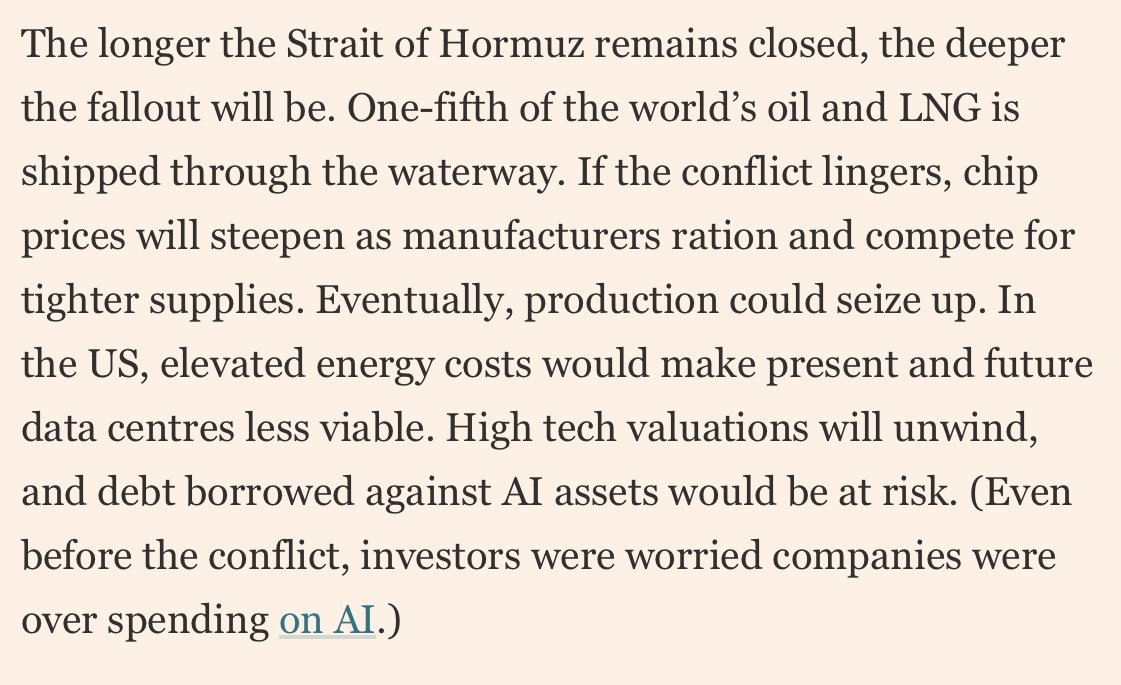
The FT now reporting that, even without the energy shocks, there's a pretty good chance that the closure of Hormuz will pop the AI bubble and lead to a stock market crash
What if Iran could trigger a crash in the U.S. economy using strategies nobody is paying attention to?
Professor Jiang Xueqin explains the hidden game.
🚨There are 3,200 ships carrying 20,000 mariners TRAPPED in Strait of Hormuz who have RUN OUT of water and food and who have been REFUSED access to restock.
Whilst the world watches ….. many fail to see the disaster unfolding in plain sight.
Let that sink in 😔👇
The news that Orbán’s people inform Moscow about EU Council meetings in every detail shouldn’t come as a surprise to anyone. We’ve had our suspicions about that for a long time. That’s one reason why I take the floor only when strictly necessary and say just as much as necessary.