Interested in Productivity, PR Comms, Digital Writing?
Over the next 30 days, I'll be writing 30 Atomic Essays.
Follow my Social Blog on @typeshare_co:
https://t.co/FYWj5pxk9R
@alloysiusattah@gyaigyimii Pressure on the power grid and driving prices up for the rest of industry due to higher demand, depletion of clean water sources used to cool the chips powering AI, brainbdrain and dumbing down and subversio of intillegigence etc etc
This has now gone beyond what is acceptable. Harare has been allocated all the Zimbabwe versus India matches and now all the Australia matches.
I am outraged that Queens in @CityofBulawayo has not been allocated a single match out of the 6 which will be played.
Please would @ZimCricketv advise how this is deemed acceptable. I trust that @ZimbabweSrc will investigate this.
Serious industrial nations don’t take accountants as seriously as South Africa does.
In industrialising nations, like Vietnam and surrounding states, for instance, the most prestigious roles are found in engineering or industrial management because the economy is physically building things.
Meanwhile, in South Africa, SAICA’s CA(SA) is viewed as the ultimate golden ticket.
But it’s not only in developing/industrialising nations where accountants take a back seat. In the US, Germany and Japan, CEOs are generally product people or engineers, while in South Africa, a massive percentage of JSE-listed CEOs are chartered accountants.
The reason for this is that the South African economy has been deindustrialising for decades, so the existing companies don’t grow by inventing new things or expanding production. They “grow” through the financial engineering of mergers, acquisitions, cost-cutting, and “tax optimisation”.
The consequence of this is that if you compare SA to an employment-dense industrialiser like Vietnam, you find that the latter focuses on vocational excellence. Over there, an accountant is just a back-office functionary who supports the factory. The hero is the plant manager who meets a production quota.
But South Africa, to its detriment, is obsessed with compliance excellence. The factory, if it even exists, is a “risk” to be managed, and the chartered accountant is the high-priest who tells the board if that risk is acceptable.
By taking accountants this seriously, South Africa has perfected the art of measuring value, but has neglected the art of creating real tangible value.
The worship and adoration of the CA(SA) is a symptom of a services-led economy that has skipped the labour-intensive industrialisation phase, and this is primarily why the unemployment epidemic cannot be resolved.
Not to be THAT dictionary, but…
It’s ‘per se,’ not ‘per say.’
It’s ‘dog-eat-dog world,’ not ‘doggy-dog world.’
It’s ‘hunger pangs,’ not ‘hunger pains.’
It’s ‘one and the same,’ not ‘one in the same.’
It's 'buck naked,' not 'butt naked.'
Do you know that French-speaking countries in Africa take $500 million in loans every year just to buy school books from France?
Not laboratories, not research centers, not teachers’ training: poor quality school books filled with caricatured faces of Africans and racial slurs. Borrowed money, disbursed directly to French publishing houses, in exchange for textbooks written in Paris, printed in Paris, and shipped to African children who will spend their entire education believing this is normal. According to French state media @lemondefr in an article published 12 years ago, the same French parent company, Hatier and its subsidiary Hachette, controls roughly 95% of the school manual market across “Francophone” Africa.
And how do we fund such purchases annually through loans from the World Bank. And again, am not making up. It is clearly explained in the article published by Le Monde. Our nations do not even touch the money. The $500 million are disbursed directly as loans from the World Bank on behalf of our countries to the French publishing company annually to produce and print in France poorly written, racist school books that are shipped to our countries. We are the only enslaved people on the planet that take loans with interests to subsidize our own enslavement.
I am telling Angola this because Angola just made French compulsory in its primary schools from age ten. And I want to be precise about what it has joined, because imprecision is exactly what keeps these arrangements alive. Two years ago, Macron stood in front of cameras and presented a government memo laying out exactly how Paris intended to arrest its accelerating loss of influence across Africa. The remedy prescribed was linguistic and cultural penetration of non-Francophone countries. Angola and Ghana were designated priority targets. João Lourenço and Nana Akufo-Addo were identified as men whose cooperation could be secured. France came bearing curricula, resources, and a check. Both men apparently found the terms reasonable although may be luckily for Ghana, it is yet to be deployed.
Here is what is worth understanding about that check: France is not being generous. France is being desperate. The survival of French hegemony depends, structurally and existentially, on maintaining influence in Africa. 70% of all French speakers on earth live on this continent, concentrated in some of the poorest countries in the planet. Without Africa, the “Francophone world” is a provincial club with a prestigious accent and a shrinking membership. France does not “invest” in African language education because it loves Africa. It does so because without Africa, France is a medium-sized European country with a permanent UN Security Council seat it would struggle to justify.
And Angola, a country whose economy is now robust enough that Portuguese nationals emigrate there looking for work, decided that the gift it would give its ten-year-old children is access to a linguistic corridor that covers less than 8% of global scholarship and connects them to none of their SADC neighbors. South Africa, Zimbabwe, Zambia, Tanzania: all English-speaking. The pragmatic choice, setting aside entirely the more principled argument for an African language, was obvious.
The saddest part is not that France keeps trying. France’s self-interest is consistent and entirely predictable. The saddest part is that some of our leaders keep making it so effortless for Paris to buy our dignity.
A video from Tanzania shows a virgin woman jumping over a dying horse three times, and the animal revived. Local belief holds that if a very sick animal is jumped over by a virgin girl, it can recover.
Since we are in the mood to Amend the Constitution, how about we amend the recall clause on Members of Parliament under Section 129 to allow the people of 🇿🇼 to recall their non-performing MPs from @ParliamentZim.
Right now, under the Constitution of Zimbabwe, MPs can effectively be recalled mainly through party mechanisms.
Here is a proposed draft clause: Right to Recall a Member of Parliament.
Right of Recall
Registered voters in a constituency shall have the right to recall their elected Member of Parliament before the expiry of their term of office, in accordance with this section.
Grounds for Recall
A recall may be initiated on any of the following grounds:
(a) Gross misconduct or abuse of office;
(b) Failure to perform parliamentary duties, including persistent absenteeism without reasonable cause;
(c) Violation of the Constitution or any law;
(d) Loss of confidence by the electorate, demonstrated in accordance with subsection (3).
Initiation of Recall Petition
A recall process shall be initiated by a petition signed by not less than [20%–30%] of registered voters in the constituency.
Verification and Referendum
(a) The electoral body shall verify the petition within a prescribed period;
(b) Upon a successful verification, a recall referendum shall be held within [60–90] days;
(c) The Member of Parliament shall be recalled if a majority of valid votes cast support the recall.
Limitations
(a) No recall petition shall be initiated within the first 12 months or last 12 months of a parliamentary term;
(b) A member of Parliament shall not be subjected to more than one recall process within a 12-month period.
Vacancy
Where a Member of Parliament is successfully recalled, the seat shall be declared vacant, and a by-election shall be held in accordance with electoral law.
As it stands there is an ongoing survey to measure people's perceptions on this, see below👇🏾
https://t.co/XKF4mPx7l5
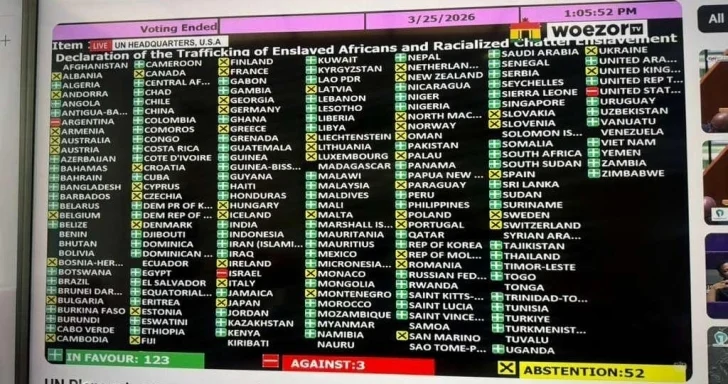
His country was one of just 3 to vote against today's UN resolution to recognise the Transatlantic slave trade and chattel slavery of Africans as a historical crime against humanity.
They just voted against our ancestors, but they care about us you see🥹
Whenever you wake up...
All dominant civilisations and empires rise and then fall, this is a law of nature.
But somehow, the West believes that it can prevent this from happening to itself by “studying history” and “learning” from the past.
Westerners genuinely hope that if they can just learn to not repeat the mistakes made by past empires, their hegemonic dominance can somehow last indefinitely.
Unfortunately, the reality is that the very things that make a civilisation great, eventually become liabilities, and there’s no opting out.
Take the United States, for example. It became a global hegemon through the dollar being the reserve currency. The problem is that when your currency is the global reserve, capital markets become your primary export, finance becomes more profitable than making things, talent and investment flow accordingly and the industrial base hollows out over decades.
America’s deindustrialisation caused by the dollar is now eating the US and the country cannot reindustrialise without losing its hegemony; but at the same time, continuing down this path of financial short-termism will guarantee loss of the hegemony. Rock and hard place.
Trump’s tariff agenda is an attempt to escape this trap through pure political will and essentially ignoring the financial consequences. The early evidence suggests the trap is real and the financial markets will not cooperate.
This is because to reindustrialise, the US would need a weak dollar to make exports competitive. But a weak dollar ends the reserve currency status. Ending the reserve currency status means the US government can no longer finance its military or social stability with mountains of cheap debt.
The underlying point is that all dominant civilisations wither away because the structural conditions that enable their dominance eventually become liabilities.
Rome didn’t lose dominance because Romans made avoidable errors, as many Westerners like to believe. Instead, Rome was trapped by its military system.
Roman legions were the source of dominance, but funding them required taxation that strangled the provincial economies that produced the tax base. Every attempt to cut the military weakened the borders, while every attempt to maintain it weakened the interior. Catch and 22.
So, the decline of empire is not about mistakes. The US didn’t necessarily err by making the dollar the reserve currency. The dollar system solved real problems such as rebuilding post-war Europe, and for the US, allowed it to expand its own economy and empire astronomically.
In this sense, the eventual decline of the American system was built into the success from the beginning. So, “learning from history” is doomed to fail. The West’s insistence that it can “learn from the fall of Rome” is a coping mechanism against a physical inevitability.
There’s nothing to learn, because there was never a fork in the road where a wiser choice was available.
Libya negotiated.
Let's be precise about what happened to Libya.
In 2003, Muammar Gaddafi made a strategic decision to abandon his weapons programs, open his country to international inspectors, and normalize relations with the West.
He paid reparations for Lockerbie.
He dismantled his nuclear program.
He cooperated with Western intelligence against Al-Qaeda.
He did everything that was asked of him.
He negotiated. He complied. He normalized.
In 2011, NATO bombed Libya for seven months.
His own military turned against him with Western backing.
He was captured in a drainage pipe.
A mob sodomized him with a bayonet while Western officials watched via satellite feed.
Hillary Clinton laughed about it on camera.
"We came, we saw, he died."
The man who gave up his deterrent in exchange for promises of security and normalization died in a drainage pipe while the people who made him those promises laughed at the footage of him being sodomized with a bayonet.
And Libya, which had the highest GDP per capita in Africa, free healthcare, free education, housing subsidies, and a functioning welfare state, became a failed state with open slave markets within three years.
This is what negotiated security guarantees look like.
This is the documented outcome.
Not a fringe case. Not a misunderstanding.
The most complete, unambiguous illustration possible of what your weapons are worth the moment you give them up.
The lesson is not complicated.
The only deterrent is a deterrent you still possess.
The moment you negotiate it away, you have nothing left to negotiate with.














![NtateRanaka's tweet photo. Since we are in the mood to Amend the Constitution, how about we amend the recall clause on Members of Parliament under Section 129 to allow the people of 🇿🇼 to recall their non-performing MPs from @ParliamentZim.
Right now, under the Constitution of Zimbabwe, MPs can effectively be recalled mainly through party mechanisms.
Here is a proposed draft clause: Right to Recall a Member of Parliament.
Right of Recall
Registered voters in a constituency shall have the right to recall their elected Member of Parliament before the expiry of their term of office, in accordance with this section.
Grounds for Recall
A recall may be initiated on any of the following grounds:
(a) Gross misconduct or abuse of office;
(b) Failure to perform parliamentary duties, including persistent absenteeism without reasonable cause;
(c) Violation of the Constitution or any law;
(d) Loss of confidence by the electorate, demonstrated in accordance with subsection (3).
Initiation of Recall Petition
A recall process shall be initiated by a petition signed by not less than [20%–30%] of registered voters in the constituency.
Verification and Referendum
(a) The electoral body shall verify the petition within a prescribed period;
(b) Upon a successful verification, a recall referendum shall be held within [60–90] days;
(c) The Member of Parliament shall be recalled if a majority of valid votes cast support the recall.
Limitations
(a) No recall petition shall be initiated within the first 12 months or last 12 months of a parliamentary term;
(b) A member of Parliament shall not be subjected to more than one recall process within a 12-month period.
Vacancy
Where a Member of Parliament is successfully recalled, the seat shall be declared vacant, and a by-election shall be held in accordance with electoral law.
As it stands there is an ongoing survey to measure people's perceptions on this, see below👇🏾
https://t.co/XKF4mPx7l5](https://pbs.twimg.com/media/HEV8HyFXQAAcyXj.jpg)