Sri Lanka to Introduce Extended Producer Responsibility Law for Plastic & Polythene
♻️ Plastic and polythene producers will be legally required to collect and take back their own product waste to prevent environmental pollution.
♻️ Mandatory Collection Targets:
● Year 1: Collect 50% of production
● Year 2: 60% of production
● Year 3: 80% of production
♻️ The bill will be presented in the next Parliamentary session.
🌱 Producers will now be held accountable for the plastic waste they create.
#SriLanka #environment
Have you ever thought about this "funflation?"
Like, the little fun things you did years ago cost much much more now? Like, maybe you went to this adventure. Say, Disney World? Even adjusted for inflation, it shouldn't be this high. Fun stuff are getting exponentially expensive.
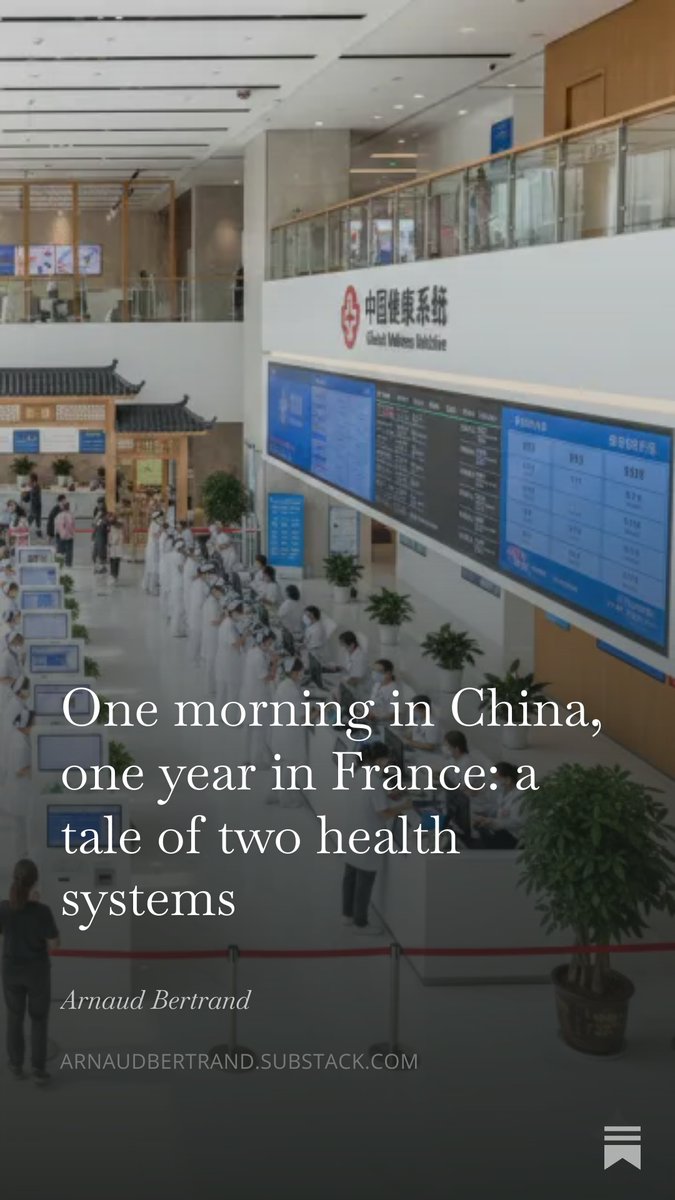
I've been wanting to write this for a while: an article on the key characteristics of the Chinese health system, as a patient.
It's something that I - perhaps unfortunately - have come to have a lot of experience with in my eight years in China.
I've been to the doctor as a patient dozens of times. My wife delivered our first daughter in a Chinese hospital, and had cancer surgery in Shanghai. My younger daughter - who once completely severed her thumb in an unfortunate accident in rural Gansu - had emergency surgery in a small clinic there (her thumb is fine now!). We spent the entire covid episode in China. And, to this day, I still go back to China every year to do my routine health tests or the occasional procedure (like a thyroid biopsy in Harbin last year).
In other words, when it comes to the Chinese health system, I've seen a lot.
What's fascinating about the Chinese health system, and that's true in general about many things in China, is that it never inherited Western dogma about how things were supposed to work, it's completely unconstrained by what everyone else has decided is "normal".
And, as a result, you end up with things that would simply sound impossible to any Western patient: a consultation with the head cardiologist of one of Shanghai's best hospitals for less than $10, blood test results in under 30 minutes, and a system where you can walk in, see three specialists and walk out with a diagnosis and your medicine - all before noon.
As I argue in the article that's all enabled by 3 characteristics that sound super unorthodox:
1) extremely short consultation times, less than 5 minutes
2) no GP gatekeepers (you go straight to see specialists)
3) systematic testing for every patient, even if you just have a cold
Each one sounds wrong. And in fact when I describe them to doctor friends in the West they immediately explain to me why that can't possibly work, and how their own system is far superior.
Except that it does work, I checked the numbers (on top of my personal experience): the Chinese system handles close to 10 billion total outpatient visits a year (https://t.co/b1xd45O73F), or about 7 visits per person per year on average, and the average wait time is only about 18 minutes (https://t.co/S3At5DtbJP).
Contrast this with France, my country, where people already go to the doctor A LOT, but still less than in China: only 5.5 visits per person per year (https://t.co/sk1kQt59tK). And the French system can't even handle this lower volume: when you can see a specialist straight away in China - you don't even need to make an appointment in advance - you need to wait months to see one in France (50 days on average for a cardiologist, for instance: https://t.co/ZKZmhzoFFO).
I've personally managed to see 3 specialists AND do all related tests AND get the test results AND get diagnoses AND buy the medicine to cure me - all in the space of a morning at a hospital in Shanghai. That would have undoubtedly taken me a whole year in the French system.
My purpose here is not to argue that the West should replicate the Chinese health system wholesale, but to ask an honest question: what if some of the things we take for granted about healthcare aren't nearly as inevitable as we think? Is it completely unthinkable that we've developed some dogmas that are costing us - in money, in time, and occasionally in lives?
That's the whole point of my article: describing a health system built from first principles by people who never assumed we in the West knew better - up to you to decide if they have a point.
Enjoy the read here: https://t.co/cNXNmo195l
Not a single week goes by without seeing a young MI or stroke ( under 40) 🥺many of them are in high stress , sedentary jobs chasing monetary dreams, caught in a spiral of competitive consumerism. Perhaps we need to reject the hustle culture and consciously slow down.
Why the NHS is failing #826363839
1. Fragmentation of care.
It’s almost impossible to read a clinical story in GP notes now. It’s messages and anima requests and “failed encounters” when someone can’t answer the phone. (1/n)
Just realized a harsh truth:
Epstein s "documentation" of his criminal activities is more meticulous than our documentation of patient data in electronic health records 😐
I am the only person in my family that can torrent. My parents couldn't and my children don't have to. All this knowledge will die with me. Like tears in rain.
Taika Waititi deliberately chose not to show Rosie’s hanging in Jojo Rabbit (2019).
“I don’t like the idea of seeing people hang,” he said adding that the audience hadn’t earned the right to witness the death of someone the film asks you to love.
THE RIGHT SIDE UP:
We often hear: "Government meds are weak" or "Cheap meds don't work."
This is false.
Our lab data proves that Indian generics match the quality of premium brands. Don't let marketing fool you. The molecule doesn't care about the brand name on the box.
Your health deserves quality.
Your wallet deserves fairness.
This large scale study proves that in general:
Generics ≠ Inferior
We tested. We verified. The results are undeniable.
EVERY. SINGLE. PILL. PASSED.
Whether it was a ₹61 liver tablet from a big brand or a ₹16 one from Jan Aushadhi - they ALL met the strict Indian Pharmacopoeia standards.
Zero failures. The cheap meds worked just as well in the lab.
Please share and RT to help your family & friends save tens of thousands on medicines!
11/11
Only 2 moods in MBBS:
- love every aspect of medicine,I love every bit of it and want to learn more and dedicate my life to it’s advancement.
- F*ck this sh*t,this course is taking my youth,the best years of my life- these sacrifices aren’t worth it.
Talk about a toxic relationship 😭