Today, new Stroke Guidelines were published. They include an update to the classic CHANCE/POINT protocol, but the flowchart may be confusing at first glance.
I built an interactive version to simplify!
Australia just recorded zero cervical cancer cases in women under 25 - for the first time since records began in 1982.
This is what happens when a country commits to HPV vaccination and screening. We protect our girls and save lives.
Dublin has opened its first dementia-inclusive shopping centre! Congratulations to our friends at @alzheimersocirl on this milestone in Ireland’s journey toward dementia-inclusive communities
https://t.co/frmm5IpOxy
Neuro-ophthalmology has two divisions
Afferent - vision
Efferent - eye movements
Efferent neuro-ophthalmology has 6 supranuclear control systems
There are 6 systems of supranuclear control
1. Saccade
2. Pursuit
3. Vergence
4. Fixation - microsaccade, microtremor and microdrifts
5. Vestibulo-ocular reflex (talking only about angular VOR here)
6. Optokinetic nystagmus (OKN)
[slow OKN = slow phase and fast OKN = fast phase]
Why do we need 6?
For that we have to go back to evolution.
The earliest animals had only vision WITHOUT a fovea which is the point with the highest visual acuity in the retina --> this was around 520-500 million years ago
So they needed to keep only the visual field in line with the head since there was no fovea!
So they developed the angular VOR and the OKN which had two different functions
VOR --> head movement WITHOUT movement of visual field
OKN --> only visual field moves WITHOUT head movement
But these usually operated together since most situations had simultaneous movement of the head and visual field
Around 450-400 millions ago, the fovea began to emerge --> this allowed fixation and much better visual acuity
Fixation --> keeping the object of interest on the fovea for maximum vision
Fixation involves miniscule movements called micro saccades, microtremors and microdrifts which help keep the object on the fovea --> these miniscule movements allow phototransduction rather than maintain fixation (that is a different issue altogether)
But how to maintain fixation on an object when the head of the animal is constantly moving?
Pursuit --> this moves the eye along an x and y axis
Vergence --> this maintains fixation along a z axis
Now what to do if we want to break fixation and focus on a new target?
We have saccades!
Now what about the older supranuclear systems of VOR and OKN?
They do well with fixation but they have evolved for at least 100 million years where they did not have fixation!
So they can do WITH and WITHOUT fixation.
In conclusion
VOR and OKN --> maintains visual field with and without fixation
Pursuit and vergence --> essential to maintain fixation
Saccades --> essential to break up fixation and acquire new fixation
This is a heavily simplified account of the evolutionary basis of eye movements!
#MedTwitter
#NeuroTwitter
#Neuroophthalmology
#EyeMovements
Time to go with the flow!
Knowing vascular anatomy is the first step to reading any angiogram
These are the key vessels you need to know!
Then I always remember to check for pathology using the mnemonic ANGIO to remind me what to look for:
A = aneurysms, arteriovenous malformations
N = Narrowing (atherosclerotic narrowing)
G = Globules (globular or beaded appearance in vasculitis or RCVS)
I = Irregularity/dissction
O = Occlusion (large vessel occlusion for endovascular)
So now you know the anatomy & pathology to look for angiographic studies!
Hopefully, now you will never have to circle back on a study of the circle of Willis!!
Michael Vaughan exposes BCCI, how this World Cup is made for India to win, how India already know where to play, which teams to play, and when to play 🇮🇳🤯
@MichaelVaughan got some serious guts, massive respect to him for speaking out ❤️ #T20WorldCup
TEMPO2: TNK (0.25mg/kg) vs BMT for minor strokes 💉 Trial reported neutral results on return to baseline function with ⬆️ sICH and mortality in the TNK group ❌️ Older & female pts might benefit more from BMT
#ESOC2024#VoiceOfStroke
🔥Day 1 Large Clinical Trials Summary🔥 #ESOC2024@ESOstroke@WorldStrokeOrg@wfneurology@CSC_Stroke@American_Stroke Colchicine, TNK, Polypill, Primary stroke centres getting Advance imaging, decompressive craniectomy in deep ICH, and Andexanet will impact our practice. Congratulations to all the presenters.
#BMJResearch Among hospital patients with at least one episode of delirium, the risk of receiving a new dementia diagnosis was 3 times higher than for patients without delirium and each additional episode of delirium increased that risk by 20%
@DrEHGordon
https://t.co/yQuwBgxS3Z
Antipsychotics used too often as a first-line response to difficult behaviour in #dementia (most often agitation) rather than as a considered second-line treatment when other non-pharmacological approaches have failed via @NHSEngland https://t.co/Uwi56XZCd5 #BGSconf
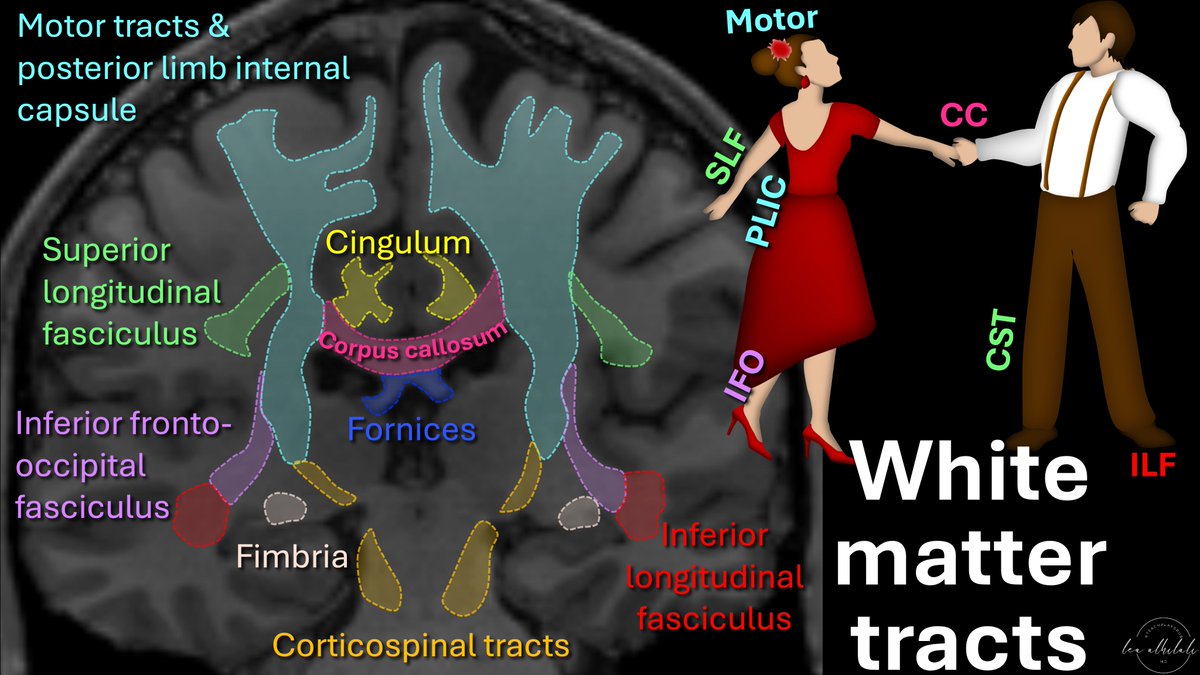
Looking for a white knight to help you remember white matter anatomy?
Do questions about white matter make you turn white as a ghost?
Well, here’s a white-hot way to remember it!
Coronally, major white matter tracts look like 2 people dancing—can you see it?
Let me explain!
🌟Here’s how to remember the major tracts🌟
➡️Motor tracts/Posterior Limb of the Internal Capsule/Corticospinal tract:
🔸Corticospinal tract goes through your CORE & SPINE.
🔸It's the body of the dancers going all the way down to the medial feet they balance on
➡️Corpus Callosum:
🔸Letter C looks like hand reaching to grab—it is the two hands reaching in the middle
➡️Superior Longitudinal Fasciculus:
🔸What is superior & long in your body—your arms! 🔸Superior longitudinal fasciculus are the arms of the dancers reaching back
➡️Inferior fronto-occipital fasciculus & Inferior longitudinal fasciculus
🔸What’s inferior & long in your body—your legs! 🔸These are the back leg of the dancers.
🔸Inferior longitudinal fasciculus is the foot bc LONG means it’s the longest or farthest away from the body
So now you can always find the major white matter tracts on a coronal image! Hopefully, now you can be right about what’s white!