#dermresidents: I've been compiling playlists of dermatology-related lectures/grand rounds presentations on YouTube to supplement residency program didactics & provide add'l info/perspectives on various topics in dermatology. You can find them at https://t.co/i9HXqRT505
I’ve been thinking that maybe the best benchmark to truly identify AGI is the ability to accurately simulate the real world & human behavior, sort of like a modern Turing test.
@claudeai beating @Pokemon Red in 50 mins is a step towards that, for me.
https://t.co/UxfuycLxkk
Have definitely experienced this with AI scribes. The task shifts from writing to editing, from piecing the story together to supervising the bot’s version thereof.
Cognitive offloading and the speedup illusion in human-AI interaction
Sunny Yu, Myra Cheng, Ahmad Jabbar, Ilia Sucholutsky, Katherine M. Collins, Dan Jurafsky, Robert D. Hawkins
https://t.co/9pvuG5Kt2N [𝚌𝚜.𝙲𝚈 𝚌𝚜.𝙷𝙲]
@MilksandMatcha building multi-agent tools for real clinical workflows and medical education; using agents to:
- coordinate LLMs/VLMs for decision support
- run “teaching agents” to generate cases, explanations, & quizzes for trainees
- fine-tune models for medical use cases
Thanks to @EricTopol for highlighting our latest study, which looks at some of the failure points in the clinical reasoning performance of reasoning models.
What does this mean for the future of diagnostic decision support? And can LLMs actually medically reason?
A 🧵⬇️
#dermresidents: I've been compiling playlists of dermatology-related lectures/grand rounds presentations on YouTube to supplement residency program didactics & provide add'l info/perspectives on various topics in dermatology. You can find them at https://t.co/i9HXqRT505
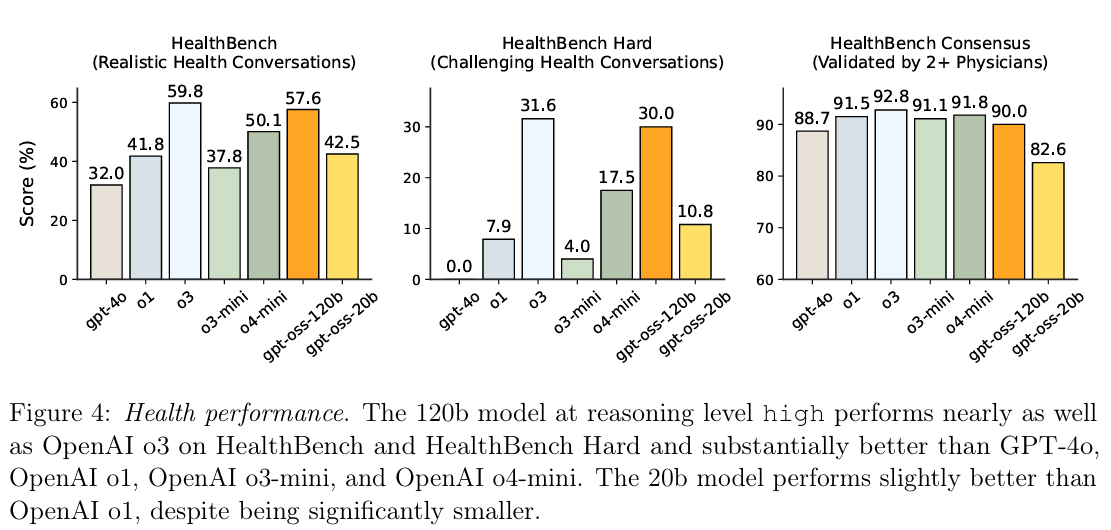
OpenAI's open source models are bringing a fundamentally new era in medical AI.
We now have an o3-level model that can run locally, HIPAA compliant. All previous medical LLM publications are obsolete.
Reviewed a Step 1 question today on MEN 2A syndrome, a rare genetic disorder that runs in families. I am glad the boards test students on this because doctors should recognize rare conditions and not just think of common stuff. But the question asked the student to identify *from memorization* the exact gene mutation that causes MEN2A and know its cellular effects. To me, this is ridiculous. This can be easily looked up. Why are we testing students in this way in the modern era? If someone can justify this type of question please let me know. I can’t see the logic of how this helps make better doctors. In fact, it promotes rote memorization which may actually be a bad thing in an era when information changes so rapidly.



![WGOV's tweet photo. Cognitive offloading and the speedup illusion in human-AI interaction
Sunny Yu, Myra Cheng, Ahmad Jabbar, Ilia Sucholutsky, Katherine M. Collins, Dan Jurafsky, Robert D. Hawkins
https://t.co/9pvuG5Kt2N [𝚌𝚜.𝙲𝚈 𝚌𝚜.𝙷𝙲] https://t.co/MP2VFqSqul](https://pbs.twimg.com/media/HJKMK03WkAAeDcv.png)