El otro día me enteré que esto existía y me ha ayudado a consolidar la idea de lo malvado que es el azúcar. Y está en todas partes. Subtitulado al castellano.
https://t.co/gNdg81B060
IBI, Patrimoni i Successions i IRPF del 40% pel que treballa per pagar tot això i després us escandalitzeu perquè els catalans es veuen obligats a vendre's el patrimoni a un americà que no competeix amb aquesta llosa. L'enveja i la ignorància econòmica han matat aquest país
As a father, I cannot stop thinking about Caitlin Clark’s dad.
He raised a daughter who represents everything parents hope their children become: humble, tough, respectful, composed, competitive, and gracious under pressure.
And now he has to watch her get assaulted and left unprotected by the very league that should be protecting her.
This is not what basketball is supposed to be about.
The WNBA has ruined it.
Tinc gossos i gats des de fa molts anys. N'he tingut a ciutat i en tinc ara al camp. I sí, a alguns els molesten molt els petards. És a dir, entenc que alguns propietaris de gossos preferirien que no hi hagués sorolls bruscos.
Ara bé, els propietaris de gossos han d'entendre que la decisió de tenir gossos és personal i, per tant, és el propietari qui ha de mirar per la salud del gos, no la resta de la humanitat. La convivència consisteix en un donar i prendre constant, i un dia tu suportes els petards i un altre dia els altres aguanten els lladrucs del teu gos, que segur que són més habituals que els petards.
Just read the Montreal mass shooter's entire 104 page manifesto. I regret to inform you that it's actually pretty interesting. Ignore any simpleton who tries to reduce his ideology to simple "left" or "right" -- or even "incel."
His main ideological belief is opposing "hypergamy," which he blames for creating a social system where most men, he claims, are heinously deprived of female romantic connection. He therefore opposes capitalism, which he views as a primary enabler of hypergamy. He praises (what he calls) communist societies such as China, North Korea, and the Soviet Union, in contrast with the "West," because he claims communist societies are superior at engendering communal structures that facilitate monogamy, wherein the average man has better access to stable female partners. He does recommend reading the works of Marx, Stalin, Robespierre, and other Left-wing revolutionaries. He also attacks conservatives for "swindling" average men by getting them needlessly focused on supporting conservative politicians, who they are falsely led to believe will support their class interests. And he opposes Christianity.
However, he also inveighs against "mass immigration," cultural degeneracy, leftists, liberals, Trans Stuff, and so on. It appears he may have targeted his mass shooting attack at the headquarters and/or CEO of a porn company (PornHub?) in Montreal. Indeed, porn companies are one of the targets he recommends his followers planning attacks against, because he regards pornography as one of the vilest contributors to male suffering and larger cultural degeneracy.
He gives advice on how to cultivate good intellectual habits (reading lots of books, giving up video games, moderate physical conditioning, firearms training) so as to best enact revolutionary violence.
Here are the ideological movements he recommends followers of his movement infiltrate, if they are not inclined toward violence, and prefer to overthrow the "hypergamy state" through legal or political methods: conservative socialism, Duginism, communism, Islamic theocracy. So those are the ideological tendencies he would regard as most compatible with his own -- particularly, I would say, "conservative socialism." He attacks both Left and Right (not uncommon with Higher IQ mass shooters) and encourages assassinating both Left and Right-wing political figures.
This guy was not some mentally ill crank like some other mass shooters, nor was he one of the guys who just copy-and-pastes a pre-existing internet brain manifesto -- see the guys who did the San Diego mass shooting a few weeks ago. He is reasonably high-intelligence and well-read. "Incel"? Sure, I guess, but I've personally never seen an "incel" manifesto that is so well-versed in political economy, history, biology, literature, and even meticulously cites peer-reviewed studies.
This was a smart guy who knew exactly what he was doing, and planned it long in advance -- although it appears he wasn't successful in assassinating the PornHub CEO. He's substantively off on a lot of the gender stuff obviously, but he clearly spent a lot of time systematically thinking about it, and putting together what has got to be the most well-written mass shooter manifesto I've read in a long time.
We have to talk about Islamophobia
There are many moderate Muslims whose beliefs are completely compatible with the West.
But there are also many Islamists who believe Muslims are better, that Sharia should be above civil law, that women and homosexuals are inferior, that leaving Islam or insulting Muhammad should be illegal...
Moderate Muslims decry them, and so should Westerners, because these attitudes are incompatible with Western values.
That's not Islamophobia: It's not against the religion
It's Islamismophobia: against the political project of Islamic supremacy
Thanks for your critique, Janet. We actually tried a couple of episodes where House (Hugh Laurie) (please put the brackets in the right place) gets it right first time, but they were only 6 minutes long. NBC weren’t happy. Then we tried some where House never gets it right and the patient dies. The audience wasn’t happy.
One could apply your trenchant analysis to other art forms: JS Bach wrote 30 Goldberg variations on the same chord structure; Frida Kahlo painted 50 portraits of herself; Henry Moore, what??
The point is, or was, variations on a theme; if all you see is hospital, medical blah blah, then it wasn’t meant for you.
Nonetheless, I look forward to your first novel!
Send the video to everyone you know showing how heinously Nowak was treated by the police in his dying moments and how the police cravenly kowtowed to his murderer.
Legacy mainstream media, same ones who wrote about George Floyd millions of times, are dead silent about Nowak.
I’m going to say this as calmly as possible:
Watching Caitlin Clark in the WNBA has become genuinely hard to stomach.
Not because she struggles sometimes. Not because she makes mistakes. Not because she gets criticized. That comes with being great.
It’s hard to stomach because it has become obvious that the league, the officials, the media, the players, and even her own organization have all decided that the most important thing is not letting Caitlin Clark become too big.
And that is insane.
This league was handed the most marketable, electric, revenue-generating player women’s basketball has ever seen, and instead of building around the moment, too many people seem obsessed with humbling her.
She gets fouled. Held. Hit. Cheap-shotted. Mocked. Targeted. Then when she reacts like a normal competitor, suddenly everyone wants to analyze her attitude.
No.
Her attitude is not the story.
The story is that a generational player is being treated like a problem by the very league she helped drag into mainstream relevance.
This reminds me of the worst kind of youth coach... the one who sees a special player, feels threatened by her talent, and slowly drains the joy out of her in the name of “teaching humility.”
That is what this looks like.
The freedom she played with at Iowa is disappearing. The fire is still there, but the joy looks damaged. The confidence looks weighed down. She looks like someone constantly fighting the refs, opponents, narratives, coaching decisions, jealousy, and a league culture that should be protecting its golden opportunity instead of resenting it.
And let’s be honest: Stephanie White has not helped.
Benching Caitlin Clark randomly when she is controlling the game tempo, or having your best shooter off the floor in critical game ending minutes when a victory is within reach is basketball malpractice. Limiting her rhythm, downplaying her greatness, benching momentum, and treating her like just another piece instead of the engine is absurd.
You do not take a player who changed the economics of your sport and manage her like you’re afraid her greatness might offend the room.
Nike deserves criticism too. Other players get signature shoes rolled out with urgency, while the biggest draw in women’s basketball is somehow still waiting on that signature shoe. That is not confusing. That is revealing.
Fans are not stupid.
They see the fouls.
They see the double standards.
They see the jealousy.
They see the media resentment.
They see the league benefiting from her popularity while refusing to fully embrace her.
And here is the part the WNBA better understand quickly:
People are not tuning in to watch Caitlin Clark be humbled.
They are tuning in to watch Caitlin Clark be great.
If she walked away tomorrow, the fans would follow her. The sponsors would follow her. The energy would follow her. The high salaries and the charter jets would follow her. And the league would be forced to confront the uncomfortable truth it keeps trying to avoid:
Caitlin Clark did not need the WNBA nearly as much as the WNBA needed Caitlin Clark.
At some point, her family, her agent, and her team need to ask a hard question:
How much longer do you let a league profit from her while allowing the culture around her to beat the spirit out of her?
Because from the outside looking in, this does not look like normal adversity anymore. It looks like abuse.
It looks like a league trying to break the very player who made millions of people care.
https://t.co/AAxFrO46Z4
@edugaresp Según el estudio:
"our findings do not imply that shifts in housing supply will have no effects on prices or quantities"
“Some, of these papers find evidence that new construction reduces rent growth in the affected area. Our results are not in conflict with these papers.”
Això és exactament el que denuncia @robertamsterdam
Hisenda et reclama primer tots els diners i, si no ets milionari, et deixa sense recursos per defensar-te i recuperar-los.
Però, quan algú s’ho pot permetre, com Shakira, aconsegueix que li retornin els diners, més interessos i costes, que acabem pagant entre tots, mentre el funcionari ja ha cobrat el bonus.
Quan polítics i funcionaris no assumeixen cap conseqüència per possibles prevaricacions, es genera aquesta perversió: ells ja han cobrat el bonus, mentre la ciutadania assumeix el cost de tot plegat.
A chemistry professor posted a bonus question to an exam...
Is Hell exothermic (gives off heat) or endothermic (absorbs heat)?
Most of the students wrote proofs of their beliefs using Boyle's Law (gas cools when it expands and heats when it is compressed) or some variant.
One student, however, wrote the following:
First, we need to know how the mass of Hell is changing in time. So we need to know the rate at which souls are moving into Hell and the rate at which they are leaving. I think that we can safely assume that once a soul gets to Hell, it will not leave. Therefore, no souls are leaving.
As for how many souls are entering Hell, let's look at the different religions that exist in the world today. Most of these religions state that if you are not a member of their religion, you will go to Hell. Since there is more than one of these religions and since people do not belong to more than one religion, we can project that all souls go to Hell.
With birth and death rates as they are, we can expect the number of souls in Hell to increase exponentially. Now, we look at the rate of change of the volume in Hell because Boyle's Law states that in order for the temperature and pressure in Hell to stay the same, the volume of Hell has to expand proportionately as souls are added.
This gives two possibilities:
1. If Hell is expanding at a slower rate than the rate at which souls enter Hell, then the temperature and pressure in Hell will increase until all Hell breaks loose.
2. If Hell is expanding at a rate faster than the increase of souls in Hell, then the temperature and pressure will drop until Hell freezes over.
So which is it?
If we accept the postulate given to me by Teresa during my Freshman year that, "it will be a cold day in Hell before I go out with you", and take into account the fact that I went out with her last night, then number 2 must be true, and thus I am sure that Hell is exothermic and has already frozen over.
The corollary of this theory is that since Hell has frozen over, it follows that it is not accepting any more souls and is therefore extinct, leaving only Heaven, thereby proving the existence of a divine being, which explains why last night Teresa kept shouting "Oh, my God!"
THIS STUDENT RECEIVED THE ONLY "A".
Emotions that don't exist in English:
Sonder (German)
The realization that every stranger you pass has a life as vivid and complex as your own
Mono no aware (Japanese)
The gentle sadness of knowing everything beautiful is temporary and loving it more because it will not last
Merak (Serbian)
A deep sense of contentment found in small moments. Shared laughter, warm light and feeling fully present
Iktsuarpok (Inuit)
The restless anticipation that makes you keep checking the door, waiting for someone who has not arrived yet
Toska (Russian)
A quiet heavy ache with no clear cause. A sadness that settles in and refuses to explain itself
Forelsket (Norwegian)
The euphoric rush of falling in love, before reality has a chance to interrupt it
Kilig (Tagalog, Philippines)
The sudden flutter in your chest when affection catches you off guard, a warmth that arrives before logic does
Hiraeth (Welsh)
A deep longing for a home that no longer exists, or maybe never did. A homesickness for a feeling rather than a place
Carta de un cura de barrio a Silvia Abril:
Estimada Silvia:
Me llamo Francisco Javier. Soy un sacerdote del montón que vive y trabaja en un barrio obrero del sur de Madrid, en Leganés. En mi día a día no hay focos ni maquillaje; aquí la vida es muy auténtica.
👇
uno de los argumentos más utilizados en el debate de las pensiones en españa es el siguiente:
"el problema no es que las pensiones sean altas, es que los salarios son bajos"
hay que reconocerle una virtud: es políticamente inmaculado. ¿quién va a estar en contra de que suban los salarios? dices algo contra esto y te conviertes automáticamente en el enemigo del pueblo. subimos los salarios, suben las cotizaciones, se pagan las pensiones y todos felices. sin embargo, para sorpresa de nadie que haya hecho las cuentas alguna vez, es un planteamiento absurdo que no resiste cinco minutos de análisis serio. voy a intentar explicar por qué.
todo sistema de reparto ofrece implícitamente una rentabilidad a sus cotizantes. aunque las cotizaciones no se capitalizan (se emplean directamente para pagar las pensiones de quienes ya están jubilados), existe una tasa de descuento que iguala, en valor presente, lo que un trabajador cotiza a lo largo de su vida laboral con lo que recibe como jubilado. esa tasa es lo que se conoce como la tasa interna de retorno (TIR) del sistema. ahora bien, esa TIR no puede ser cualquiera: un sistema de reparto solo es sostenible a largo plazo si la rentabilidad que promete es coherente con el crecimiento de sus ingresos.
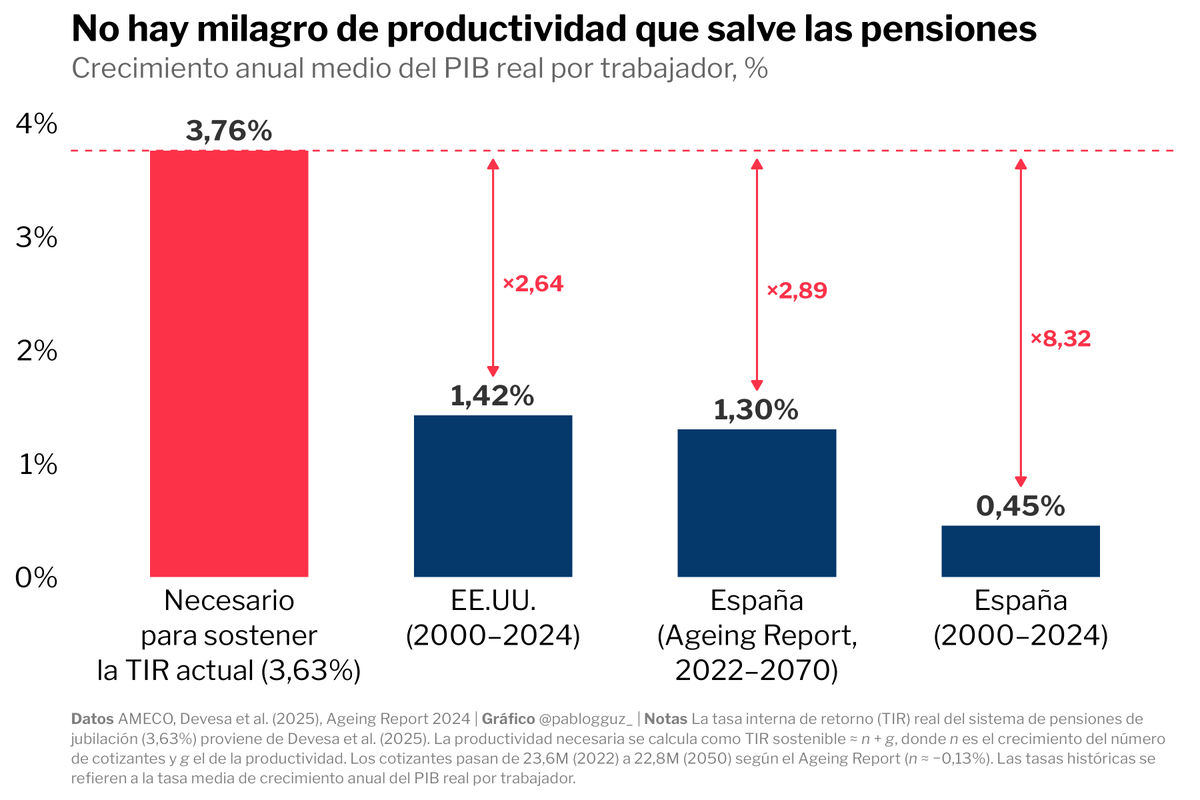
formalmente, la TIR sostenible de un sistema de reparto es aproximadamente igual a n + g, donde n es la tasa de crecimiento del número de cotizantes y g es la tasa de crecimiento de la productividad (es decir, de las cotizaciones por trabajador). en españa, la TIR real implícita del sistema se sitúa alrededor del 3,63% (https://t.co/kG7XnXvyNE), mientras que los ingresos del sistema vienen creciendo en términos reales a una media del 1,4% anual entre 2005 y 2024. esa brecha de sostenibilidad (de más de dos puntos porcentuales) es el problema de fondo del sistema de pensiones español.
una primera observación es que una subida de salarios no es lo mismo que un aumento del crecimiento de la productividad, aunque a menudo se confundan. imaginemos que mañana se produce un salto en los salarios, digamos del 20%. los ingresos por cotizaciones aumentan, lo que genera un alivio inmediato para pagar las pensiones actuales. pero la tasa de crecimiento posterior de los ingresos del sistema sigue siendo n + g. esto es lo que en economía llamamos un efecto de nivel: hay un salto puntual en los ingresos por cotizaciones, pero su tasa de crecimiento no se altera. ¿y qué pasa cuando los trabajadores que disfrutaron de ese salto salarial se jubilan? que sus pensiones se calculan sobre bases de cotización más altas. el sistema entonces tiene que pagar pensiones proporcionalmente mayores, y volvemos al punto de partida. en otras palabras, un efecto de nivel no soluciona un problema de tasa. es como intentar llenar un cubo con un agujero en el fondo: puedes echar más agua de golpe, pero si no tapas el agujero, el cubo se vuelve a vaciar.
una segunda observación, más importante todavía, es que incluso si entendemos que lo relevante es el efecto de tasa (es decir, un aumento permanente del crecimiento de la productividad, g), las cifras necesarias son sencillamente inverosímiles. hagamos las cuentas. el ageing report 2024 de la comisión europea proyecta que el número de cotizantes pasará de 23,6 millones en 2022 a 22,8 millones en 2050, lo que implica un crecimiento de n de aproximadamente -0,13% anual. con n negativo, toda la carga recae sobre g: la productividad del trabajo tendría que crecer a un ritmo del 3,76% anual de forma sostenida para cerrar la brecha.
¿es esto remotamente plausible? el PIB por trabajador en estados unidos (la economía frontera del mundo, la que más innova, la que tiene los mercados laborales más dinámicos y flexibles) ha crecido a una media del 1,42% anual entre 2000 y 2024. en ese mismo periodo, el PIB por trabajador en españa ha crecido al 0,45% anual. el propio ageing report, en lo que ya es un supuesto heroico, proyecta un crecimiento de la productividad en españa a largo plazo del 1,3% anual (casi tres veces la tasa observada desde el año 2000). y aun así, esa cifra se queda muy lejos de lo necesario. españa tendría que crecer en productividad más del doble que estados unidos (y unas ocho veces más rápido que su propio ritmo de las últimas dos décadas), de forma sostenida, para que la subida de salarios resolviese el problema de las pensiones. no ha ocurrido en ningún periodo de la historia económica moderna de ningún país avanzado.
el argumento de que "el problema no son las pensiones, son los salarios" confunde, por tanto, dos cosas distintas. un aumento puntual de los salarios genera un efecto de nivel que ayuda transitoriamente pero no altera la sostenibilidad a largo plazo del sistema. y un aumento permanente de la productividad del calibre necesario es un absoluto disparate (estamos hablando de que españa tendría que multiplicar por ocho su ritmo de crecimiento de la productividad de las últimas dos décadas, de forma sostenida, indefinidamente).
se puede repetir lo contrario las veces que se quiera, pero el problema del sistema de pensiones español no es de salarios: es que promete una rentabilidad que la economía no puede generar. punto. y quien no lo entienda tiene un problema con la aritmética básica, no con las pensiones.
@Diletantez@GangasMIR O igual es gente muy lista, que no se ha entretenido en sacar buenas notas con trabajos que no les aportaban, o peor, haciendo la pelota a algún profesor con ego y se han centrado en entrenar para el MIR, que es la nota que saben que más cuenta. Podría ser, no?
If your child becomes a reader, about 80% of the education job is already done. That's my honest assessment after working in education for over thirty years. Everything else is secondary. Most parents think science education is important. Yes it is. But if you can't read the biology textbook, you're not going to learn biology.
Reading is the meta-skill that enables all other skills. History requires reading. Science requires reading. Even math increasingly requires reading as it becomes more sophisticated. The child who reads voraciously will figure out everything else. The child who doesn't will struggle with everything.
Most people will read this and think optimists live longer because they eat better and exercise more. The study says something wilder.
Lee et al. controlled for smoking, diet, exercise, alcohol, depression, BMI, and socioeconomic status. The longevity effect still held. The most optimistic quartile lived 11 to 15% longer and had 1.5 to 1.7x odds of reaching 85 even after removing every behavioral difference.
Which means something is happening at the level of biology, not just habits.
Rozanski’s meta-analysis across 229,391 participants found optimists carry 35% lower cardiovascular event risk. Blackburn’s Nobel Prize-winning lab at UCSF found pessimistic attitudes are associated with accelerated telomere shortening. Cortisol suppresses telomerase, the enzyme that rebuilds the protective caps on your chromosomes. So chronic negative expectation literally erodes the structures that keep your cells from aging.
The loop runs: pessimistic cognitive style → sustained HPA axis activation → elevated cortisol → telomere degradation → accelerated cellular senescence. Optimists interrupt that loop at the top. They show less emotional reactivity to stressors, faster recovery from acute stress, and they default to reframing threats as challenges rather than catastrophizing.
The part nobody talks about from this paper: the authors explicitly state optimism is modifiable. This isn’t a personality trait you’re born with. Cognitive reappraisal training, morning sunlight for cortisol rhythm regulation, deliberate breathing protocols for vagal tone, structured gratitude practices. All of these shift the prefrontal cortex patterns that determine where you sit on the optimism spectrum.
A 35% reduction in cardiac events from a trainable psychological variable is a bigger effect size than most supplements on the market. That’s the real story buried in this abstract.
junior pm: i have to run my first global alignment meeting and i'm freaking out
senior pm: what's your plan?
junior pm: schedule the call, walk everyone through the proposal, get buy-in
senior pm: how many people?
junior pm: like 8 stakeholders across 4 time zones
senior pm: and you're meeting them for the first time... in the alignment meeting?
junior pm: well yeah. that's the point of the meeting
senior pm: there's your problem
junior pm: what do you mean?
senior pm: alignment meetings don't create alignment
junior pm: then what's the point?
senior pm: they confirm alignment you already have
junior pm: i don't follow
senior pm: have you talked to any of these 8 people yet?
junior pm: i sent them the pre-read
senior pm: that's not talking
junior pm: so i should... call them first?
senior pm: every single one. 1:1. before the big meeting
junior pm: that's 8 separate calls just to prep for 1 meeting
senior pm: now you're getting it
junior pm: seems like a lot
senior pm: it's the whole job
junior pm: what would i even say in these calls?
senior pm: you're not saying. you're listening
junior pm: listening to what?
senior pm: their fears. their motivations. their hidden objections
junior pm: why wouldn't they just say that in the meeting?
senior pm: politics. pride. audience
junior pm: so they'll tell me privately what they won't say publicly?
senior pm: if you ask right
junior pm: how do i ask right?
senior pm: frame it as soliciting their expertise
junior pm: "i'm new to this and want your input"?
senior pm: exactly. people love feeling like the wise advisor
junior pm: and then i just... shut up?
senior pm: shut up and write everything down
junior pm: what am i looking for?
senior pm: conflicting goals between stakeholders. who wants what and why
junior pm: ok say i do all this. what changes?
senior pm: two things
junior pm: go on
senior pm: first, you adjust your proposal based on what you learned
junior pm: makes sense
senior pm: second, you sprinkle their exact phrases into your presentation
junior pm: why?
senior pm: people support what they helped create
junior pm: even if they didn't technically create it
senior pm: especially then
junior pm: what about the difficult ones? the ones who'll disagree no matter what?
senior pm: you pre-negotiate
junior pm: how?
senior pm: in your 1:1, you say "i know you have concerns about X. i can't fully address them. can you disagree and commit in the meeting?"
junior pm: you can just ask that?
senior pm: you'd be surprised how often the answer is yes
junior pm: because you asked privately
senior pm: because you respected them enough to ask
junior pm: so the alignment meeting itself is basically...
senior pm: a ceremony
junior pm: confirming decisions already made
senior pm: in hallways. in 1:1s. in coffee chats
junior pm: the meeting before the meeting
senior pm: now you're ready to run alignment
Básicamente, el gobierno de Singapur obliga a la gente a ahorrar una parte de entre el 8 y el 10,5% de sus sueldos brutos —dependiendo de la edad— en cuentas de ahorro médico exentas de impuestos (Medisave), los obliga a contratar al menos un seguro de salud básico provisto por el gobierno (MediShield), con la opción de un seguro privado más completo (un Integrated Shield Plan), y luego les hace pagar algo de su propio bolsillo por todo.
En este sentido, los deducibles de MediShield se fijan en niveles relativamente altos, alrededor de S$1.500-$3.000. Y para MediShield, el copago mínimo es del 10%, pero incluso con seguro privado el gobierno exige copagos mínimos de al menos el 5%.
Para calificar para la cobertura de internación de MediShield, normalmente necesitás estar hospitalizado al menos 8 horas. El seguro también cubre cirugías ambulatorias específicas aprobadas y tratamientos ambulatorios costosos como quimioterapia o diálisis. Esto es una barrera deliberada para evitar que el seguro se convierta en una forma de pagar consultas generales. Es esencialmente un esquema de seguros con distribución de riesgos (risk pooling) obligatorio, aunque el gobierno ofrece subsidios en las primas para las personas con menores ingresos.
Por su parte, las cuentas Medisave tienen límites de extracción, poniendo un tope a cuánto de tus propios ahorros podés usar por día o por procedimiento. Una cuenta MediSave es propiedad personal tuya, aunque podés usar tu saldo para ayudar a pagar la atención de un familiar, y el saldo por encima de un mínimo se convierte en parte de tus ahorros generales para la jubilación. Cuando morís, el saldo pasa a tus herederos.
La atención primaria la brindan médicos clínicos privados y se paga de bolsillo, aunque ahora con algunos subsidios para personas de ingresos bajos y medios a través del Community Health Assist Scheme. El gobierno también administra Policlínicos, que brindan atención primaria altamente subsidiada abierta a todos los ciudadanos, incluyendo vacunación, chequeos o el tratamiento de enfermedades agudas estándar. Sin embargo, los Policlínicos suelen estar muy concurridos, por lo que la gente que puede permitírselo generalmente va a un médico privado y paga un poco más.
La atención hospitalaria básica se ofrece con tarifas altamente subsidiadas, pero si querés una habitación mejor en el hospital, por ejemplo una habitación privada con aire acondicionado, podés tenerla pagando más. Esto es en los hospitales públicos. Estas tarifas más altas se utilizan entonces, efectivamente, para subsidiar de forma cruzada el costo de la atención básica.
También ofrecen subsidios de respaldo a través de otro esquema, MediFund, para personas que absolutamente no pueden pagar. Las decisiones se toman caso por caso.
Y recientemente introdujeron un seguro de cuidados a largo plazo obligatorio, CareShield Life, para los mayores de 30 años.
La idea central de todo el sistema es minimizar el riesgo moral (moral hazard) a través de los gastos del bolsillo y copagos y usar la discriminación de precios para focalizar los subsidios. Así, Singapur rechaza activamente lo "gratuito en el punto de atención" ("free at the point of use"), el modelo del NHS que critica Lee, como concepto y es activamente anti-igualitario, al tiempo que brinda a toda la población un alto estándar de atención.
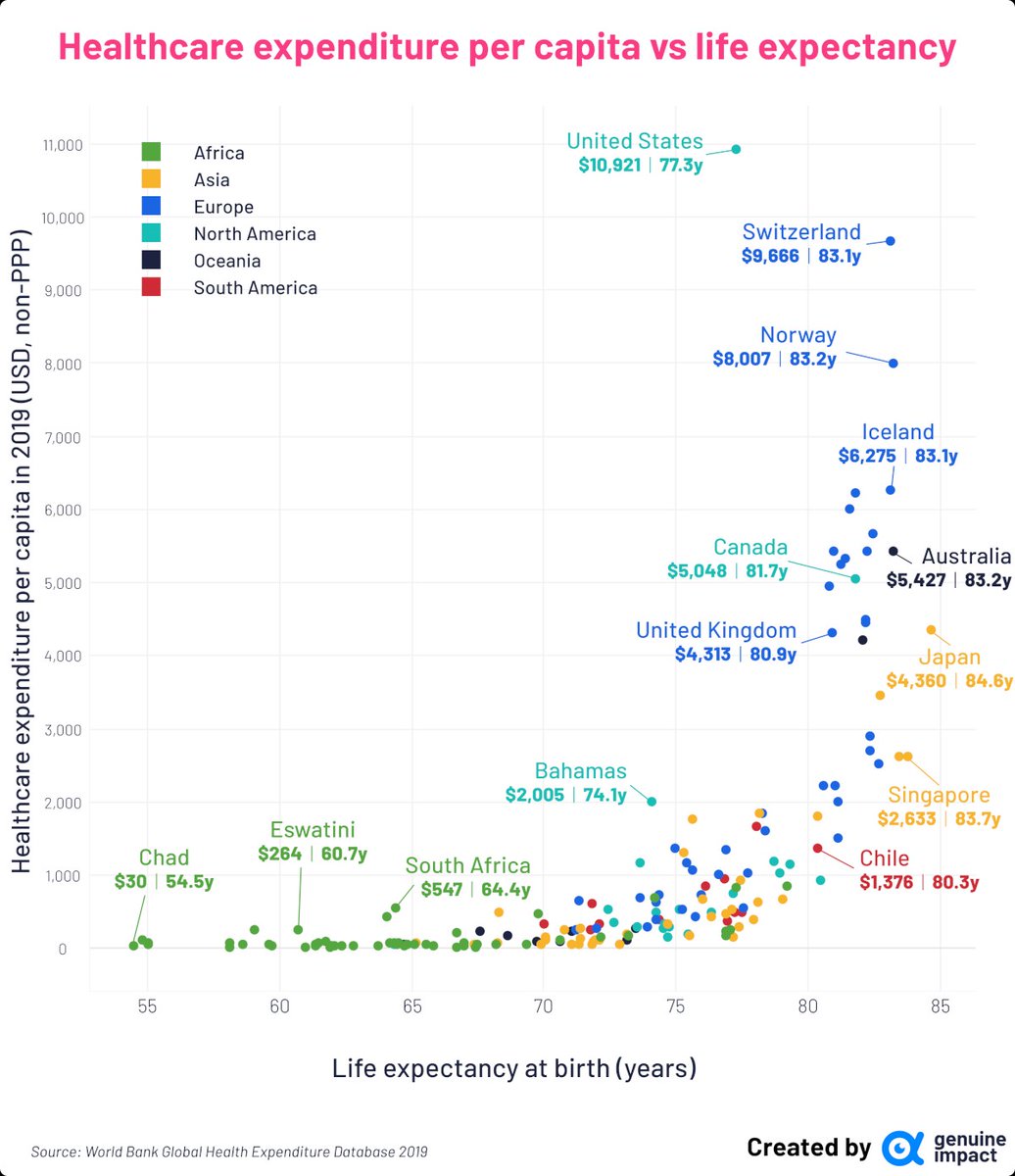
Los resultados son muy impresionantes, con desenlaces de clase mundial gastando solo alrededor del 3-5% del PIB en salud, del cual el 1-2,5% del PIB proviene del gobierno. Históricamente era más bajo, pero post-COVID, ha estado un poco por debajo del 5%.
Para ser un país rico con una población relativamente envejecida (el 14% de la población tiene más de 65 años frente al 10% en el mundo y el 19% en la OCDE), esto es extremadamente bajo. Alrededor de la mitad que la mayoría de los países europeos, y un 25-30% del gasto de Estados Unidos.