Sr Director, Early Childhood Policy @amprog • #GoBlue〽️ • Elder Millennial • “Anyone who does anything to help a child in his life is a hero to me.”-Fred Rogers
Teachers who work in child care settings in the U.S. earn $11.65/hour on average—less than half of what teachers in K-12 schools earn and below a living wage in most U.S. counties, write @daphnabassok, @laurabellows, @ajmarkowitz, & Kate Miller-Bains.
https://t.co/QOxzVV23AC
Big thank you to @Arlcf for providing a briefing on supporting economic security in Arlington this afternoon
We have so much work to do to support our lowest income residents. I’m glad to see the intersections of housing, child care & good jobs all highlighted together!
BREAKING: The @WhiteHouse issued a proclamation today, declaring the month of April Care Worker Recognition Month, recognizing the essential work of child care, early childhood, home care and direct care workers across the country. 1/4 🧵
https://t.co/BTyP8GrsYo.
🧵:The months- and years-long wait to get into a child care center is one of the most infuriating symptoms of a child care industry in market failure.
Many lists are hundreds of kids long.
Parents are waiting years.
And the wait is only getting longer.
https://t.co/edLxoLswuc
To expand their workforce, infrastructure industries must look beyond their historical labor pools and bring in new, more diverse pipelines of talent—especially women.
Funding child care programs is one way to hire and retain these potential workers. https://t.co/ctBjRC7PjO
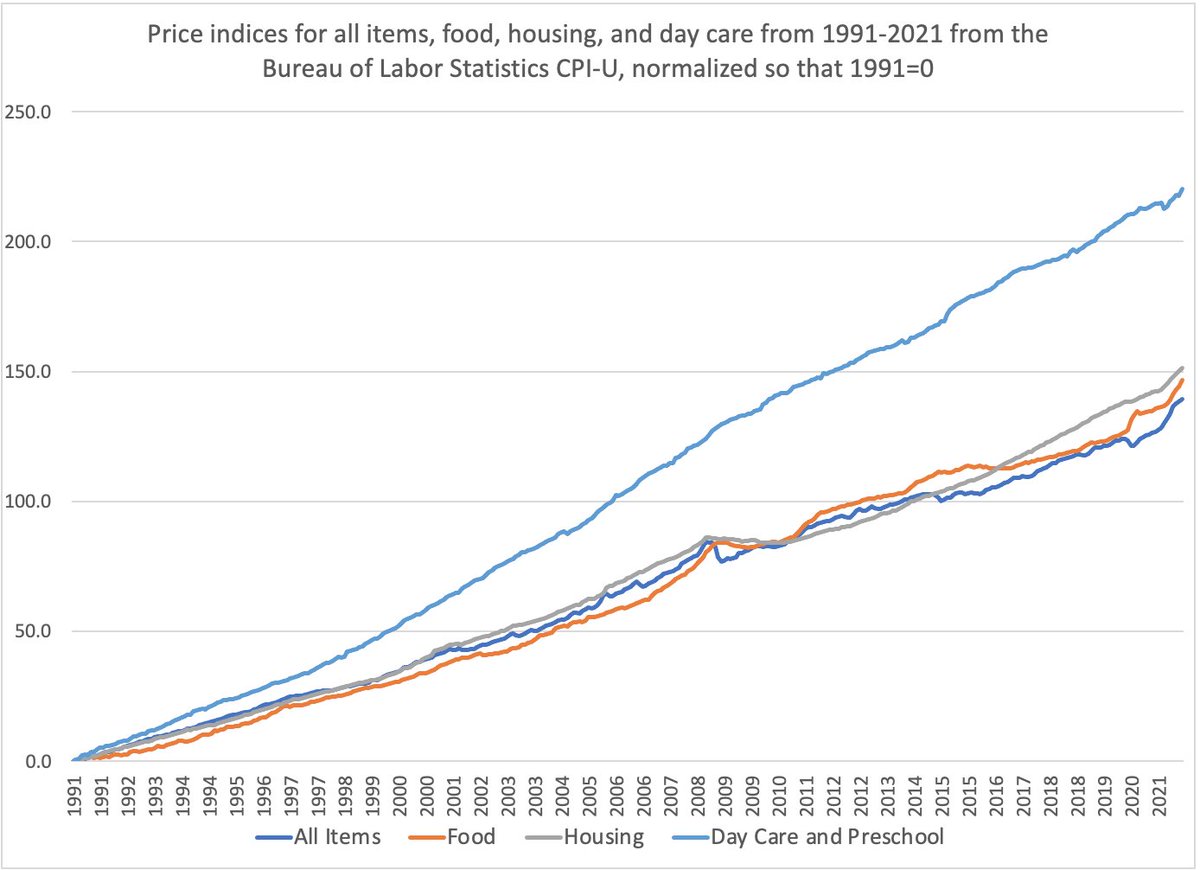
The market for childcare in the U.S. is a failure. This is a thread to give some context to that statement.
First, prices. The price of child care has risen faster than prices overall (even for things like housing) over the past twenty years. It's not close.
1/
I’m really proud of my report, published today for @CAPEarlyEd /@amprog:
“Market rate surveys capture prices that are only attainable by continuing to pay child care staff poverty wages without necessary benefits or advancement opportunities.”
https://t.co/a5C02A1s7n
The Biden administration plans to leverage new investments in semiconductors to advance another goal: affordable child care. Any manufacturer seeking to tap $40 billion in subsidies will need to guarantee affordable, high-quality child care for its workers.https://t.co/k92q9CXfKm
Governors across the country are making child care and early education policy priorities in their states.
Learn more about their proposals:
https://t.co/yj7knmjqSD
MO Gov. Parson: “There is a clear need to do better when it comes to early childhood. Let’s meet this moment for Missouri kids, families, and businesses!”
See what else governors are saying about early childhood policy:
https://t.co/C22guZCNW7
A thread: From CAP’s new brief, five steps that governors can take to address the child care crisis:
1.Calculate the true cost of care & set subsidy rates accordingly
(1/5) https://t.co/U4NjJveVUg
"We must do more to increase our nation’s stagnant labor force participation rate," say @childcareaware's Michelle McCready and @WB_DOL's Wendy Chun-Hoon. That means "a #childcare system that is affordable, accessible and equitable in the long term." https://t.co/8GwXi1L3s8