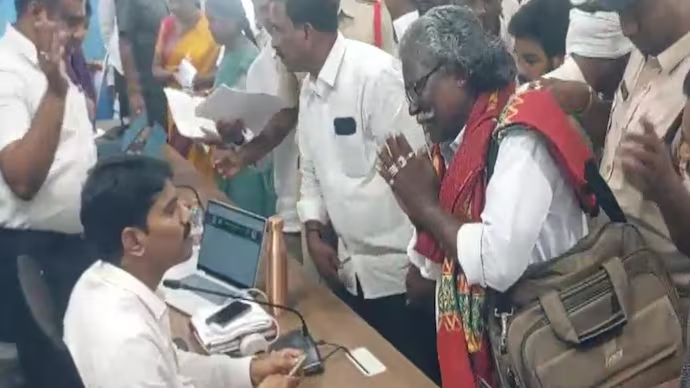
బ్రహ్మాజీ మీకు ఇలా కనిపిస్తున్నాడు కానీ ఎప్పుడో భూమి పుట్టినప్పుడు పుట్టాడు
వృద్ధ వయసులో కూడా మంచి మంచి పాత్రలు చేస్తున్నాడు: బ్రహ్మానందం
#Hangman#Brahmaji#Brahmanandam
People remember Abhimanyu because he died fighting.
I remember him because he walked into a battle he knew he wasn't fully prepared for.
He knew how to enter the Chakravyuh, He didn't know how to come out of it.
He knew the warriors waiting inside were older, stronger, and far more experienced than he was.
He went anyway. That's what stayed with me.
Life doesn't always give you complete instructions before asking you to fight.
Sometimes you don't know how it's going to end,
Sometimes you don't know if you're enough.
You just know that turning back isn't an option.
I think that's why Abhimanyu's story has survived for thousands of years.
Not because he won. He didn't.
But because courage isn't always about victory.
Sometimes courage is stepping into the battle anyway, knowing the odds aren't in your favor.
Some people leave behind victories, Others leave behind an example.
Abhimanyu left behind the kind of courage that people still talk about thousands of years later.
According to the Vedic scriptures,
Sri Kṛṣṇa says in Bhagavad Gītā 15.12:
yad āditya-gataṁ tejo jagad bhāsayate 'khilam...
"The splendor of the sun, which illuminates the entire universe, is to be understood as coming from Me."
The Śrīmad Bhāgavatam (5.22) describes the Sun (Sūrya) as a celestial globe presided over by the deity Vivasvān, who travels in a divine chariot. Its brilliance is an intrinsic feature of its divine constitution—not the result of combustion like wood or coal.
The Brahma-saṁhitā (5.52) further states:
yac-cakṣur eṣa savitā sakala-grahāṇāṁ...
"The Sun, the king of all planets, is the eye of the Supreme Lord, moving in His ordained orbit."
Thus, from the Vedic standpoint, asking "Where does the Sun get oxygen?" assumes the Sun burns by ordinary chemical fire. The Vedas describe the Sun as tejas (self-effulgent divine fire), whose existence and radiance are sustained by the Supreme Lord Sri Kṛṣṇa—not by atmospheric oxygen. 🙏🏻
Watched The Sheep Detectives today. I honestly thought this was one of those side quest movies actors do and that it was just going to be a fun comedy flick.
The movie had no right being that deep and heartstrings pulling.
I was genuinely surprised it went in that direction so early on. Having not seen the trailers or known anything about it made me enjoy the story a whole lot more. It was clever and funny, but also sad and inspiring.
It makes you appreciate the memory of someone, no matter how much it may hurt, and the love and acceptance of the people closest to you.
I did not think I'd get teary eyed watching this, but it got me.
It's a gem. Definitely watch it.
#Deloitte#Pune, could you please help us understand how a #female employee with a 7-month-old baby is expected to work a 6:00 PM to 3:00 AM night shift and then travel back home?
If she is caring for an infant, why isn’t she being provided a day shift, along with a #crèche facility as required by law, or work-from-home/flexible arrangements if the nature of her role permits?
#Workingmothers deserve a safe, practical, and supportive work environment. We hope Deloitte Pune will clarify how such situations are being handled.
👩👦🌙🏢
@Deloitte@DeloitteIndia@DeloitteUS@CMOMaharashtra@advakash@RajyaAayog@Maha_MahilaAyog@Maha_MahilaAyog
#Deloitte #DeloittePune #WorkingMothers #WomenAtWork #EmployeeRights #NightShift #CrecheFacility #MaternitySupport #WorkLifeBalance #ITEmployees
#Blast is such a cool commercial movie, man. I absolutely loved it. No dull moments, screenplay is engaging, action set pieces are really cool. No matter what anyone says, when women do action, they look so bold & hot. It's a total treat to watch. Best action movie after RXD.🔥
Padma Shri awardee and Kinnera artist Darshanam Mogilaiah has alleged that a 600-square-yard plot allotted to him by the government is stuck in a legal dispute. The artist says he has spent nearly Rs 9 lakh on legal fees and is seeking official intervention to secure possession.
Read More: https://t.co/rToUgDg5KN
#DarshanamMogilaiah @Journo_Abdul
Kashi Yatra: From Sacred Resolve to Ritual Comedy, A Call for Restoration of Meaning
In many contemporary Hindu weddings, the ritual of Kashi Yatra has been reduced to a lighthearted interlude, an opportunity for laughter, playful negotiation, and theatrical persuasion. The groom, clad in traditional attire, symbolically declares his intention to renounce worldly life and depart for Kashi in pursuit of spiritual knowledge. The bride’s father intercepts him, persuades him to abandon this path, and offers his daughter in marriage. What unfolds is often treated as comic relief.
Yet beneath this dramatization lies a profound philosophical tension, one that speaks to the very structure of Hindu thought: the balance between renunciation and engagement, between moksha and dharma, between withdrawal and responsibility.
At its core, the Kashi Yatra ritual represents a moment of existential choice. The groom symbolically stands at a crossroads between two legitimate paths: sannyāsa (renunciation in pursuit of liberation) and gṛhasthāśrama (the householder’s life). This is not a trivial decision. Classical Indian thought does not dismiss the world as mere illusion to be casually abandoned, nor does it celebrate worldly life without restraint. Instead, it organizes human aspiration through the framework of the puruṣārthas: Dharma (righteous duty), Artha (material well-being), Kāma (desire and emotional fulfillment), and Mokṣa (liberation).
The Kashi Yatra is, in essence, a ritualized negotiation between these aims.
When the bride’s father intervenes, he is not merely “stopping” the groom; he is making a philosophical argument. He asserts that the life of a gṛhastha is not inferior to that of a renunciate. Rather, it is foundational. The householder sustains society, enables the performance of rituals, supports dependents, and creates the conditions in which dharma can flourish. Classical texts reinforce this view. The Mahābhārata states that the householder stage is the root of all dharmas, and the Manusmṛti extols it as the most sustaining of the four āśramas.
Crucially, the father’s promise, that his daughter will be a sahadharmacāriṇī, a partner in dharma, is not ornamental. It reflects a deeply embedded Vedic ideal: that spiritual progress within the householder stage is a shared endeavor. Marriage, in this framework, is not merely a social contract or emotional union; it is a disciplined partnership oriented toward ethical living, ritual responsibility, and ultimately, transcendence.
However, when this ritual is reduced to humor, its pedagogical value is lost. The participants, especially the groom and his family, are rarely encouraged to reflect on the philosophical implications of the act. The groom’s “renunciation” becomes theatrical rather than contemplative; the father’s “persuasion” becomes playful rather than instructive.
This dilution has broader consequences. Without understanding the interplay of Dharma, Artha, Kāma, and Mokṣa, the householder stage risks being misinterpreted as merely materialistic or socially obligatory. Conversely, sannyāsa is romanticized without appreciation for its rigor and prerequisites. The original intent of the ritual, to emphasize that gṛhasthāśrama, properly lived, is itself a valid and powerful path toward mokṣa, is obscured.
Reclaiming the depth of Kashi Yatra does not require abandoning joy or celebration. Rather, it calls for informed participation. Priests, families, and especially parents can play a crucial role by explaining the symbolism before or during the ritual. The groom should be made aware that his symbolic departure represents a genuine philosophical option, and his acceptance of marriage signifies a conscious commitment to a life of responsibility, discipline, and spiritual partnership.
In an age where rituals are often performed mechanically or repurposed for entertainment, restoring meaning is itself an act of cultural preservation. The Kashi Yatra is not a relic to be modernized through humor, but a living expression of a sophisticated ethical vision, one that integrates worldly life with spiritual aspiration.
To honor it fully is to remember that the journey to Kashi need not be abandoned; it can be undertaken from within the home itself.
Meet Aakriti Goel, a https://t.co/YSvOF5fxhn 2015 graduate from BITS Pilani. She worked for 7 years and then left her ₹30 LPA job at the age of 30, while still unmarried, to pursue her dream of becoming a doctor. She finally cracked NEET UG 2021 with an All India Rank of 1118 within 10 months. 🔥🤯
In 2021, she decided that she did not want to continue her corporate career. She had worked in several startups and tech-finance companies in Bangalore for 7 years, and one day she decided to quit her tech life, let go of her ₹30 LPA salary, and join MBBS.
Why did she quit everything? Because she no longer wanted to be part of the world of capitalism. She stopped finding it meaningful. Though she had money, power, and authority as a Head of Ops, none of it gave her the thrill or sense of purpose she was looking for. She always wanted to do something that truly impacted people's lives.
After nearly 10 years away from academics, it wasn't easy for her to get back to books again. She started by watching free Biology classes online and began studying 10 hours every day. In just 10 months of preparation, she wrote more than 100 mock tests. When the NEET 2021 results were announced, she scored 676 marks and secured an All India Rank of 1118, surprising everyone.
Currently, she is studying in the final year of MBBS at Hindu Rao Medical College
FYI check :-
https://t.co/jY6Q1CXe1U