Hoy hemos perdido a Anwar Shaikh: economista pakistaní-estadounidense que empezó en la economía poskeynesiana y acabó en la economía política clásica, sobre todo en el marxismo. Con esas herramientas predijo la crisis de 2008. Y además protagonizó uno de los mejores "troleos" de la historia académica 🧵
Our paper “Difference-in-Differences Designs: A Practitioner’s Guide” is now published in the Journal of Economic Literature. It took us a while but we are happy!
We put together a lot of material to make the paper useful in practice: https://t.co/30TbAgihlz
Hope you like!
📢 Next in our Economics of Longevity & Ageing webinar series:
🎙️ Daron Acemoğlu @DAcemogluMIT@MITEcon
📖 Baby Busts and Growth Booms: Demographic Change and the Macroeconomy
🗓️ 19 May 2026
⏰ 07:00–08:30 PT | 10:00–11:30 ET | 15:00–16:30 BST
Open to all with registration.
🔗 https://t.co/KUKQ3VajH3
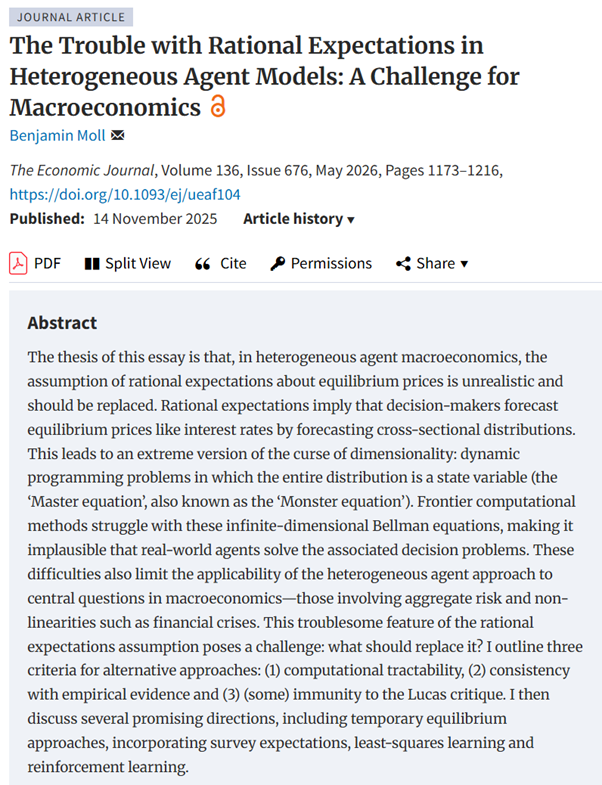
In the May 2026 issue: ‘The Trouble with Rational Expectations in Heterogeneous Agent Models: A Challenge for Macroeconomics,’ by Benjamin Moll https://t.co/RWvehwIsA8 @ben_moll@RoyalEconSoc#EconTwitter
🚨
In our next seminar Tarun Ramadorai will present his new book "Fixed: Why personal finance is broken and how to make it work for everyone" with a discussion by @KimPeijnenburg.
🕐15:30 BST/16:30 CET
📅12th June 2026
Register here: https://t.co/qPu0cGnkNh
Join us!
I am very happy to share that our paper, “Ideological Alignment and Evidence-Based Policy Adoption,” is now published in the American Economic Review (#AER). This is a hugely ambitious project that has taken more than four years of work together with an amazing team of co-authors.
We conducted a nationwide #RCT involving over 5,000 real local politicians, as well as national think tanks, newspapers, and a leading global academic institution, to answer a simple but very important question: does the political “colour” of the messenger influence policy implementation?
One of the central challenges of the #evidence-based policy agenda is turning evidence into actual policy. From my experience in politics, this is far from straightforward: evidence has limited value if it does not translate into policies that improve people’s lives. Why is it so difficult to persuade policymakers to adopt policies with strong empirical backing? If the evidence is there, why are these policies so rarely implemented?
🔬 In our study, we address this by sending identical information about an evidence-based policy to local policymakers, introducing variation only in the #messenger of the policy: a non-ideological research institution versus think tanks and newspapers with clear ideological leanings. The policy itself is a recommendation - strongly supported by evidence- that improving a municipality’s Wikipedia page increases tourism.
We find that policy adoption increases by 65% when the information comes from a source perceived as ideologically aligned with the policymaker. In contrast, ideologically opposed institutions have no effect.
Publishing in what is arguably the world’s leading academic journal is a dream for any economist. For me - having stepped away from academia for politics - the joy is even greater.
🙏 I am deeply grateful to all my incredble co-authors for their generosity of offering me the opportunity to share this project with them, and for everything I have learned throughout this process. I also want to thank all the collaborators and RAs that have contributed, as well as across institutions, including https://t.co/jQdIMjTLbI, El Mundo, Alternativas, FAES, and FEMP, as well as the support from the Social Research Call of La Caixa and the Wikimedia Foundation.
https://t.co/k5k9bpaYz1
@IEuniversity@iespega@EnricoLetta@manuelmunizv@Borjamonde@JuanSantalo
🧵1/ ¿Se puede enseñar economía de una forma más conectada con los problemas actuales de nuestras sociedades y con hechos históricos, sin empeorar los resultados?
Este estudio para Uruguay comparó un curso tradicional de microeconomía con uno basado en el proyecto CORE.
"Life Expectancy, Retirement Age, and Pension Wealth" - new publication by @_Tim_Maurer_ , Miguel Sousa Duarte and Svend E. Hougaard Jensen:
https://t.co/ndBKxEP6Mr
@AlephEdu Ojo, que estás usando el supuesto que las tasas de retorno de las AFP es estático. Notar que los países está creciendo a tasas más bajas. Por tanto, los retornos de las AFP no son estáticos. Al menos yo ya leí un informe del problema que puede generar en las pensiones
1/4🧵
⏱️Serie “Evidencia en 1 minuto” | 💳 Sesgos de género en decisiones de crédito de consumo
¿Qué ocurre cuando hombres y mujeres presentan solicitudes comparables de crédito de consumo? Un estudio en Chile aporta evidencia sobre sesgos en decisiones financieras.
The economic consequences of living longer
🎧 Listen: https://t.co/d7njLBIyRV
What does rising longevity mean for economic choices, work, and public policy?
@JulianAshwin@umsbe and Martin Ellison @NuCampEconomics explain how longer lives are reshaping the macroeconomy.
New CEPR Discussion Paper - DP21296
Consumption Inequality in the Digital Age
Kai Arvai @KaiArvai @ecb, Katja Mann @CBScph
https://t.co/l17HT6D5ka
#CEPR_MG#EconTwitter
@ReynaldoRocha2@espinosacrim La realidad existe. Además, podemos hacer construcciones sociales, instituciones, pero eso no les quita sus poderes reales (que es otra cosa). Podemos equivocarnos en cómo investigar, cambiar posiciones, etc, pero no siempre vamos a ser parte del fenómeno estudiado.
@espinosacrim@ReynaldoRocha2 Estoy en desacuerdo, las posiciones afectan como comprendemos el fenómenos, pero no por ello vamos a ser parte del fenómeno.
Bajo tu premisa, cambiar o no cambiar posiciones es irrelevante, luego, ser humano solo sería necesario para ser parte del proceso.
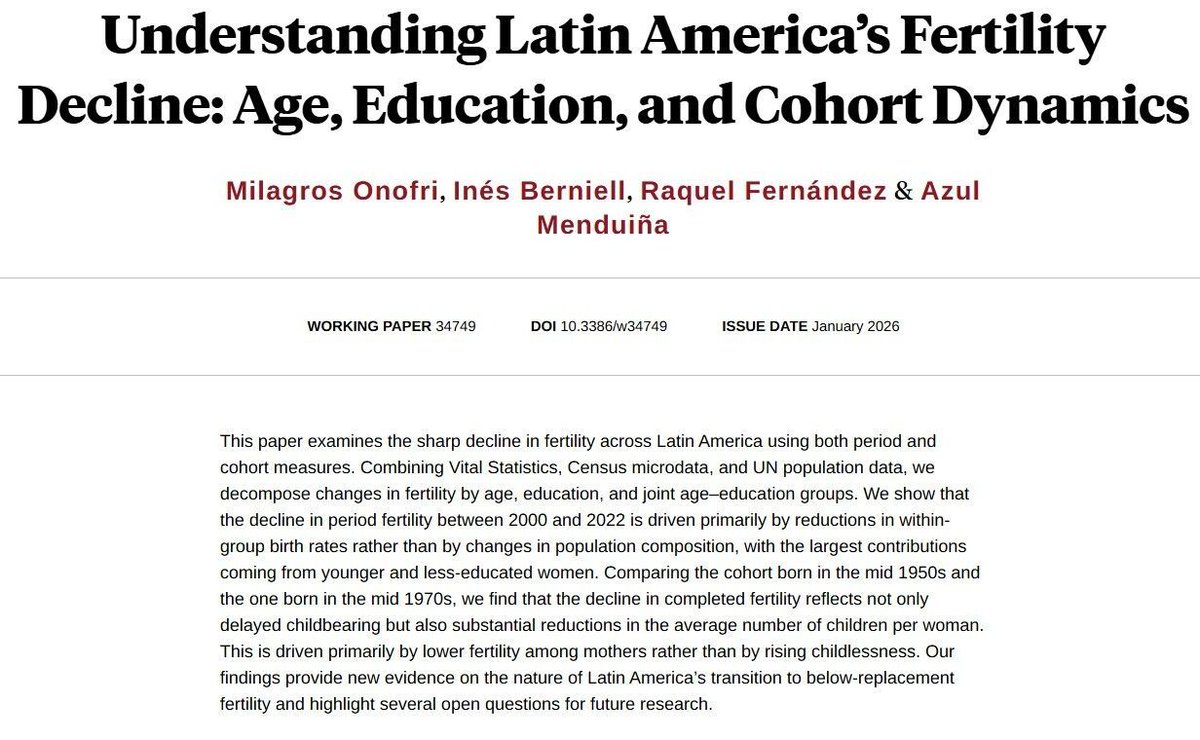
The very rapid decline in fertility in Latin America is driven by behavioral change, rather than demographic changes. Childlessness plays only a minor role in, from @milagrosonofri, @InesBerniell, @raquel1fernan, and Azul Menduiña https://t.co/uXUMyexW8K
@OcecUdp@MiguelLorcaE@jpbravom@faeudp La comparación que se está haciendo no es factible. Hay cambios metodológicos en la medición del empleo y desempleo entre los gobiernos.