@SahilBloom “If you don’t do the small things well, they’ll never trust you to do the big things. Remember that. Everything you do matters—act accordingly.”
The highest concentration of Michelin-starred restaurants in the world is 20x denser than Paris, 50x Manhattan/SF and 100x Tokyo.
It’s Higashiyama ward in Kyoto.
With ~50 stars for ~35k residents, it has an insane 1 star every ~700 residents!
You can’t be >200m away from one.
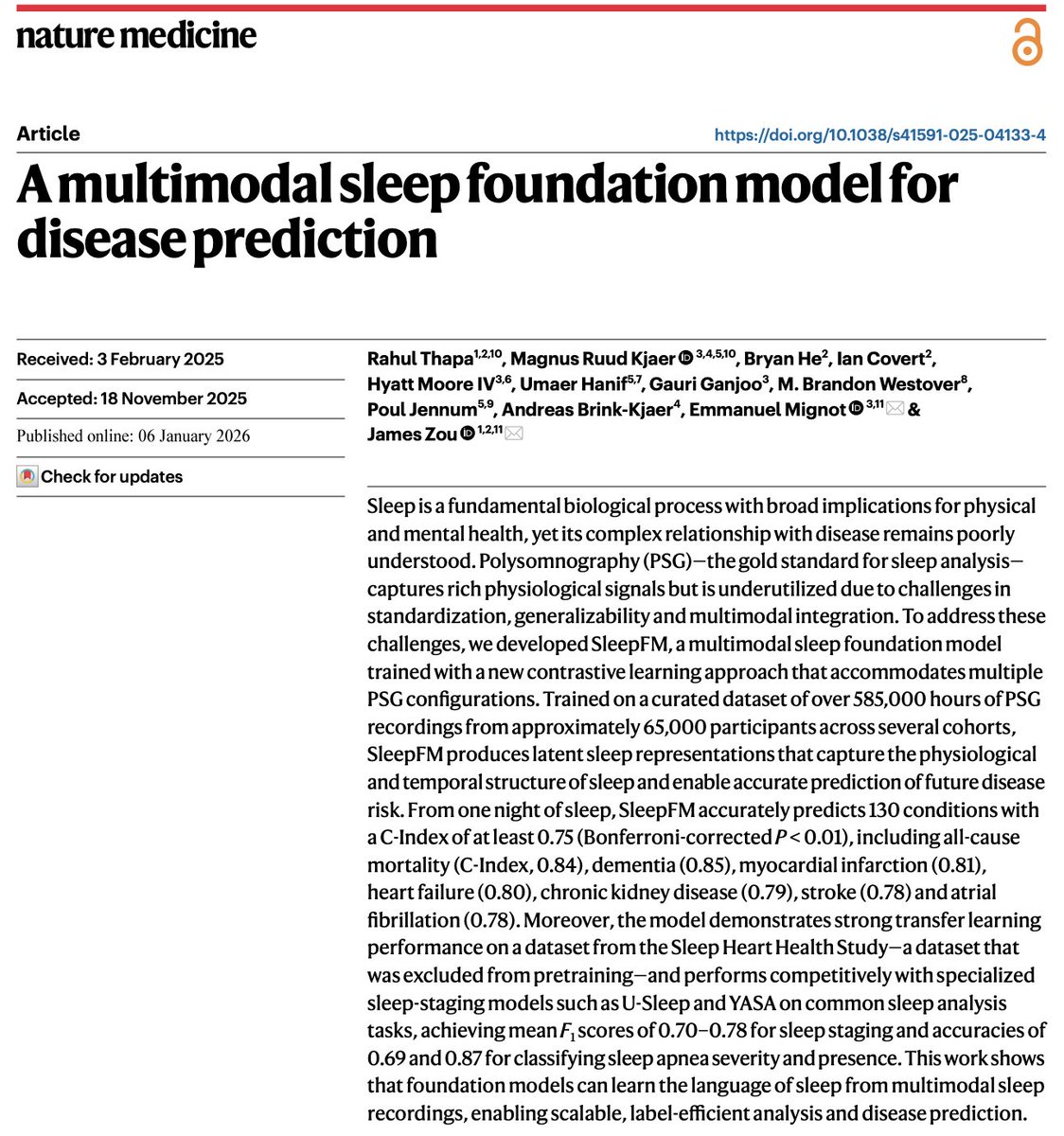
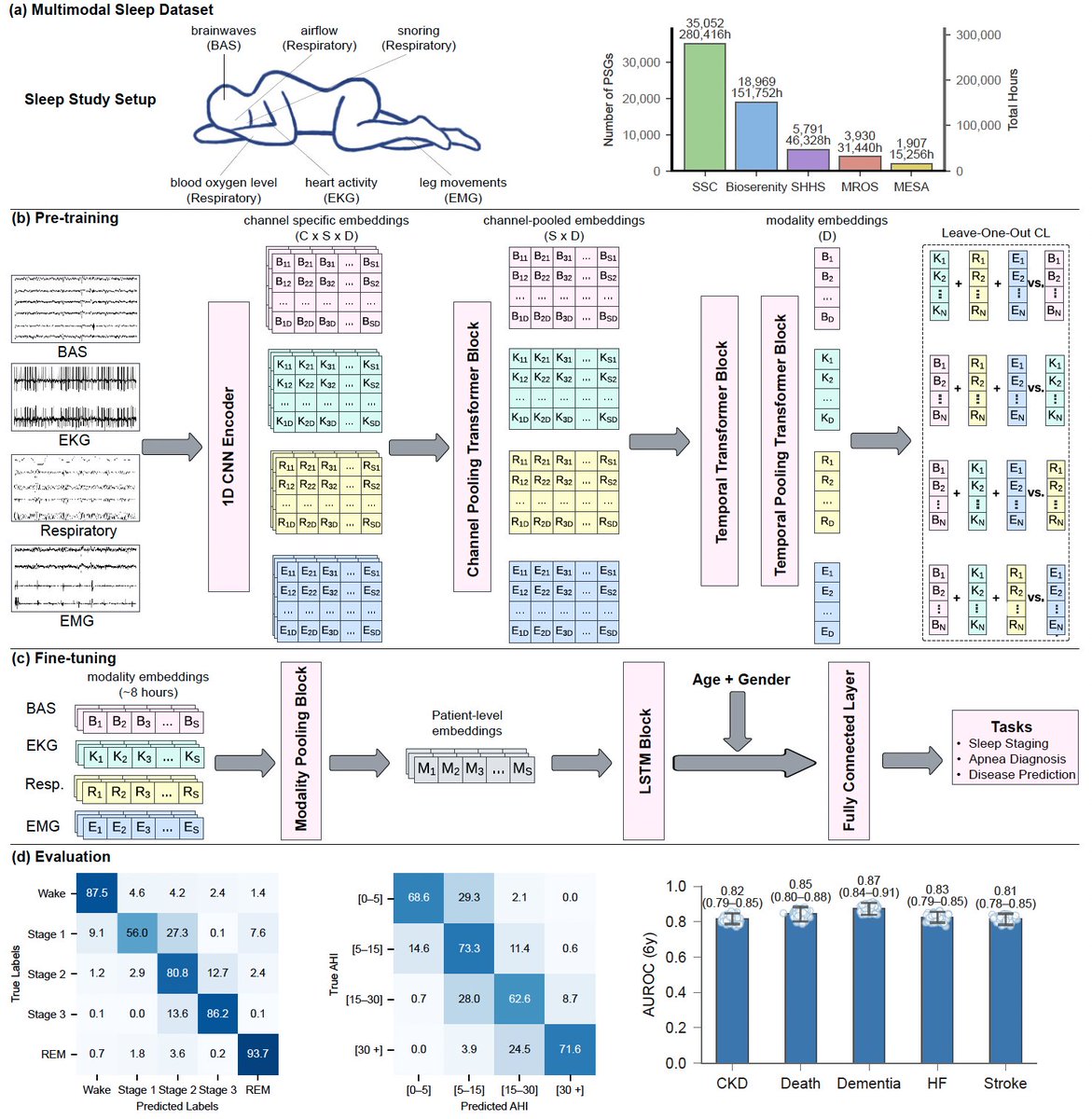
Today in @NatureMedicine we report that AI can predict 130 diseases from 1 night of sleep🛌
We trained a foundation model (#SleepFM) on 585K hours of sleep recordings from 65K people—brain, heart, muscle & breathing signals combined.
AI learns the language of sleep🧵
The AlphaBind pre-print is out! Both the model and data are available as open-source. Thanks @owl_poster for the in-depth breakdown. https://t.co/wpYGx3NWMB
@AAlphaBio paper on their protein-protein interaction model is out!
paper: https://t.co/jEZDqMznr4
for context, i wrote about them a few months ago (https://t.co/taf8zhGixO) and was very looking forwards to seeing this paper
some thoughts
1. bootstrapping learning via ESM2 embeddings (before being fed into another transformer to pretrain) feels increasingly common, I saw it done in the Universal Cell Embeddings paper too. they ablate this and show its useful too, but still feels weird to do…
2. zero shot prediction of binders for new targets is still not possible, despite pretraining a general binding model on 7M~ measurements across 6k targets. for each new target, you need a parent antibody that binds to it + finetuning of mutants of the parent. sad! i wonder how much you need the parent for…would a random set of antibodies for each new target actually be enough?
3. 30k~ new samples (generated via naive mutations to a parent antibody) are required to retrain their general model for new target, but that is within scope to gather in a single run of their internal assay. given that data to finetune their model, the resulting hit rate is quite good, even as edit distance from the parents gets high (by high, i mean 11). take a look at fig 4A
4. their proposed mutations are *across* the entire HCDR1-3 region! not just the regions themselves, but everything in between! decently high diversity on this, which is cool + reasonably new amongst IgG antibody design works (since last i checked)
5. there’s a really interesting section here titled ‘Affinity-Guided Developability Engineering’, showing how their model may be used in practice to do a multi-property-ish optimization thing on top of an antibody with some good characteristics (good binding), but some bad ones (bad developability and high immunogenicity). cool to see how stuff like this could be used in practice to create Actual Drugs
overall, cool work. nothing revolutionary, but they dont really claim that it is. slight improvement on some dimensions compared to others, roughly equal on everything else. also one of the better written antibody design papers, most of the others ive read are much harder to understand than this one
but the utility of large-scale continuous binding information is less than id hoped. i imagine the desire here is that there is some crazy scaling law to-be-seen, something that requires even more data, but we’ll see how true that ends up being. considering this paper a mild mental update for now
final galaxy brained idea: i hope a-alpha bio is looking into mechanistic interpretability! if you’re the only one in the world with a generalized high-diversity binding model, you may be well positioned to learn what **actually** makes for good binders AND good targets (maybe). useful insights to have for a human drug designer probably
I hope I’m wrong—that Trump’s autocratic tendencies are an anomaly that can be contained, and that we won’t see a similar decline in the next 10-20 years.
In 1992, Hugo Chavez attempted a coup against a democratically elected president, yet by 1999, Venezuelans still elected him in a landslide, setting a path that would erode their democracy.
The erosion of democracy, institutions, and civil norms ultimately led to Venezuela’s collapse. Many foresaw the unraveling and fled Venezuela in the 1990s and early 2000s. I left in 2007 when the situation was already dire, seeing those who left earlier as visionaries.
@jasonrantz Yeah, let’s stop talking about the fact that he did everything he could to stop the transfer of power, including send a mob to storm the Capitol of the US. Trivial stuff.
@michelletandler In your attempt to be balanced, you are missing the forest for the trees. The MSG rally was terrifying, without any need for spin from the media.
As a Venezuelan immigrant and American citizen, the real danger of a Trump presidency isn’t just in policies but in the weakening of democratic institutions and the rule of law. It’s heartbreaking to be living through this decline for a second time.
Very neat article covering A-Alpha @owl_poster! Our upcoming pre-print should answer some of the questions around AlphaSeq scale and AlphaBind performance with actual data!
Creating the largest protein-protein interaction dataset in the world (A-Alpha Bio)
https://t.co/taf8zhGixO
i cover @AAlphaBio, an incredibly promising biotech startup ive been evangelizing for over a year now
4.6k words, 22 minutes
table of contents in reply! 🧵
@DanielDiMartino I think you are not capturing the full lesson of what happened to Venezuela. Yes, socialism set the foundations for economic collapse, but the inability to maintain our democracy and institutions is what destroyed the country and why we are stuck with those failed policies.
@DanielDiMartino Venezuelans would have steered away from socialism if given the opportunity. By the time most people in Venezuela realized the consequences, all democratic institutions had been gutted, leaving no feedback system.