@imetatronink@MyLordBebo Parallel to this, I see another unsustainable trend in the US... the relentless expansion of the welfare state. So far, US has sustained as a military superpower because it's first rate economy was not overburdened by welfarism. I wrote about it here:
https://t.co/4VDffjTXbb
Today, the President of Hungary released a dramatic video message announcing that the democratic rule of law in Hungary has come to an end because he was unlawfully removed from office. Nothing like this has happened in modern European history.
A puppet will now be installed in his place, but that person’s mandate will be illegitimate from the very beginning. At the same time, the governing parties have barred their political opponents from standing in future elections.
These are the very people who spent decades calling Viktor Orbán a dictator. Yet the moment they won a democratic election, they turned against both him and democracy itself. They did not act on their own. They did it with the support and at the direction of Brussels.
The European Union is increasingly behaving like a liberal authoritarian empire, determined to tell people what they may say, what they must do, and even whom they are allowed to vote for.
No person who truly values freedom can accept this.
Watched The Odyssey on its day of release. Given the sheer richness of its source material and cultural history, it is an extraordinarily ordinary film. If it were anyone other than Christopher Nolan directing it, we would have shrugged and gone back home complaining about the price of a Pepsi in a PVR. But this is Nolan, so...
The first thing you expect is spectacle. There is none (Where did that $250-million budget go?). The apocalyptic storms that Poseidon and the Sun God hurl upon Odysseus and his crew... well, we've seen better storms on screen in The Life of Pi, whose production cost must have been less than Matt Damon's hotel bills.
There are no grand battle scenes — instead we have skirmishes that consist mainly of Odysseus shouting "Go go go!" at his men as they are chased by monstrous creatures. And the war for Troy or the supposed majesty of that city? Forget it. Even the Trojan horse (inside which about 40 warriors were hidden) looks rather puny. For some obscure reason, the only towering figure is that of King Agamemnon, who is shown as a cross between the Dark Knight and Darth Vader shot at a low angle.
The monsters, one would think, would be the highlight of any Odyssey film. Here, the Cyclops is a creaky geriatric and Scylla appears and disappears before you can even take a good look at it. At no point do you get a sense of the scale of the dangers the men face.
When the ship is lost at sea, you get a nice blue expanse of the Aegean/ Mediterranean on a bright sunny day. Hades looks like Mordor of The Lord of the Rings shot on a legacy smartphone using an early free version of Canva.
As for the unearthly femmes fatale, Circe is a dumpy house help from the servants' quarters of Downton Abbey; the sirens are seen only in such extreme long shot that they might as well be iPods for all we know; and Calypso is a middle-aged suburban single woman who knows that her best years are behind her.
The climactic set piece, where Odysseus fights and kills his wife Penelope's suitors, is, as my friend Shivram pointed out, a classic Kill Bill situation. Like The Bride, Odysseus is up against dozens of feral nasties inside a closed space.
No one is asking for Tarantino's exhilarating comic book violence, but hey, how about having the mayhem a bit better choreographed? How about slow motion once in a while, for God's sake? How about making our man look a little, um, heroic? This is after all an epic of the Western world, right?
When Penelope challenges her suitors to string Odysseus' hunting bow and shoot an arrow through a long line of axe heads to hit the target, Nolan decides to film the scene in semi-darkness and one can't even make out the skill needed to string a bow, other than watch men heaving away till their faces turn purple.
When Odysseus shoots the arrow and hits, it's all over in a jiffy. There is nothing special in the way Nolan shows that moment that Odysseus and Penelope have been waiting for for 18 years.
In fact, Nolan makes an epic tale astonishingly un-special. In the process, he also shoves in a juvenile anti-war theme. Odysseus is wracked by guilt, but all that he is really losing his sleep over is that he cheated!—he tricked the Trojans into defeat (that wooden horse). As a result, all his dead soldiers exist in a state of dishonour. They are understandably peeved and chase him and his still-surviving men ("Go go go!").
In Homer's Odyssey, his hero never repents the Trojan horse move and is very proud of it, since it quickly brought a ten-year siege to an end with minimal loss of Greek lives. But Nolan's version of the Mahabharata, I guess, would have Bhima feeling serious remorse after killing Duryodhana with a blow to his thighs, violating the rules of mace battles.
So does Nolan believe that if the Greeks had won the war "fair and square" (whatever Nolan's definition of that is—bore the Trojans to death with that interminable siege?), it would have been all right? Just as, in Oppenheimer, the Allies are fighting for a just case, but a nuclear bomb—now that's not on.
From the necessary breadth of vision that an epic demands to the personal motivations of individual characters, Odyssey disappoints at all levels. How I wish Ridley Scott had made this film!
So if you want to watch a gripping movie about an army veteran coming back to a small town and struggling with hostility and post-traumatic stress on his return, try Rambo: First Blood. And if you want a real fun version of the Odyssey, go go go for the Coen Brothers' O Brother Where Art Thou.
PS: What about all the social media noise about Black actresses playing Helen of Troy and Athena? In my opinion, that feeble and gratuitous look-we-ticked-the-woke-box casting gesture should be treated with indifference and a yawn. #Odyssey
When I first came to India, the space industry was closed to private players.
The most well-known "startup" at that time was TeamIndus. Skyroot didn't exist.
A year later, in 2018, Skyroot was founded. Private companies in India couldn't launch rockets yet, but Pawan and Bharath forged ahead regardless, optimistic that liberalisation would happen someday.
Then, in 2020, it did. Indian companies were finally free to compete with American, Russian, European, and Chinese startups. They could build their own launch vehicles. And satellites. At an undisclosed location in the United States, Elon swallowed hard.
I was publishing videos about Indian companies on YouTube at this point. I remember thinking, "Making content about these spacetech developments is a once-in-a-lifetime opportunity."
Now, ~6 years later, Skyroot has gifted India with the biggest white pill of all time. While the world watched, a team of ~1,000+ Indian optimists (with an average age of 28) flawlessly executed an orbital rocket launch.
No private space company IN THE WORLD has ever done this on their first try. As I write this, I have goosebumps. I feel incredibly privileged to have been able to witness this firsthand. I also feel inspired by the resilience, ingenuity, and wherewithal of the entire Skyroot team.
The next chapter of India's space journey has officially begun.
I broadly agree with Sadanand. India is not “stuck”. Per capita income has risen steadily, and India will almost certainly move into the upper-middle-income category in the coming years. He is also right that total GDP can flatter a country of India’s size. Per capita GDP remains the best single measure of average prosperity and productivity, and India cannot dismiss it merely because the comparison with China, Vietnam, South Korea or Taiwan is uncomfortable. The facts must be faced: India has decisively fallen behind those East Asian high-growth economies and presently its peers are Indonesia and Bangladesh.
But that is if one goes only by the GDP story. That needs to be qualified. GDP does not fully capture the unbundling of deprivation or the wider availability of public goods or the widening of everyday opportunities. A society can become "better off" even before those gains are fully reflected in per capita income.
My impressions are anecdotal but please have the patience to listen.
Post retirement I have travelled through India’s smaller towns and rural areas for the last 20 years. Something fundamental has changed.
Roads, electricity, mobile connectivity, banking, UPI, housing, consumer goods and access to markets have spread to places that once seemed like black holes- like in districts like Navrangpur, Dhaulpur, Rajnandgaon, Unao, Dewas and Barmer.
The Tier II and III towns are visibly more prosperous today. Cities such as Vijayawadal in AP; Bareilly/ Jhansi in UP; and Gwalior and even Satna in MP and Mukutban ( Tier IV) in MH have grown. Their outskirts are lined with new housing, shopping complexes, hospitalsand educational institutions. Roads are better, digital connectivity is ubiquitous, and consumer spending is visible. I saw innumerable jewellery+ appliances shops everywhere. Because people are buying not gawking!
Cleaner? Absolutely NOT! Anecdotal summation? Maybe. But truthful? YES!
Rural people are moving into towns fast. In Delhi in the massive Kusumpur Pahadi slum,next to Vasant Vihar I have third generation kids who still go to their ancestral villages in Pratapgarh in UP, Chappra in Bihar,Bundi in Rajasthan and villages in the Sunderbans and Jharkhand. Their parents are domestic helps, guards, drivers and malis. These " informal-sector " 3rd gen kids are earning and spending in ways that conventional income statistics often miss.
Their family owns a smartphone, sends money home instantly, travels on better roads, accesses subsidised food and holds a bank account.The kid is learning "graphic designing, " backend share investing and are setting up entire CCTV systems single handed in one day!
These are not substitutes for a good job or secure housing, but neither are they trivial.
That is why progress must also be judged through other indicators. The HDI, the Multidimensional Poverty Index and Household consumption data also matter- sometimes more!
Access to electricity, sanitation, piped water, cooking gas, banking and digital connectivity have spiraled upwards.Ownership of two-wheelers, refrigerators, phones have also gone up.
Direct Benefit Transfers and large-scale food support ( debatable) have left disposable income into once poor hands.
In short, India has perhaps progressed faster in reducing deprivation than in creating prosperity.Reducing deprivation means fewer people without food, roads, electricity, sanitation, banking or basic connectivity.
Creating prosperity means sustained productivity growth, high-quality employment, rising wages, better education, reliable healthcare and the capacity to compete globally.
We have the first not the second.
My conclusion is not that GDP does not matter. It matters enormously. Nor should India console itself with the size of its total economy while remaining poor per person.
But neither should we overlook the scale of change because it is imperfectly captured by one statistic.
Come to think of it, this is also the kind of writing that wins plaudits for Indian authors writing for a Western audience. Confirm all preconceived negative notions about India, and you it made.
@LudowicoI@ishaantharoor@NewYorker Me hizo acordar a Borges cuando dicr que a la Mistral la premiaban en Europa porque llenaba los casilleros de lo que ellos esperaban de un sudamericano (entre los que incluia ser fea y marron, segun recuerdo)
Such an endearing conversation. Gary Sobers being ever so humble about the six sixes. More importantly, Malcolm Nash, the bowler at the receiving end, being so gracious and such a good sport.
https://t.co/eL29WxgFSY
It is fascinating how 'press freedom' is treated as an absolute, untouchable Western virtue right up until it becomes politically inconvenient.
You pride yourself on a system where everything is out in the open, yet the European Union enacted sweeping, blanket bans on Russian media outlets like RT and Sputnik, recently even extending those censorship laws to target independent, donation-funded bloggers who simply share that content.
When India regulates digital spaces or restricts platforms in the interest of national security, Western journalists waste no time labeling it 'authoritarian censorship' and a 'crackdown on free speech.' But when Europe completely deplatforms entire networks and criminalizes alternative viewpoints, it is seamlessly reframed as a 'necessary defense of democratic values' against foreign hybrid threats.
The truth is, the West does not have absolute press freedom; it has conditional press freedom. You tolerate dissent only as long as it remains within the boundaries of your geopolitical comfort zone. If the European judicial and political apparatus can systematically decide what its citizens are allowed to read and watch under the guise of public order, then stop lecturing India from a pedestal of moral superiority. Your press freedom ends exactly where your political anxiety begins.
Henry Kissinger, May 1992:
“A new world order will come. The question is whether it emerges from intellectual and moral insight, or from a series of catastrophes.”
Thirty-four years later, we have the answer.
Henry Kissinger, May 1992:
“A new world order will come. The question is whether it emerges from intellectual and moral insight, or from a series of catastrophes.”
Thirty-four years later, we have the answer.
Let me explain what this whole fight is about, because it is very different from what the tweet by the Japanese official makes it sound like.
Back in 2015, India and Japan signed the Mumbai to Ahmedabad bullet train deal. 508 km.
India would use Japan's Shinkansen trains and Shinkansen technology. Japan put up a massive soft loan, covering most of the cost, at almost no interest, 0.1 percent, to be repaid over 50 years.
On paper it sounded amazing. Cheap money, world class trains.
But every such loan has a catch. Cheap Japanese money came tied to buying Japanese things.
Their trains. Their coaches. Their signal system. Their price, largely on their terms. That is normal. No country lends billions out of pure love. They lend to sell their own industry.
Then two things went wrong, and this is where his anger comes from.
One, the price.
The Japanese Shinkansen trainsets turned out to be extremely expensive. India felt it was being overcharged for the rolling stock. So, talks hit a wall.
Two, the timeline.
The newest Japanese trains, the E10 series, would reportedly only be ready for India around 2032. India did not want to sit on a finished 1.08 lakh crore track with no trains to run on it.
So India made a call. And this is the part I am proud of.
Instead of waiting and overpaying, India decided to run its own trains first. BEML in Bengaluru got an order to build indigenous high speed trainsets at about 866 crore each, designed to run at 280 kmph.
India will open the line with Indian made trains on the Surat to Vapi stretch around 2027, and bring in the Japanese Shinkansen later.
And the signal system, the thing he is bitter about, India switched from Japan's DS-ATC to the European ETCS Level 2 system.
The same family already used on the Delhi Meerut rapid rail. That is what he means by Japan being excluded from the signal system. India looked at the Japanese option, found it too costly and too slow, and picked a different one.
Now let me be fair, because I cannot be blind just because I am pro India.
He is not lying about everything.
India is genuinely a tough, frustrating negotiator. We change our mind. We push for our own interest till the last minute. We renegotiate things others thought were settled.
To a Japanese official raised on politeness and fixed agreements, this feels like betrayal.
But flip it around and look at it from our seat.
Our job is not to protect Japanese honour. Our job is to get India a bullet train at a fair price, that runs soon, and that builds Indian factories in the process.
On all three, changing course was the right call. Waiting till 2032 and overpaying for imported trains would have been the polite choice. It would also have been the stupid choice.
There is a bigger thing hiding under his frustration, and I think it is the real reason for the anger.
For decades, the deal was simple. Rich countries gave loans and technology, and poorer countries said thank you and bought whatever came bundled with it.
You took the money, you took their trains, you did not argue.
India argued. India took the loan, then insisted on its own trains, its own signal system, its own factories getting the work. We used their money to build our capability instead of just renting theirs.
That is what stings them. Not that we were reckless. That we refused to stay the junior partner in our own project.
I will give the Japanese side genuine credit.
Their engineering is world class. In 60 years, the Shinkansen has never had a passenger death from a derailment or collision.
That safety record is worth respecting. Their frustration with our chaos is also probably fair on a human level. Working with India can be maddening. Anyone who has managed an Indian project knows this.
For me, the real issue is what’s in it for our country.
India has the track. India is building its own trains for it. India picked its own signal system.
India got a 50 year loan at almost zero interest. And India will still get the Shinkansen later, on better terms than the original bundle.
If that is what Indian recklessness produces, I will take it every single time.
Be tough. Be a nightmare to negotiate with. Just make sure the country wins at the end of it. :)
First time ever caught on Tape!
While filming the mountains of the Himalayas, a cameraman noticed a long line of silhouettes moving through the freezing snow at over 5,000 meters above sea level. Without realizing it at first, he was about to capture a real execution on camera.
The people in the distance were Tibetans-men, women, and even children-risking their lives to secretly escape into India. Suddenly, a Chinese border guard got into position and aimed his weapon. A gunshot echoed through the mountains, and a figure at the back of the line collapsed into the snow.
The victim was Kelsang Namtso, a 17-year-old Tibetan nun. The cameraman, in pure shock, uttered a sentence that would later become famous:
"They're shooting them like dogs".
This footage remains one of the most disturbing and crucial pieces of recorded evidence showing unarmed civilians being targeted while simply trying to flee their country.
#DarkHistory #Documentary #CaughtOnCamera #Himalayas #TrueStory #HistoricalFootage #ScaryStories #WorldHistory #USANews #UKHistory #DisturbingFacts #TrueCrimeCommunity #TrendingReels
Himalayas execution caught on camera full footage, Tibetan escape documentary USA, Kelsang Namtso true story, darkest footage ever recorded UK, historical tragedies caught on tape, Chinese border guard footage, real documentary videos, scary historical events.
Comments plz!
In 1951, China had a literacy rate of 18%, Vietnam 15%, India 18.3%. Indian per capita was higher than both.
In 1991, after the ruinous Legru family rule,
Chinese literacy was at 80%, Vietnamese at 90%, India? 45%.
While muh legru gave iit, muh atom bomb he forgot basic primary level literacy.
Chinese per capita was already 30% higher. Vietnamese per capita was 1/4th of Indian thanks to the endless wars Vietnam had fought.
In 2001 though Chinese per capita was 3x India. Vietnam went from 90 in 1991 to $413 in 2001. India? Went from 305 to $415.
What people like Shivam don't understand is a lot of countries were in a similar boat or WORSE, way worse but they improved on a scale that the Legru dynasty can't even dream of.
VImag Labs blew my mind.
They've built what they call a Virtual Magnet Synchronous Motor (VMSM).
Traditional permanent magnet motors rely on rare earth magnets inside the rotor. These magnets are imported and expensive.
Instead of using permanent magnets, VImag's rotor contains windings that are electronically excited and precisely controlled through software. As current is induced and managed in the rotor, it behaves like a "virtual magnet" allowing the rotating magnetic field from the stator to drive the motor just like a conventional permanent magnet synchronous motor.
This means that the motor delivers the benefits of a permanent magnet design without actually needing rare earth magnets.
Their current prototype is rated for 6 kW continuous power, with a peak output of 10 kW and 48 to 58 Nm of torque. The initial target market is EVs (everything from two wheelers, three wheelers, buses, and trucks). They may also use them in compressors and ceiling fans.
The upsides are:
1. Lower cost.
2. Lower weight.
3. Smaller size.
4. Ability to control magnetic field.
5. Improved efficiency over PMSM.
6. Indigenous manufacturing and supply chain resilience.
The company has been working on this tech since 2020.
The Irish once called themselves the Tuatha de Danaan.
Children of Danu.
The same Danu appears in the Rig Veda as the mother goddess of the flowing waters. She is where the Danube gets its name. And the Dniester, the Dnieper, the Don and the Donau. And Denmark. And Greek Demeter. Northern Greeks called themselves Dannuni.
Two hills in southwest Ireland are still known as the Paps of Danu. At Beltane, fires were lit around them and cattle driven between the flames for protection and good harvest. The same ritual is described in the Vedas.
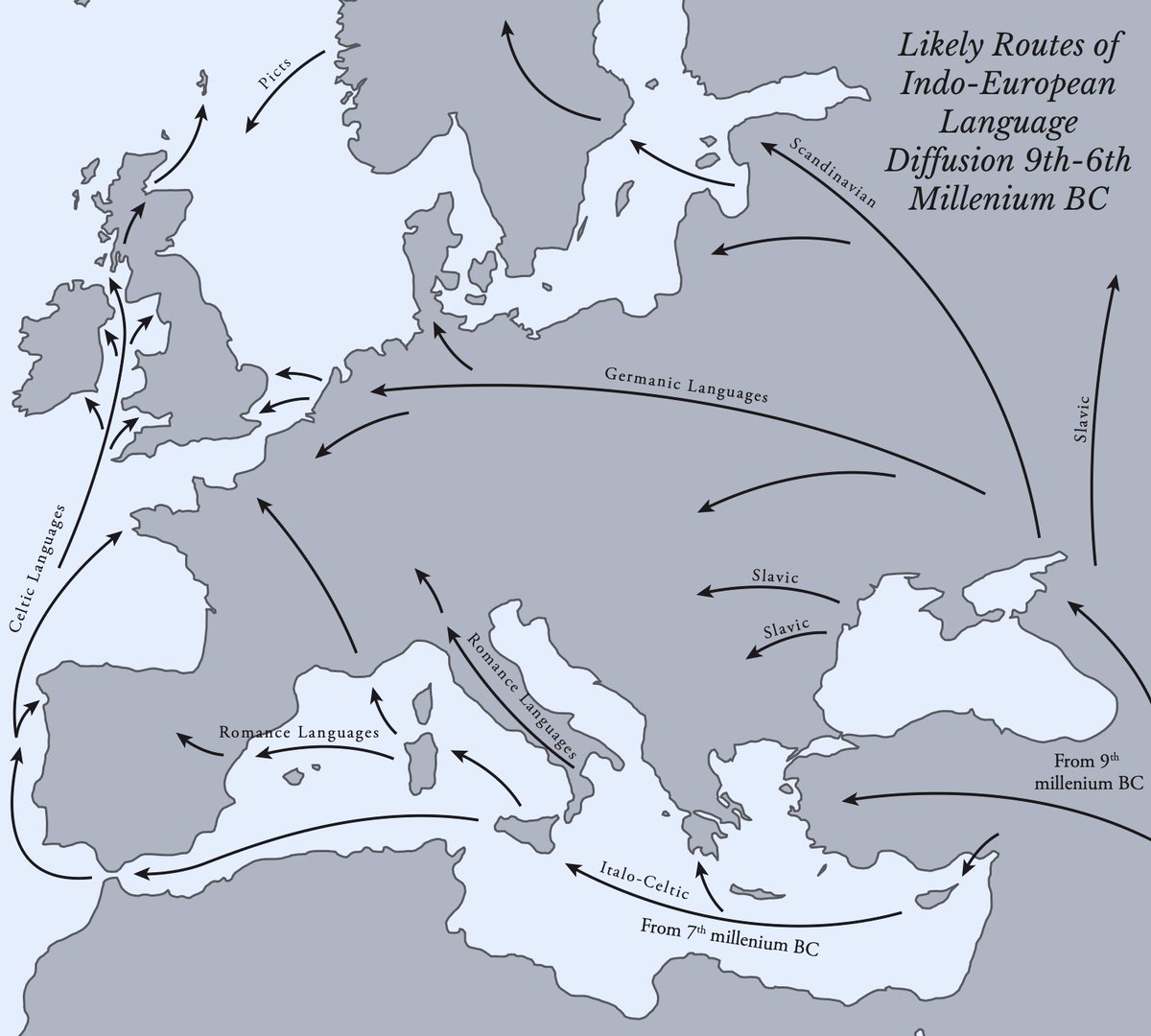
The oldest surviving Irish text, the Book of Invasions, records a tribe called Erainn, from Arya, arriving from the south by sea and making its way inland to the Hill of Tara. The Persians took the same name for themselves. Iran means the land of the Aryas.
These Vedic influences arrived in pulses. The Iranian is the oldest. A landward pulse followed the river valleys of the Dniester, the Dnieper, the Donau and on into Denmark, leaving the mother goddess's name behind at each stage.
The Celtic pulse came after 5,600 BC. The Celtic branch had by then separated from Italo-Celtic in the Mediterranean and continued up the Atlantic seaboard. The route is still readable on the map. Portugal. Galicia. Gaul. Pays de Galles. Cornwall. Galloway. Galway. The "gal" names trace the coast.
Ireland remembered its origin.
The old story of Aryan nomads riding into India from the steppe has no DNA support. Michel Danino reviewed nine large-sample genetic studies from 1999 to 2006 and found no invasion signal. The archaeological record shows no cultural break from prehistory. The outstanding character of ancient India is continuity.
The trails from Iran and from Ireland both lead back to India.
I set the full case out in "How Maritime Trade and the Indian Subcontinent Shaped the World."