at airport. flanked by a 20 something boy on the right mowing down rice and fries and watching friends on the laptop. on the left, a 20 something girl is deep lost reading from her laptop screen and she just told me off for some random tab that started playing as soon as i flipped me laptop screen open. that's physical reality. death by screens. in me head i am all animal farm. shooting pigs. bless orwell.
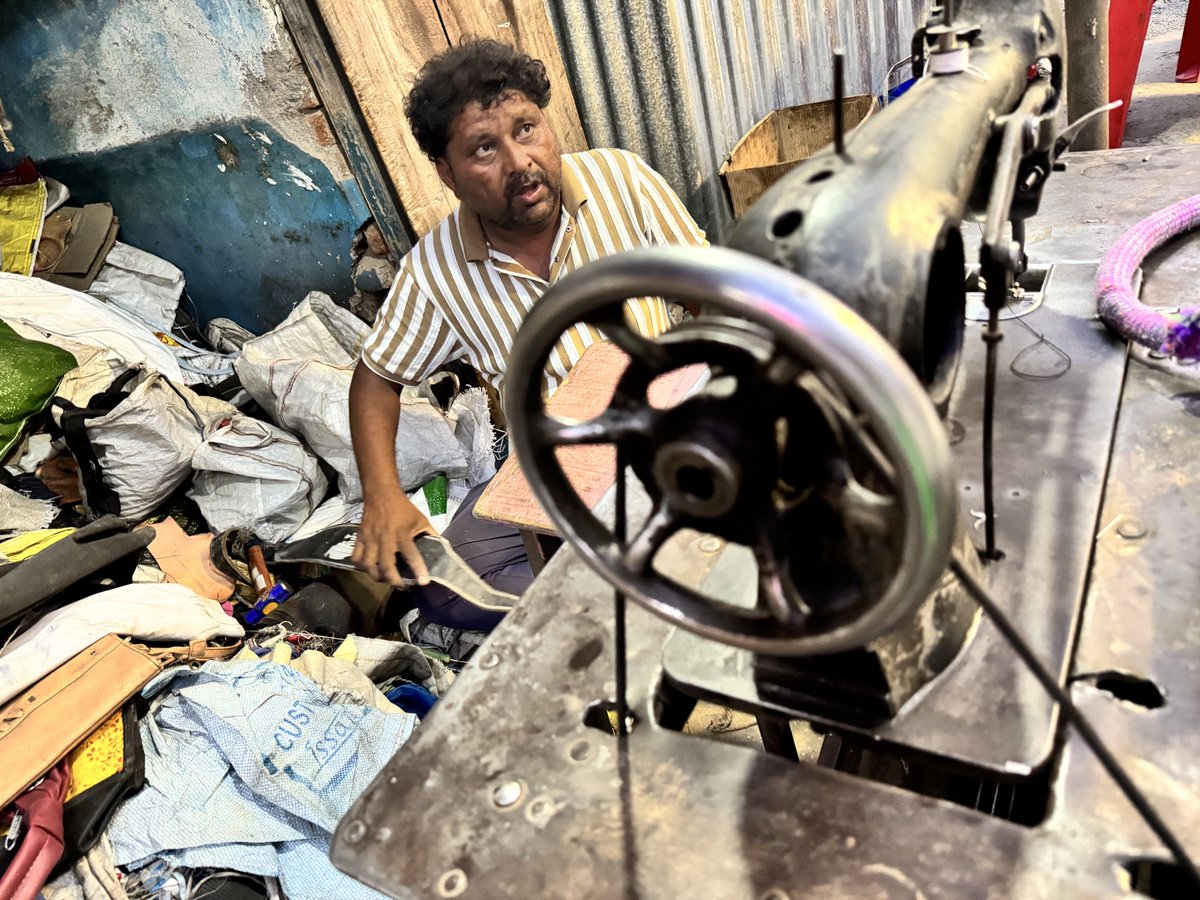
electrician sounds just about right.
this is gold though ⬇️
I find myself saying this over and over again to young people today: the future does not belong to people who are able to get good grades on tests. It belongs to people who can operate under uncertainty, in domains where correctness is hard to define.
Those domains will become the thin waist of the economy: as productivity everywhere else accelerates, the humans who excel there will become our economic Strait of Hormuz.
The best humans in these domains will demand an enormous cut of the growing economic pie. Your imperative going forward is to make sure you're one of these people.
The highest-value human work in the AI era will be in domains with sparse reward signals. Internalize this, or watch your value erode over the next decade.
Math, programming, rote memorization, data science, all fucked. The classic “smart nerd” jobs are exactly where AI is strongest, because the feedback loops are dense. You can check the answer. You can run the test. That means AI can improve quickly, and humans will rapidly fall behind.
Your advantage as a human is in messy domains.
Taste. Judgment. Negotiation. Risk-taking. Politics. Sales. Science at the frontier. Anything you can only really learn by doing. Cross-disciplinary stuff.
The valuable domains will be the ones guarded by secrets, tacit knowledge, weak labels, long feedback cycles, and ambiguous outcomes. Places where the training data is scarce, the ground truth is disputed, and it's impossible to explain why something is good.
AI will still enter these domains. But we will be slower to trust it unsupervised there, because it will be harder to tell when it is right, harder to prove when it is wrong, and difficult to construct secure sandboxes. The stakes will be too high to YOLO it.
I find myself saying this over and over again to young people today: the future does not belong to people who are able to get good grades on tests. It belongs to people who can operate under uncertainty, in domains where correctness is hard to define.
Those domains will become the thin waist of the economy: as productivity everywhere else accelerates, the humans who excel there will become our economic Strait of Hormuz. The best humans in these domains will demand an enormous cut of the growing economic pie.
Your imperative going forward is to make sure you're one of these people.
(Or become an electrician. That probably works too.)
Your best people are leaving.
If it was just money, you could fix it. This is different. The real reason is your environment doesn’t let them do their best work.
You hired A-players and they became spectators. You hired people with taste and speed, then trained them to wait.
And instead of fixing the environment, you added more process. More oversight. More “alignment.”
The result? Slow suffocation disguised as management.
I've been on both sides of this. Built environments as a founder. Lived in one as an IC at Dropbox. The difference taught me everything about why great talent fails in wrong environments.
Great people don’t suddenly get mediocre. The environment makes them act that way.
I wrote about the real framework that works: Vibe → Environment → Culture. How @morganb made his explicit. And why this order changes everything.
If you're losing people you can't afford to lose, this might explain why.
@joeljohn wars are based on human mistrust and power you can wield or care you neglect. it is human existence’s fallacy. we all live it in many ways. we all exercise it is may ways. some just brutal than others.