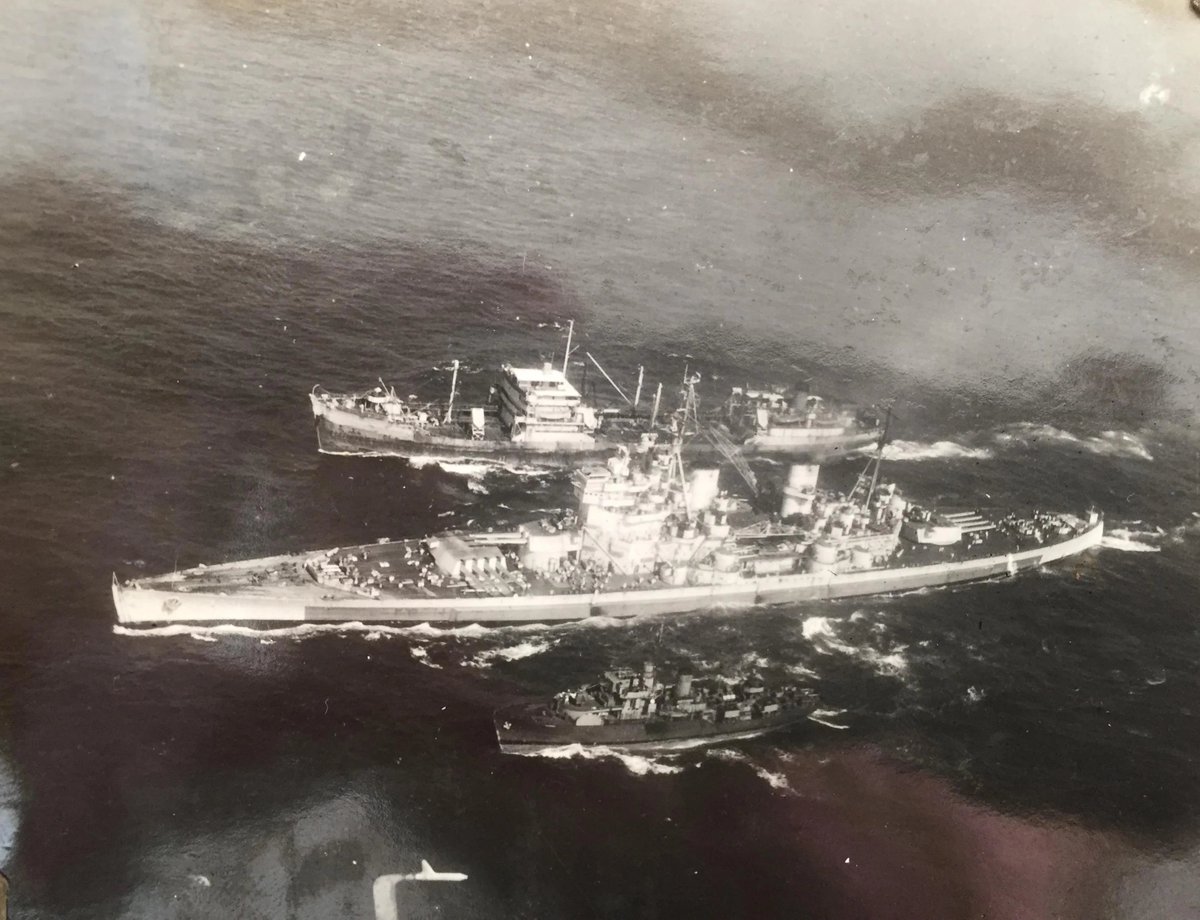
The battleship HMS King George V takes on supplies during an underway replenishment in July of 1945.
The process of refueling while underway was one of the biggest issues affecting British ships during operations in the Pacific. Previously, the capability was not as important given the Royal Navy had an extensive network of bases for resupply. However, the loss of vital Pacific bases severely hampered the Royal Navy, contributing to their decision to pull back to the western Indian Ocean.
At the same time, the greater threat of submarines and aircraft in the Atlantic convinced the Royal Navy to forgo the riskier replenishment at sea option in favor of the safety of their Atlantic network of ports. This lack of training became an issue when British ships integrated with fleets of the United States Navy. The British ships often had difficulty taking on fuel and supplies at the speed of the American ships, leading to flexibility issues. This was one of the factors leading to the early reluctance of the United States Pacific Fleet to operate alongside the British, a sentiment also shared by some politicians in Britain (who feared that they would end up being baggage).
However, with many in the Royal Navy eager to take a greater part in the fighting as well as to re-establish a British presence in the Pacific for political reasons, a whirlwind effort was made to dramatically improve the supply network so that British ships could push forward. The British Pacific Fleet had to establish a comprehensive fleet train, a supply line of oilers, ammunition ships, and other support ships. Many were supplied by the merchant fleet while others were supplied by the United States. At the same time, many officers were sent to the United States to learn how the US fleet operated and how it resupplied. Other observers were assigned to the Pacific fleets to gain first hand experience.
The end result was a dramatic overhaul of Royal Navy operations. Within the span of roughly a year, the British Pacific Fleet went from what were largely regional operations to being able to conduct operations deep into enemy territory for extended periods of time.
This overhaul was one of the more impressive feats of the Second World War and a testament to the skill and flexibility of the Royal Navy.