@random_poisson J'habite aussi un appart RT2012 qui chauffe beaucoup. Cette réglementation vise principalement le confort d'hiver. Cela change avec la RE2020 qui intègre mieux le confort d'été. Côté matériaux, pour allier les deux il faut de bons isolants qui permettent également de déphaser.
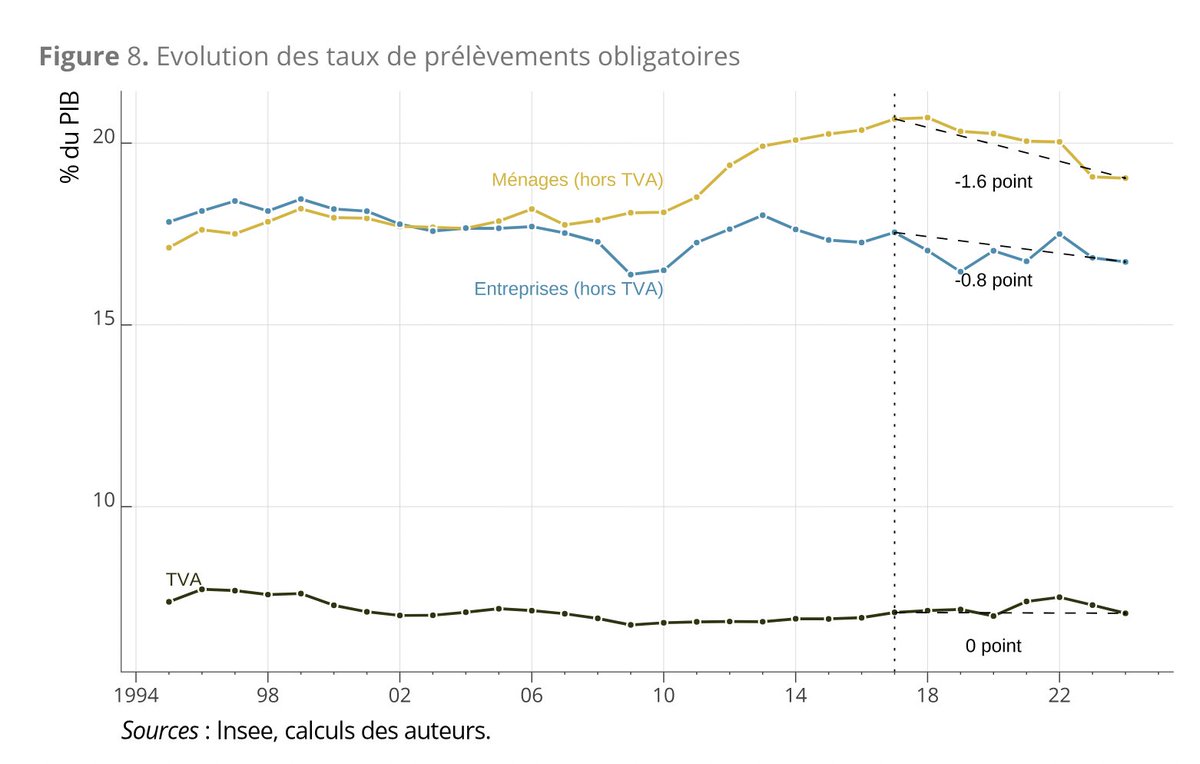
On entend régulièrement que le déficit serait dû au choix de réduire les recettes en baissant les impôts sur les riches.
On cite pour cela une étude OFCE, qui dit que les prélèvements ont baissé de 2.5% de PIB de 2017 à 2024 (-1.7 sur ménages, -0.8 sur entreprises).
@_ilestlor S'il vous plaît, ne répandez pas de contre-vérités : la RT 2012 (car pour un immeuble construit en 2020, c'est cette dernière qui s'applique) autorise les PAC et n'oblige pas à installer du gaz. Le gaz était autorisé mais seulement un certain type avec un meilleur rendement.
Ce qui est fou dans le dogmatisme éthique écologique anti climatisation c’est que chacun livré à lui-même, s’équipe ou va s’équiper quand même pour arrêter de suffoquer mais de manière anarchique avec des équipements venus de loin, de qualité très inégale que ce soit en termes de consommation d’énergie ou de rejets de fluides frigorigènes… au total, le déni prohibitionniste, va conduire au pire là où anticipation, recherche, industrialisation et politique publique aurait permis de réguler et de créer de la richesse. Mais non..
Le CNRS, sous couvert de faire de l'anthropologie, fait la promotion de la biodynamie.
C'est dans la lettre mensuelle du département SHS, et c'est juste dingue
page 10
Quelques extraits ci dessous
https://t.co/SWThwikumt
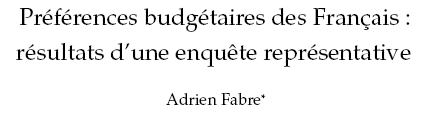
🚨 Quelles mesures les Français sont-ils prêts à accepter pour réduire le déficit public ? J'analyse les résultats d'une enquête inédite menée en 2026 sur un échantillon représentatif de 1 000 Français.
🧵Voici les 5 résultats qui m'ont le plus surpris :
Présentation particulièrement malhonnete (sans surprise). Ce ne sont pas LES scénarios du GIEC qui sont révisés à la baisse, mais uniquement le scénario le plus émissif.
Le scénario "moyen" n'est pas revu à la baisse et justifie largement l'alarmisme climatique.
One thing that’s missing in this conversation but reinforce Luis’ side is cultural and political power.
You cannot ppp adjust the fact that the technological sector is a huge part of our lives and Americans are shaping it while Europeans are just consuming what’s offered to them.
How much would it be worth for Europeans to have more influence over the way the digital world is being shaped ?
I am not even saying that Americans are doing a poor job, but they’re doing it with their tastes and their interests in mind.
🇸🇳🗣️ "On leur a fait croire que si tu tues un homosexuel, tu vas aller au paradis". Au Sénégal, la traque des homosexuels s'intensifie. Des centaines d’hommes ont été interpellés ces dernières semaines, dont un Français de 30 ans. Ils risquent jusqu’à 10 ans de prison, certains sont lynchés directement par la population. #JT20h
J'étais conseiller à Bercy lorsque s'est posée la question de sous-indexer ou non les pensions au 1er janvier 2024 alors qu'une revalorisation automatique représentait +5,3% avec l'inflation (soit environ +15 Md€ de dépenses ; c'est l'équivalent du budget des universités pour donner un ordre de comparaison).
Évidemment que ce scénario a été débattu. @BrunoLeMaire l'évoque d'ailleurs dans ses récentes interviews. Dans le même temps, nos voisins européens choisissaient de sous-indexer pour maîtriser leurs dépenses publiques.
Nous pouvions choisir par exemple une augmentation forfaitaire de +50 € par mois de toutes les retraites, ce qui permettait de maintenir les petites retraites tout en répartissant l'effort justement.
Et pourquoi cette décision n'a pas été prise ? Tout simplement parce qu'en situation de majorité relative à l'Assemblée nationale (nous étions en 2023), tous les groupes parlementaires d'opposition avaient menacé de censure en cas de sous-indexation des retraites dans le PLFSS.
Vous constaterez que les positions n'ont pas varié depuis.
Et les mêmes débats ont lieu tous les ans sur les transports sanitaires, les cures thermales, etc. etc., avec des refus systématiques de réaliser des économies et rééquilibrer notre modèle, qui pèse aujourd'hui beaucoup trop sur les actifs.
Il faudra une nouvelle majorité pour changer tout cela.
We stopped everything to write an answer (link below) to Paul Krugman's two posts of today (one informal, one with a simple model) arguing that Europe is broadly not falling behind the United States.
The change measured by the Draghi report, he argues, is mostly due to growth in the technology industry, which has distorted GDP numbers without actually leading to higher standards of living. We should believe our eyes when we walk around France and walk around Mississippi.
Krugman is wrong. The measures he uses understate European stagnation. This matters enormously. Divergence with the United States is the strongest evidence for reform in Europe.
1. The growth numbers
Krugman compares the United States, France, and Germany at purchasing power parity in current prices. On that measure, France's and Germany's position relative to America has been roughly constant since 2000.
But current price comparisons miss productivity gains in sectors where prices fall. If America produces twice as much software while the price of each unit halves, the value of American software output looks unchanged even though the volume has doubled.
Most economists therefore use constant prices, which fix the base-year PPP level and apply each country's real output growth on top of it. American output growth has concentrated in tech, where prices have fallen tremendously as productivity rises. In terms of the volume of things produced, America has pulled away from Europe.
2. Is it all the tech industry?
Krugman concedes this tech divergence but says it is not welfare-relevant. The American growth lead is an accounting artefact of measuring more iPhones at base-year prices, not a sign that Americans are actually richer, because Europeans buy the same iPhones at the same world prices.
This is not the right way to think about the world today, as an earlier Paul Krugman would have argued.
His model assumes tradable goods, interchangeable workers, marginal-cost pricing, and no profits. Each assumption fails.
Most of what households buy is non-tradable: housing, healthcare, childcare, education. When American tech firms bid workers from haircutting to coding, American haircut wages rise. Germany has no growing tech sector to do the bidding, so German wages stay flat.
Technology is not priced at marginal cost. Apple's margins are around 40 percent. Anthropic's inference margins are at 70 percent. The major platforms enjoy network effects, switching costs, and lock-in that hold prices well above what a competitive market would deliver. A large share of the productivity gains in technology stays as profit.
A lot of the value of American technology dominance shows up in equity, not in wages. Apple, Microsoft, Nvidia, Alphabet, Meta, and Amazon together are worth $21 trillion, more than the entire combined stock market value of all European stock markets. Around 60 percent of US equity is held by American households. The median French or Spanish household holds almost no equity.
The median employee at Meta, a company with almost 80,000 employees, earned $388,000 in 2025.
This advantage is not going to go away. Krugman's own 1991 paper, cited in his Nobel prize, showed that comparative advantage in modern industries is produced by increasing returns to scale, specialized labor markets, supplier networks and the agglomeration of suppliers, workers, and ideas in particular places. Once an industry concentrates somewhere, the concentration is self-reinforcing. Europe is being pushed away from the next round of technology industries (AI!).
3. What about inequality?
Another retort is that GDP per capita hides substantial inequality, and so even if America is rich on average, this is mostly due to the super wealthy.
But despite the US's high pre-tax income inequality, it also achieves higher median incomes than Europe, in part because of such a high base, and in part because it actually redistributes more than many European countries.
The cleanest comparison is median equivalised disposable household income: income after cash taxes and transfers, adjusted for household size and purchasing power. According to the OECD's 2021 numbers, the median American earns 30 percent more than the median Dutchman, about 31 percent more than the median German, and about 52 percent more than the median Frenchman.
4. What about hours worked?
Krugman points out that while American GDP per person is higher, most of this is because Americans work more. For this divergence to be an hours worked story, Americans must work more relative to Europeans now than they did in 2000.
The opposite has happened. Birinci, Karabarbounis, and See in a 2026 NBER paper show that about half of the American-European hours gap that existed in the 1990s has reversed by the end of the 2010s. Americans work fewer hours per person than they did in 2000, while most Europeans work more.
5. Is America not a bad place to live?
Walk around Alabama and France: surely the former cannot be substantially richer than the latter?
American cities often have poorer centres and richer suburbs or exurbs. European cities preserve richer and more attractive historic cores. A visit to a city as a tourist in America compared with a city in France will leave one having seen different spots on the income distribution. Americans in Europe go to the nicest and richest European cities.
Rather than a walking around test, do a driving around test. Go to the periphery of any modern American city and see a level of new-built material wealth that is extremely uncommon in Europe, with thousands of enormous four- or five-bedroom homes. In the South, in places like Nashville and Austin, drive around the downtowns to see hundreds of luxury apartment buildings springing from the ground. This construction boom is replicated virtually nowhere in Europe today.
The other question is generational. Housing often costs more in Europe than in the United States, despite the quality of the housing stock generally being much better. Europe has nice city cores but these are inaccessible to young Europeans.
Consider the salaries available to entry-level workers. The starting pay for a London police officer is $57,000. In Washington, DC, $75,000. The entry-level Deloitte consultant job in Madrid pays around €28,000, roughly $33,000 per year. In Charlotte, the entry-level Deloitte job pays $63,000.
There are many things to dislike about life in America. But relative to 25 years ago, the gap in material wealth has shifted dramatically in America's favor.
https://t.co/VOpQ32R5tg
For the past few days we’ve been reading that once we correct for rising prices, living standards in the United States would be comparable to (Western) Europe.
Thrilled that our paper "Almost fare free: Impact of a cheap public transport ticket on mobility patterns and train delays" - the 9-Euro Ticket - is now out at @JPubEcon:
https://t.co/OzFA3Dy0ou
Using three different datasets and MVPF analysis, we find that...
New QJE paper on France’s mandated profit-sharing: distributing excess profits to workers raises the labor share and reduces the profit share, with little effect on investment or productivity. Gains mainly go to lower-skilled workers; high-skilled pay unaffected.
On vous a créé une super calculette pour simuler l'achat d'une voiture électrique.
C'est totalement indépendant. Vous obtenez le bilan économique et écologique et pouvez même comparer différents modes de financement.
https://t.co/uUMZTh9qFh
Est-il sain pour la démocratie que des sensibilités réelles (Bournazel, Knafo, Chikirou) disparaissent pendant 6 ans du Conseil de Paris, au profit d’une majorité artificielle fabriquée par la prime majoritaire ?
Replacing hospital managers who are doctors with MBAs reduced mortality by 8%. That works out to two fewer deaths per every thousand patients. Managerial quality really does matter, and their pay is justified by the value created. 1/