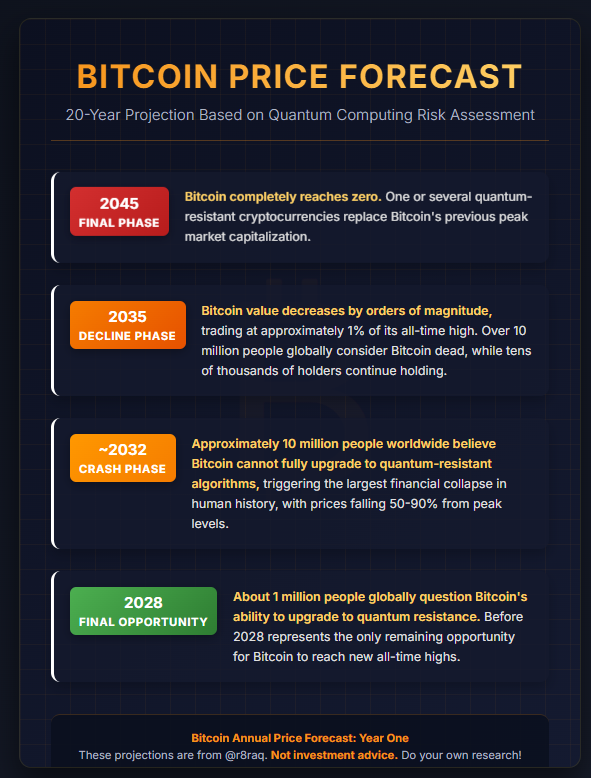
@ZynxBTC Yes, We all hope bitcoin to get a new ATH be4 2028.
While it could be all way down after 2028...
Quantum-safe! it's an unsurmountable barrier.
The quantum timeline just got shorter, again.
Harvard, Anthropic, and QuEra Breakthrough Research Uniquely Shows AI Can Reduce the Resources Quantum Applications Need, Significantly Accelerating the Era of Useful Quantum Computing
AI-designed circuits achieved up to a 39-fold reduction in a combined gate-and-qubit resource metric, helping near-term fault-tolerant systems tackle more demanding problems sooner.
https://t.co/6L8nLYDayX
Agree that quantum safety is essential for core infrastructure. My concern is that even 2028 may be optimistic — round 4 signatures won’t be selected until 2027, and based on previous rounds, final parameters may take another year to settle.
Among round 4 candidates, UOV seems to have one of the strongest long-term track records. However, standardized parameters are designed for broad use cases, so they may not be ideal for every scenario. It may be worth continuing to explore practical adaptations alongside NIST’s standardization process.
A high-quality debate on post-quantum algorithms: lattice-based, hash-based, and multivariate. RAQCoin: the only post-quantum token currently using multivariate unbalanced Oil-Vinegar algorithms and zip-code public-key compression.
Agree that quantum safety is essential for core infrastructure. My concern is that even 2028 may be optimistic — round 4 signatures won’t be selected until 2027, and based on previous rounds, final parameters may take another year to settle.
Among round 4 candidates, UOV seems to have one of the strongest long-term track records. However, standardized parameters are designed for broad use cases, so they may not be ideal for every scenario. It may be worth continuing to explore practical adaptations alongside NIST’s standardization process.
This is a list I compiled several years ago outlining the obstacles to Bitcoin’s migration to quantum-resistant, for your reference. @P3b7_@FutureDies
The obstacles to migration are as follows.
1. No suitable quantum-resistant algorithm
2. Hash-based and lattice-based algorithms have excessively large public keys and signatures
3. Migrating to quantum-resistant algorithms could cause severe on-chain congestion and even paralysis
4. Quantum-resistant algorithms result in a significant reduction in transaction efficiency
5. Increased node and transaction fees
6. Who has the authority to freeze or burn Satoshi’s addresses and other lost addresses
7. The aggregation threshold in quantum-resistant algorithms is challenging
8. Taproot makes the transition to quantum-resistant even more difficult
9. High hardware upgrade costs
10. 1MB block size is not suitable for quantum-resistant algorithms
11.Achieving global consensus is extremely difficult
and more...
@P3b7_ Are we sure of that ML-DSA could give us a real path to post-quantum threshold signing?
As a lattice-based dig-sig, ML-DSA per se gets a quite complicated re-design to be aggregated efficient. right?
It's probably a big "could-be", not a "real", IMO.
#Raqcoin, which utilizes #Multivariate- UOV — a type of signature resistant to quantum computer attacks.
It also supports a unique Proof-of-Work (PoW) mining mechanism based on solving multivariate equations that is designed for long-term POW operation.
#Bitcoin#Raqcoin #PQC #NIST #Multivariate #UOV