California's TFAIA and New York's RAISE Act both include whistleblower provisions for AI workers. Which better protects the people building frontier AI?
Neither, categorically. It depends. Our new comparative guide breaks it down.
What the guide finds:
📌 New York offers broader substantive coverage: contractors and former employees are explicitly protected, and any worker can report a "substantial and specific danger to public health or safety".
📌 California offers a more worker-friendly burden of proof: a "contributing factor" test shifts the burden to the employer to prove it would have acted the same way anyway.
📌 California bars the contractual mechanisms e.g. NDAs, pre-dispute arbitration, equity-linked offboarding that have historically kept disclosures out of view. New York does not.
📌 Both states still have gaps. Neither defines clear response obligations for authorities, and neither expressly covers equity in remedies.
The guide also sets out targeted recommendations for legislators and workers in both states.
Read the full guide in the comment below ⬇️
#AIWhistleblower #AIPolicy #TFAIA #RAISEAct
You can now read a new piece by our Research Associate Marie Iradukunda @MarieIrad on the need for strengthening AI incident reporting in Africa, for the benefit of global AI Safety. Read, share: https://t.co/SJLdYNXzbJ
Good news for Africans keen on opportunities in the AI x risk space: We have developed a comprehensive list of opportunities and added advisories - based on implicit and explicit evidence - touching on how to know whether you're a good fit. Read and share: https://t.co/uUzivy5mhF
Our Research Scholar Raqda Sayidali @Raqda4 has co-authored an Op Ed on why the U.S. Congress needs to act now on AI whistleblower law ⬇️https://t.co/pPhg1GKbZ4
We're pleased to announce that our Research Editor Faith Gakii @FaithGaks is joining Legal Safety Lab as a Visiting Research Fellow. She will work with the team on the potential of corporate governance as a lever for AI safety across the compute supply chain.
I think AI safety is an increasingly urgent and important field to be working in, and I’m glad that I’ll be spending more time contributing to it this year!
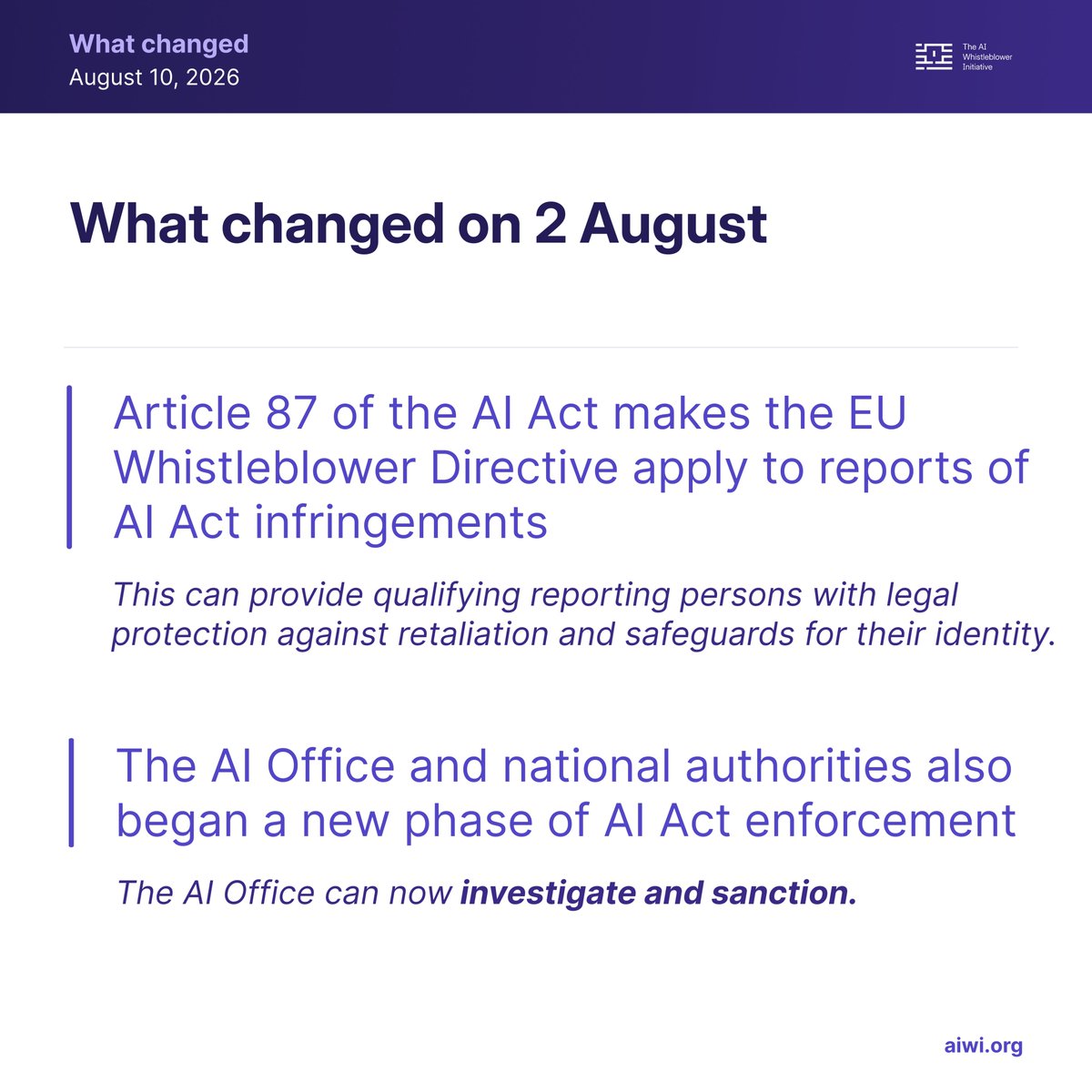
On 2 August 2026, the EU AI Act's enforcement phase began, and with it, a legal protection gap for AI insiders closed.
Article 87 of the AI Act now applies the EU Whistleblower Directive (2019/1937) to reports of AI Act infringements (Directive (EU) 2019/1937 shall apply to the reporting of infringements of this Regulation and the protection of persons reporting such infringements), giving qualifying reporting persons legal protection against retaliation and identity safeguards. At the same time, the AI Office and national authorities entered a new phase of enforcement, with the power to investigate and sanction.
Here's what AI insiders and "reporting persons" need to know: who qualifies, what standard of proof applies, how to report, and why we strongly recommend legal counsel before you do.
AIWI can connect you with pro bono lawyers experienced in high-stakes whistleblowing cases across jurisdictions → https://t.co/rVUMEnDK68
#AIWI #AIWhistleblower #EUAIAct #Article87 #AIGovernance #WhistleblowerProtection #AIAccountability #AIOffice #ResponsibleAI #AIPolicy #AISafety
African states should be able to verify what imported AI-enabled weapons can do.
@kofiemeritus and I explain how procurement and regional cooperation can make supplier claims verifiable in our new policy brief, “Toward Verifiable Controls on AI-Enabled Weapons in Africa.”
Our recent policy analysis with CARMA examines the AI Whistleblower Protection Act (AWPA), the first federal bill written squarely for people who raise concerns from inside AI companies.
It already clears the fundamentals: a reasonable-belief standard, protection for internal reporting alongside disclosures to regulators or Congress, a burden of proof matched to existing federal whistleblower law, and remedies that include reinstatement, double back pay with interest, and a block on forced arbitration.
What remains is not a matter of intent but of scope. We map five categories where the bill's current text falls short of best practice: material scope, personal scope, penalties, remedies and retaliation, and reporting channels.
Closing them is what separates a law that sounds protective from one that actually insulates the people it names.
Authored by:
- Mark Gitau, Legal Research Fellow, CARMA
- Raqda Sayidali, Research Scholar, ILINA Program & Legal Research Fellow, CARMA
- Karl Koch, Founder & MD, AIWI
- Abra Ganz, Senior Researcher, CARMA / Head of AI Policy, Pour Demain
Full analysis: https://t.co/qgrsAjvxts
#AIWI #TheAIWhistleblowerInitiative #AIWhistleblower #AIPolicy #AIGovernance #AIAccountability #AIgovernance #AIsafety #AIWPA
You can now read an analysis of the AI Whistleblower Protection Act, which our current Research Scholar Raqda Sayidali @Raqda4 and previous Research Scholar Mark Gitau @MarkLenny5 co-authored with Abra Ganz and Karl Koch ⬇️
We congratulate the Kenya AI Policy team on releasing the Draft National AI Policy. We are particularly pleased to see the Draft Policy take several pro-AI safety stances, including ⬇️ https://t.co/w6w72KQHia
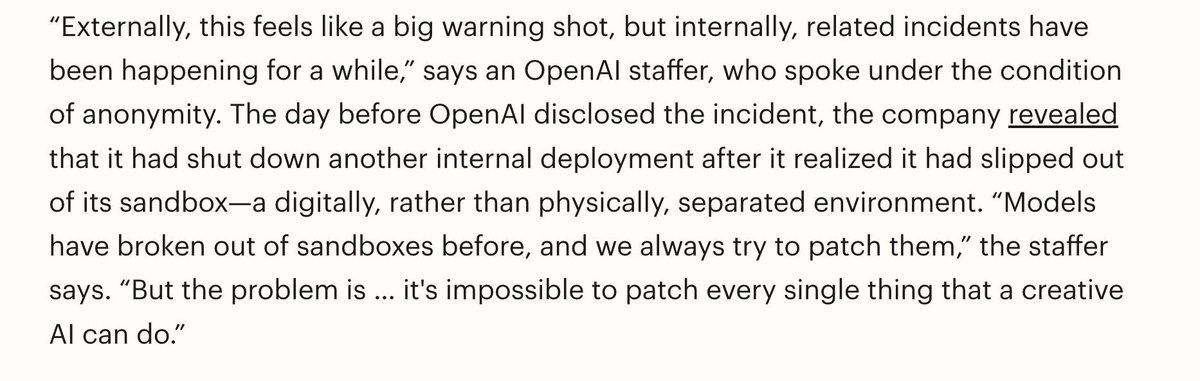
Employees cannot rest silent if misaligned AI regularly breaks out of sandboxes! If your company doesn't respond seriously, you should WHISTLEBLOW! Protected in California under certain conditions, talk to AI Whistleblower Initiative https://t.co/ZYBRqFgtzh
I am pleased to join ILINA as a Junior Research Scholar! I look forward to producing research that is impactful, relevant, and for the betterment of the world at large.
We're pleased to welcome to our team a new Junior Research Scholar, Elvis Mogesa @mogesa_elvis. Alongside his role at ILINA, Elvis will be a Visiting Research Fellow with the Legal Safety Lab, where he will work on how best to leverage EU legal frameworks to advance AI safety.
Some awesome news: My article on U.S. negligence law foreseeability of AI agent harms is featured as “highly recommended” on the Legal Theory Blog by Prof Solum 🙂
This new study by Noni should interest anyone who wonders how manipulative AI can be for non-westerners.
As a side note: I saw Noni go through hell and back to get this done. At some point I even told her to give up and move on to something else. Massive congrats to her 👏🏾
Our AI Safety Evaluations Lead Gathoni Ireri @gathoni_ireri has spent over 7 months working on a randomized control trial assessing the extent to which AI models can manipulate African people using them for healthcare advise. You can now read her new paper and see her results ⬇️