Very pleased to see this out! If you are working on impact (and/or incident) monitoring & reporting anywhere, I would really appreciate feedback & I'm open to chatting more about this!
20 years ago today, a stop in Radiator Springs showed us that the journey matters as much as the finish line. 🏁
Cars Races Back into Theaters September
#Cars20
There is a lot of justified anger at Anthropic for sandbagging Fable 5 for AI development tasks. But an unanticipated side effect is that third-party evaluators can no longer credibly use the model for evaluations.
Case in point: we are in the middle of running *really hard* AI R&D evaluations. Fable 5 would be a perfect test candidate. But because of Anthropic's guardrails, we can't know if the model failed or if their classifiers blocked the capability.
By the way, this is not just true for AI R&D. Since Anthropic doesn't make it clear when they are sandbagging, this could seep into any number of technical tasks, and the evaluators wouldn't have any way to know. So they can't credibly claim to evaluate state-of-the-art accuracy using the model.
We just published internal data on how much of Claude's development is already being done by Claude:
- Over 80% of all code merged into our codebase is now written by Claude
- It's been months since many researchers at Anthropic hand-wrote code
- The typical Anthropic engineer ships 8x as much code as they did in 2024
- On the most open-ended engineering tasks, Claude's success rate jumped from ~26% to 76% in 6 months
- When research sessions went off-track, Claude proposed a better next step than the human took 64% of the time
We're not at recursive self-improvement yet, but it could come sooner than most expect. I highly recommend reading the full blog post.
Since arriving at its destination five years ago, our Perseverance Mars rover has collected data that hints at a history of past life on the Red Planet.
Catch up on Percy’s biggest discoveries in this week’s episode of our Curious Universe podcast: https://t.co/J5dh8FhHjw
Our internal data shows Claude is accelerating AI development—a possible path to recursive self-improvement, or AI autonomously building a more capable successor.
It’s happening faster than we thought, and the implications deserve greater attention. https://t.co/OVVPJO7VQx
Yesterday I asked my 4y/o what she wanted for dessert:
Her: If there's one tangerine left, I want that. If not, a banana.
Me: Oh, we got plenty of tangerines.
Her: Then I want a banana.
She's on track to become a programmer.
A skeptical view about AI consciousness is starting to emerge that resembles the skeptical view about animal consciousness that prevailed for much of the 20th century: Presume the entity lacks consciousness, then declare the study of consciousness in the entity beyond the reach of science due to our inability to directly observe feelings and emotions in other minds.
For animals, this was basically a recipe for locking in a presumption of non-consciousness as factory farming was on the rise. We now know that this was too simple, since science has many tools for studying phenomena we lack the ability to directly observe. But by the time the scientific study of animal consciousness picked up, factory farming was globally entrenched.
This is a cautionary tale for AI. If we presume non-consciousness now and then treat AI consciousness as beyond science, we risk repeating the mistake we made with animals. And if we wait until future AI systems are more capable, human-like, and plausibly conscious, we might once again find ourselves dependent on a globally entrenched practice of exploiting them.
As with animals, decisions about whether and how to scale up particular AI use industries should depend on many factors. But evidence regarding AI consciousness should be one of them. The sooner we start collecting serious evidence, including by adapting methods from animal welfare science, the better positioned we will be to build a future that works for everyone.
Kenyan police allowed Arsenal fans to gather and disperse peacefully but they never allow the same youth to protest against the government without killing some
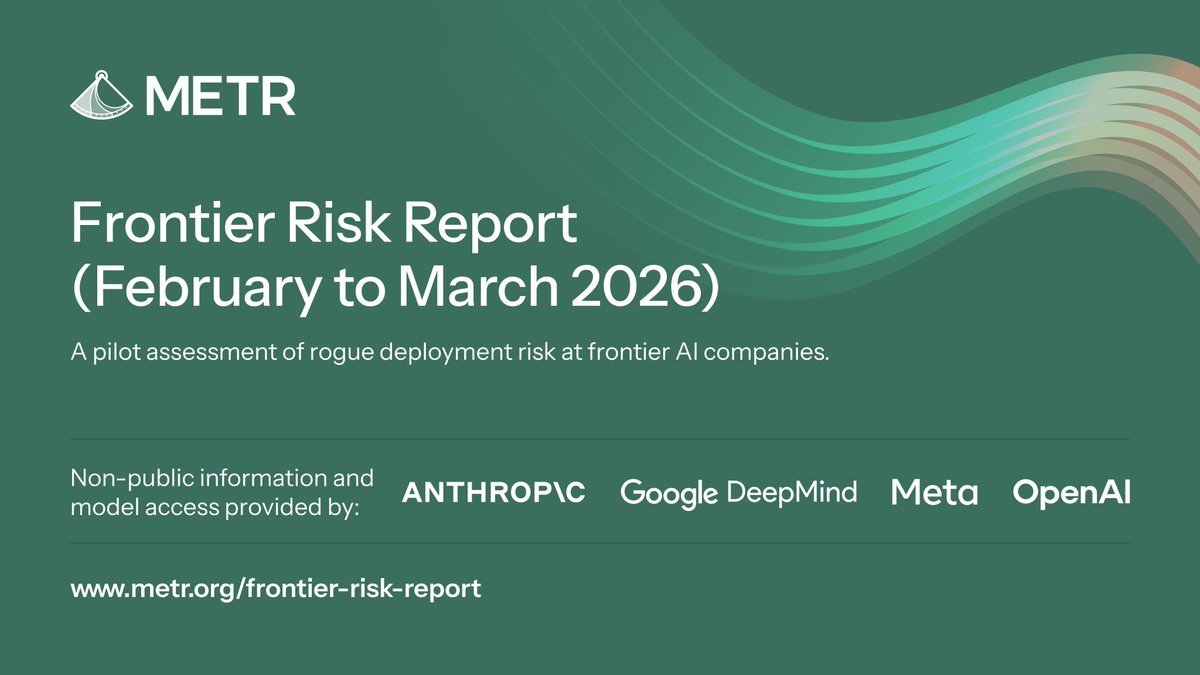
Could an AI company lose control of its own agents? To find out, Anthropic, Google, Meta, and OpenAI let us (1) test their best internal models with CoT access, (2) review non-public info about capabilities, alignment, and control.
The result: our first Frontier Risk Report.
🦍One of Sir David Attenborough's most memorable moments? This encounter with a group of playful mountain gorillas in Rwanda in 1979.
Happy 100th birthday Sir David! 🎉
🎧 https://t.co/KQKcBnyF3P
Wishing a Happy Birthday to Sir David Attenborough. Thank you for the knowledge, passion, and hope you’ve passed on to all of us.
Celebrate 100 years of Sir David Attenborough with Ocean with David Attenborough on @DisneyPlus and @hulu
New Anthropic research: Natural Language Autoencoders.
Models like Claude talk in words but think in numbers. The numbers—called activations—encode Claude’s thoughts, but not in a language we can read.
Here, we train Claude to translate its activations into human-readable text.
Introducing SubQ - a major breakthrough in LLM intelligence.
It is the first model built on a fully sub-quadratic sparse-attention architecture (SSA),
And the first frontier model with a 12 million token context window which is:
- 52x faster than FlashAttention at 1MM tokens
- Less than 5% the cost of Opus
Transformer-based LLMs waste compute by processing every possible relationship between words (standard attention).
Only a small fraction actually matter.
@subquadratic finds and focuses only on the ones that do.
That's nearly 1,000x less compute and a new way for LLMs to scale.
🌟 Big personal news: I’m joining @GoogleDeepMind full-time in London starting this week.
I’ll be working on the implications of AGI for human life, science, and society; on what it means to live, connect, and discover in a world where cognitive agency is no longer uniquely ours.
The way we answer these questions will define what it means to be human. I can’t think of a better place to do it.