🚨 New open-access paper out now in PB&R: https://t.co/zbZ6t7vrrW
We (w/ @LanguageMIT, @AphasiaLab) explore how individuals with aphasia interpret sentences & whether their comprehension difficulties stem from increased expectations of noise in language input. 🧵👇
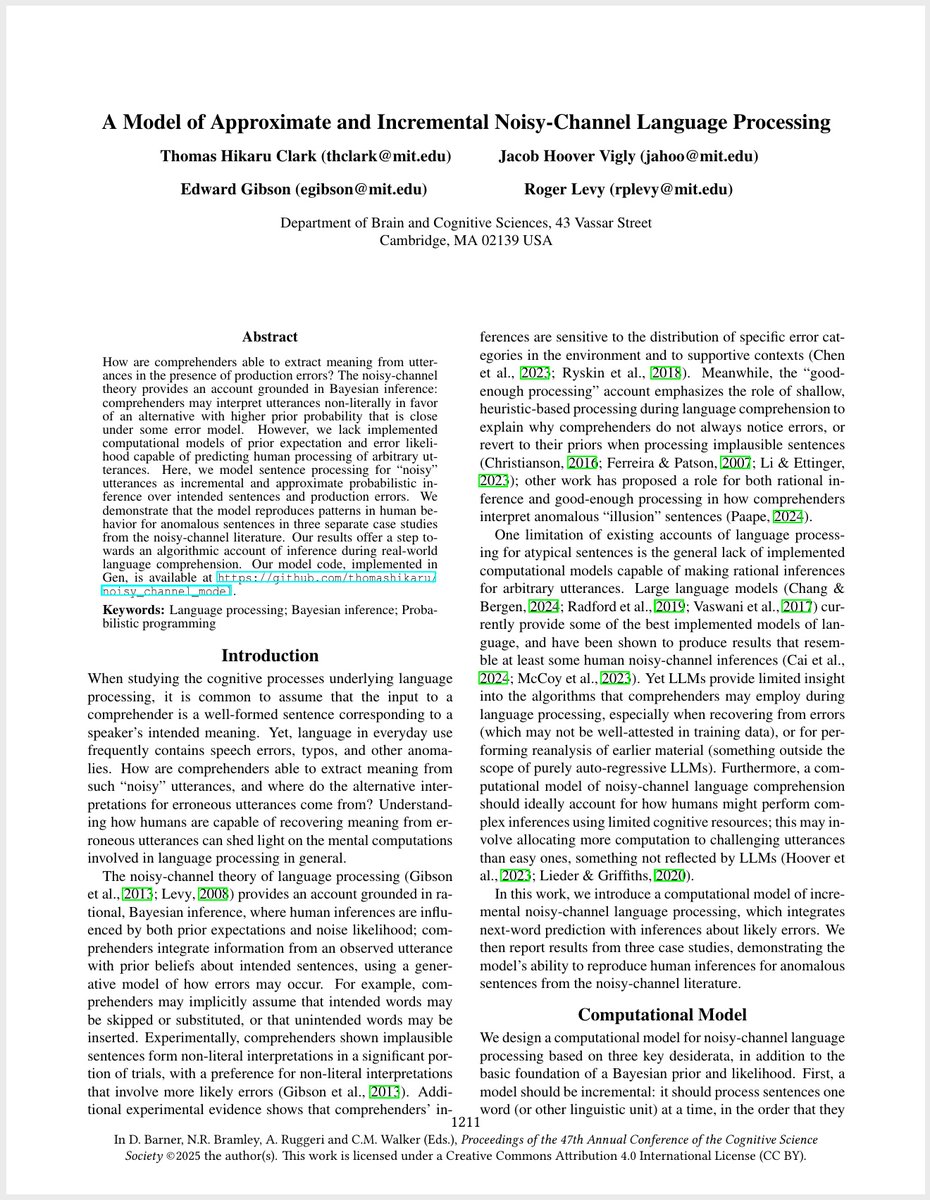
1/7 If you're at CogSci 2025, I'd love to see you at my talk on Friday 1pm PDT in Nob Hill A! I'll be talking about our work towards an implemented computational model of noisy-channel comprehension (with @postylem, @LanguageMIT, and @roger_p_levy).
Looking forward to attending #cogsci2025! I’m especially excited to meet students who will be applying to PhD programs in Computational Ling/CogSci in the coming cycle.
Please reach out if you want to meet up and chat! Email is best, but DM also works if you must
quick🧵:
New brain/language study w/ @ev_fedorenko! We applied task-agnostic individualized functional connectomics (iFC) to the entire history of fMRI in the Fedorenko lab, parcellating nearly 1200 brains into networks based on activity fluctuations alone. https://t.co/hJQRfIDQfQ . 🧵
Interested in how language production is regulated and controlled? Here's an update, in light of new developments in the cognitive control literature. https://t.co/UOfd9VCzNr
🚨 New open-access paper out now in PB&R: https://t.co/zbZ6t7vrrW
We (w/ @LanguageMIT, @AphasiaLab) explore how individuals with aphasia interpret sentences & whether their comprehension difficulties stem from increased expectations of noise in language input. 🧵👇
@michaelwdickey@LanguageMIT@AphasiaLab Thanks so much, Michael! Really appreciate the work you all are doing in this space -- excited to keep the conversation going!
6/ These findings suggest that some comprehension challenges in aphasia may be due to altered *expectations about noise* rather than a purely syntactic deficit. Understanding language processing in aphasia through a noisy-channel lens could inform new approaches to treatment.
5/ What about ppl w/ aphasia?
✅ They rely more on noisy-channel inferences than healthy adults, even when we account for differences in guessing btwn populations using a hierarchical mixture model.
🔹 Unlike healthy adults, their ability to adapt to noise remains unclear.
Glad to share that our paper (with @rljfutrell) is now on JML. In this paper, we proposed strategic memory allocation as a mechanism to handle less predictable but more informative linguistic units.
Check out this link for more details:
https://t.co/2L2aZhDoRL
The reply to our NRN piece (https://t.co/LFOLHlHzN6) by Drijvers et al. presented a chance to clarify common confusions about our work on the language network (LN) and the functional localization approach more generally: https://t.co/2MwLf6nSYd. 🧵1/n w/@neuranna@tamaregev
I'm recruiting PhD students this cycle! My lab works at the intersection of information theory, cognition, language, and AI. Wanna hear more? I asked notebookLM to generate a podcast just for you (but pls take it with a big grain of salt...)
https://t.co/YGPrJEh8gm
🚨PREPRINT ALERT🚨 New paper lead by @17copeal We use co-registration of EEG and eye movements to examine how context processing unfolds across multiple fixations in natural reading. Our first full co-registration reading study. Check it out!!
https://t.co/BZEnQPhvKt
Very excited about new paper with the amazing Susan Goldin-Meadow: Children creating language engage in whole-to-part learning. This suggests such learning is not driven by hard-to-segment input, but is a bias children bring to language: https://t.co/MLvMb5EKZt.