Looking inside and beyond eye fixations in reading
Opinion by Elizabeth R. Schotter & Brennan R. Payne
Free access before May 17: https://t.co/TNPkqqR3c4
How do we read faster than our brains process each word?
Out now in Trends in Cognitive Sciences, Liz Schotter and I explore how co-registering eye-tracking and EEG helps solve this paradox by looking "beyond" the individual fixation to probe coupling between the brain and eye
🚨Pre-print alert!🚨 https://t.co/uSCtzPvRbu
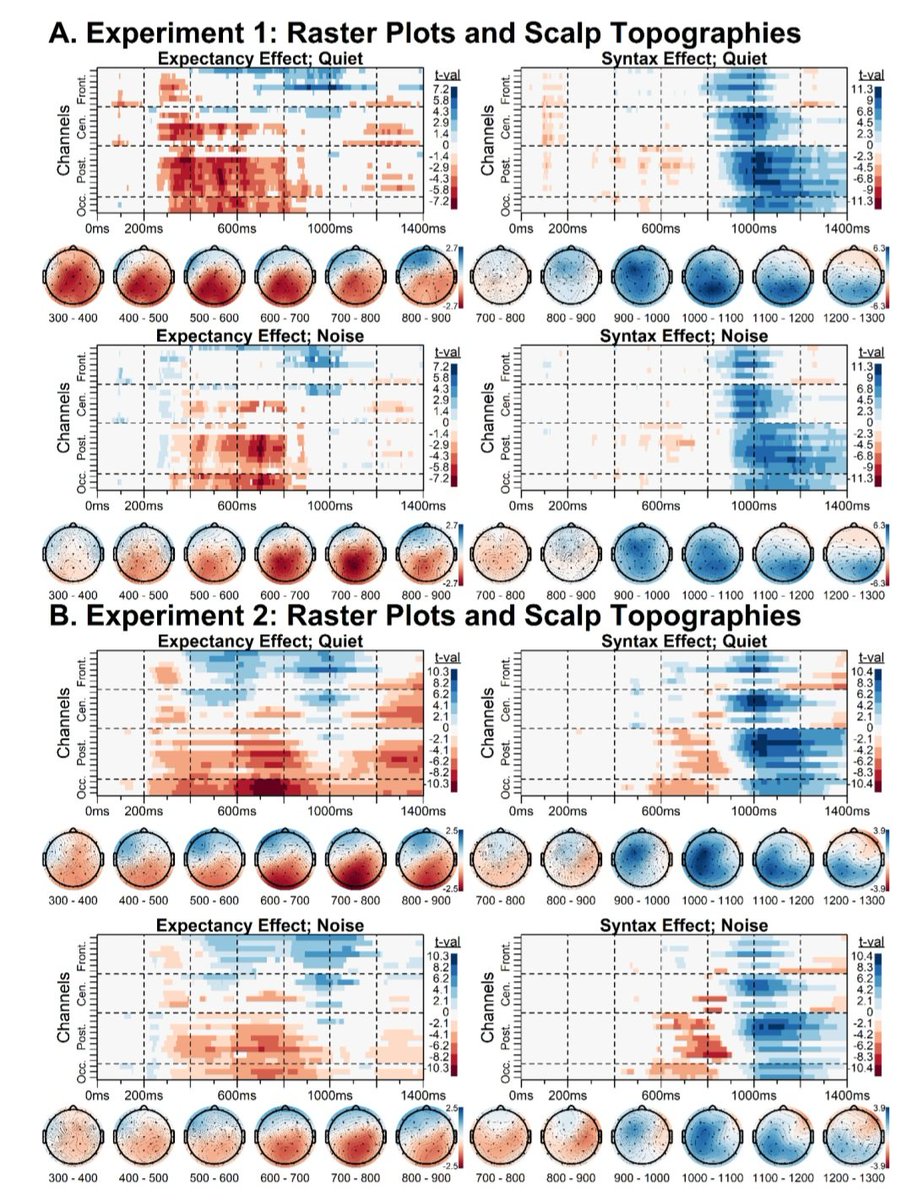
The first paper from our NIDCD-funded study examining the effects of aging, acoustic challenge, and hearing loss on language-related ERPs. w/ Jack Silcox, David Strayer, Sarah Ferguson, and Karen Bennett. Check it out!
It's clear that many do not understand what @NIH-funded research does to improve health. It's time to revive a study published 10 years ago that provides incredible information about this. link in the comment
Every single new drug approved by the FDA from 2010–2016 was built on NIH-funded research—that’s all 210 drugs. But what the public sees is just the tip of the iceberg.
Pharma takes credit for the final product, but beneath each drug developed, there are ~20 years of basic research, and 90% of the cost is from basic research funded by the NIH, which discovers drug targets, understands disease mechanisms, and creates life-saving treatments.
Figuring out how cancer evades the immune system, how addiction rewires the brain, and how heart disease develops is the role of the NIH, creating the foundation for the breakthrough drugs that come 20 years later, and the NIH does all that with only 0.8% of the US budget.
Without NIH, there would be no cancer immunotherapy, no anti-overdose medication, no anti-heart attack or stroke medication, no cutting-edge treatments.
If NIH funding is cut, the iceberg will melt. That means fewer cures, more suffering, and more lives lost.
The science beneath the surface keeps us afloat.
Invest in NIH. Invest in life
This year, I received the best Christmas present I could have asked for. I have accepted a position as a tenure-track Assistant Professor in Psychology at the @UUtah starting summer 2025. 🎉🥳🍾
🚨Pre-print alert! 🚨 New paper lead by Sara LoTemplio & Jack Silcox -- We examine single-trial relationships between error-related brain and pupil responses and their prediction of post-error behavior via simultaneous EEG-pupillometry.
https://t.co/Vz3MXiSLob
@jgeller_phd Assuming lpc to semantic violations, some evidence they are separable from Leckey and Federmeier: https://t.co/LHkfG3J1kB
https://t.co/C3BoVnoCyp
We have some data (in prep) showing lpc eliciting semantic violations show a strong pupil dilation response while not for syntax-p6
🚨PREPRINT ALERT🚨 New paper lead by @17copeal We use co-registration of EEG and eye movements to examine how context processing unfolds across multiple fixations in natural reading. Our first full co-registration reading study. Check it out!!
https://t.co/BZEnQPhvKt
The vocabulary of systems neuroscience may appear daunting to many. Here's a short dictionary of common terms. BTW if you use them in your papers and grants you will have greater success
I'm looking to recruit a PhD student (maybe even two!) to work in my lab in the Psychology Department here at SUNY Albany!
The application deadline for the Cognitive Psychology PhD program for Fall 2025 is January 15th. Read more here: https://t.co/8xqn7aPtjN
@drewjmclaughlin We looked at pupil (+ ERP) and RT relationships in an oddball paradigm https://t.co/sB0mFnZfa0
Also we report error related pupil dilation and post error slowing in a flanker paradigm https://t.co/66Y7S0HR5w
🚨 New paper alert! 🚨 Lead by Sarah Woods, we show evidence of separable effects of background noise on frontal aperiodic activity and posterior alpha power during speech perception
https://t.co/0uFTRIu7ut
As the semester begins, we are increasingly alarmed at the ramifications of the wave of new campus restrictions on speech & peaceful protest.
➡️https://t.co/Du755Tkf2P