A step towards making deep learning more flexible for the simulation of processes! Very proud of this work. Paper available here https://t.co/18hpjYzbtT
Great to host @raseidi in our research group for the next 5 months. Today, Rafael presented an overview of his research in #processmining and predictive process monitoring in particular. Special thanks to @paoloceravolo for making this possible!
Our new paper has been published in the special issue on Artificial Intelligence for Process Mining in the Engineering Applications of Artificial Intelligence journal. Check it out!
How might an encoding method contribute to a better comprehension of your initial problem within a new representation space? We extensively compared and discussed this matter in the context of trace data. https://t.co/tl7dZQsgF8 @MaleLabTs@paoloceravolo@gmtavares_@raseidi
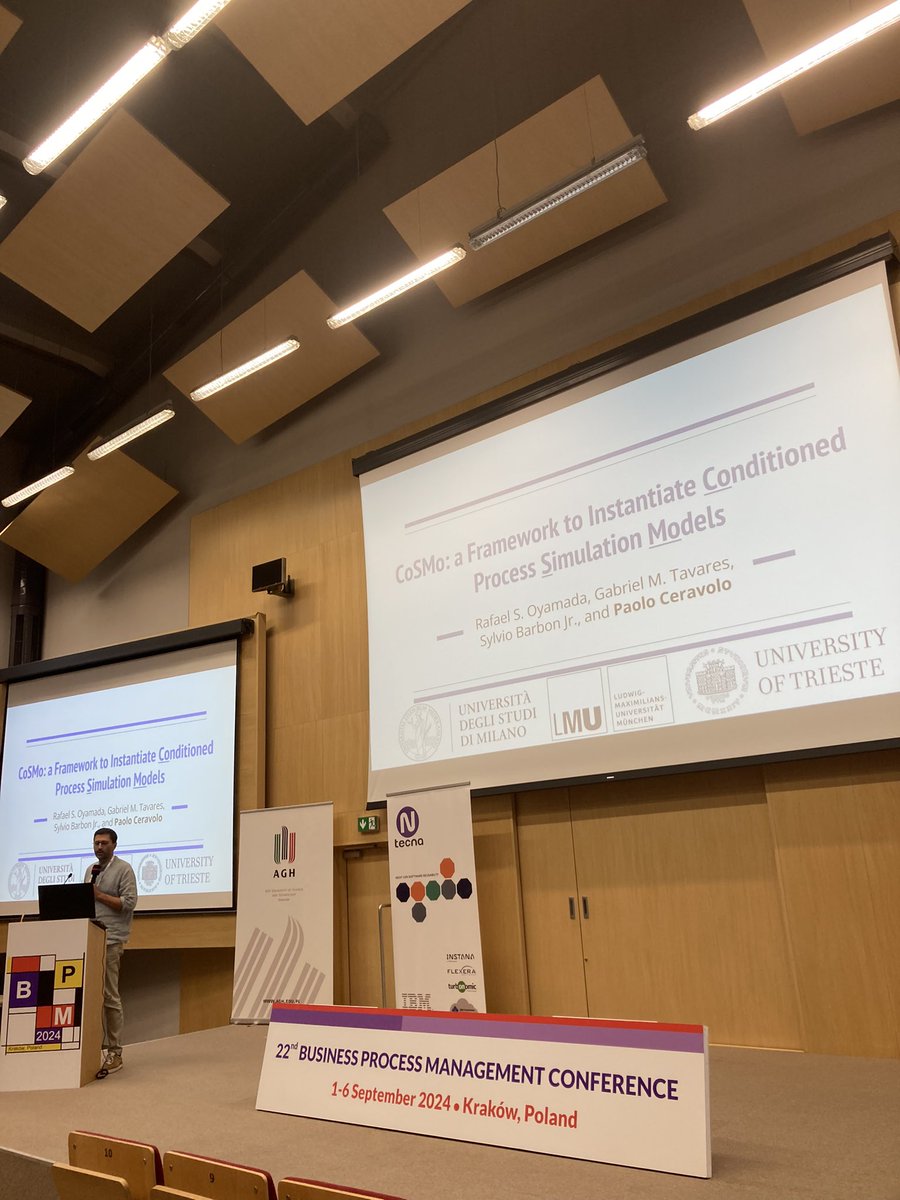
A new preprint is now available! Designing conditioned networks is the key to successful process simulation models. In this work, we propose CoSMo: a framework for implementing COnditioned process Simulation MOdels!
https://t.co/p2GMsrXGuN @gmtavares_@paoloceravolo
By biasing desired outputs, we can mitigate the natural stochasticity of deep neural nets. Our approach unlocks a range of powerful applications, such as synthetic log generation, what-if analysis, and outcome prediction.
https://t.co/6JLfeIpeHA
#Metalearning meets Active Learning in Online Machine Learning. In this paper on Elsevier Pattern Recognition, we discuss when updating an online model reduces its performance!
@MaleLabTs
Our survey about encoding methods in process mining is now available on arXiv: https://t.co/d4m17JZX4R
Here is a brief overview of what I, @sbarbonjr, @paoloceravolo, and @gmtavares_ found out:
The benchmark focuses on the anomaly detection task and assesses 27 encoding methods through hundreds of event logs. We discuss future directions based on our findings. Therefore, we also expect the proposals and insights presented in our work can be leveraged for other PM tasks.