I still remember when Scorpion said that $TMDX was putting a freeze on hiring.
7 job openings in Italy in just one week! 🇮🇹🏥
It looks like the expansion in Europe is starting to gain momentum.
When Borel presented cyclosporine to Sandoz in 1972, his employer declined to develop it.
The reasoning was sound: estimated production costs were high, and organ transplantation was too small a market to justify them.
They were right about the market size. They were wrong about what the drug would do to that market size.
Cyclosporine didn't enter an existing transplant market. It created one. FDA approval in 1983. From that point: 2,000 transplants per year to 49,000.
The same logic applied to $TMDX in 2000 when no large device company built the OCS.
Transplant medicine was a small market with complex logistics, variable reimbursement, and no obvious regulatory pathway. The returns weren't sufficient to justify the investment.
They were right about the market size. They were wrong about what the technology would do to it.
Medtronic and J&J didn't build the OCS for the same reason Sandoz almost didn't develop cyclosporine.
The companies that see the market as it is don't build the markets that didn't exist yet.
Part I of our deep dive is the history of both. Link in bio.
Part I of our $TMDX deep dive is live.🏥
The market keeps misreading every decision Waleed makes.
To understand why Summit, CHOPS, and PAD Aviation are all the same decision , you need to understand the industry before the company.🫀
That's what this piece is about. Link in bio. 👇👇
The market keeps asking the wrong questions about $TMDX.
Why did Waleed acquire Summit Aviation in 2023? Why accept margin compression at the exact moment the model was proving itself? Why enter cold storage with CHOPS after building the case against it for 26 years? Why deploy capital again into PAD Aviation in Europe?
These aren't contradictions. They're the same decision, made repeatedly.
Vertical integration of a service this complex is not a distraction from the moat, it is the moat. Every asset that looks like overhead from the outside is a coordination cost that a competitor would have to replicate before they could meaningfully compete. The margin compression is the price of making the network irreproducible.
What looks like poor capital allocation from a device-company framework looks very different when you understand that TransMedics stopped being a device company in 2022.
They are building the operating infrastructure of US organ transplantation. The NOP. The fleet. The routing algorithm. The digital ecosystem. The hub network. Each layer raises the cost of entry for anyone who comes after.
To understand why Summit was rational, why OCS commands a premium over cheaper alternatives, and why the current investment cycle is compressing margins intentionally, you need to understand the industry before the company.
That's what Part I of our deep dive covers: the 60-year failure of cold storage, the structural dysfunction of the OPO system, and how TransMedics was built from a one-man research project into the infrastructure behind 26% of all liver, heart, and lung transplants in the US.
Part II covers the numbers. CHOPS, next-gen lung and heart trials, OCS Kidney, full valuation. Coming soon.
Part I is live. Link in bio.
Part I of our $TMDX deep dive is live.🏥
The market keeps misreading every decision Waleed makes.
To understand why Summit, CHOPS, and PAD Aviation are all the same decision , you need to understand the industry before the company.🫀
That's what this piece is about. Link in bio. 👇👇
The market keeps asking the wrong questions about $TMDX.
Why did Waleed acquire Summit Aviation in 2023? Why accept margin compression at the exact moment the model was proving itself? Why enter cold storage with CHOPS after building the case against it for 26 years? Why deploy capital again into PAD Aviation in Europe?
These aren't contradictions. They're the same decision, made repeatedly.
Vertical integration of a service this complex is not a distraction from the moat, it is the moat. Every asset that looks like overhead from the outside is a coordination cost that a competitor would have to replicate before they could meaningfully compete. The margin compression is the price of making the network irreproducible.
What looks like poor capital allocation from a device-company framework looks very different when you understand that TransMedics stopped being a device company in 2022.
They are building the operating infrastructure of US organ transplantation. The NOP. The fleet. The routing algorithm. The digital ecosystem. The hub network. Each layer raises the cost of entry for anyone who comes after.
To understand why Summit was rational, why OCS commands a premium over cheaper alternatives, and why the current investment cycle is compressing margins intentionally, you need to understand the industry before the company.
That's what Part I of our deep dive covers: the 60-year failure of cold storage, the structural dysfunction of the OPO system, and how TransMedics was built from a one-man research project into the infrastructure behind 26% of all liver, heart, and lung transplants in the US.
Part II covers the numbers. CHOPS, next-gen lung and heart trials, OCS Kidney, full valuation. Coming soon.
Part I is live. Link in bio.
🇫🇷 LACROIX Group might be one of the most absurd mispricings in European equities today. $LACR $LACR.PA
The market values the ENTIRE company at just ~€69M equity value.
Inside it sits a hidden critical infrastructure software/IoT asset that alone could plausibly be worth 5-6x that amount.
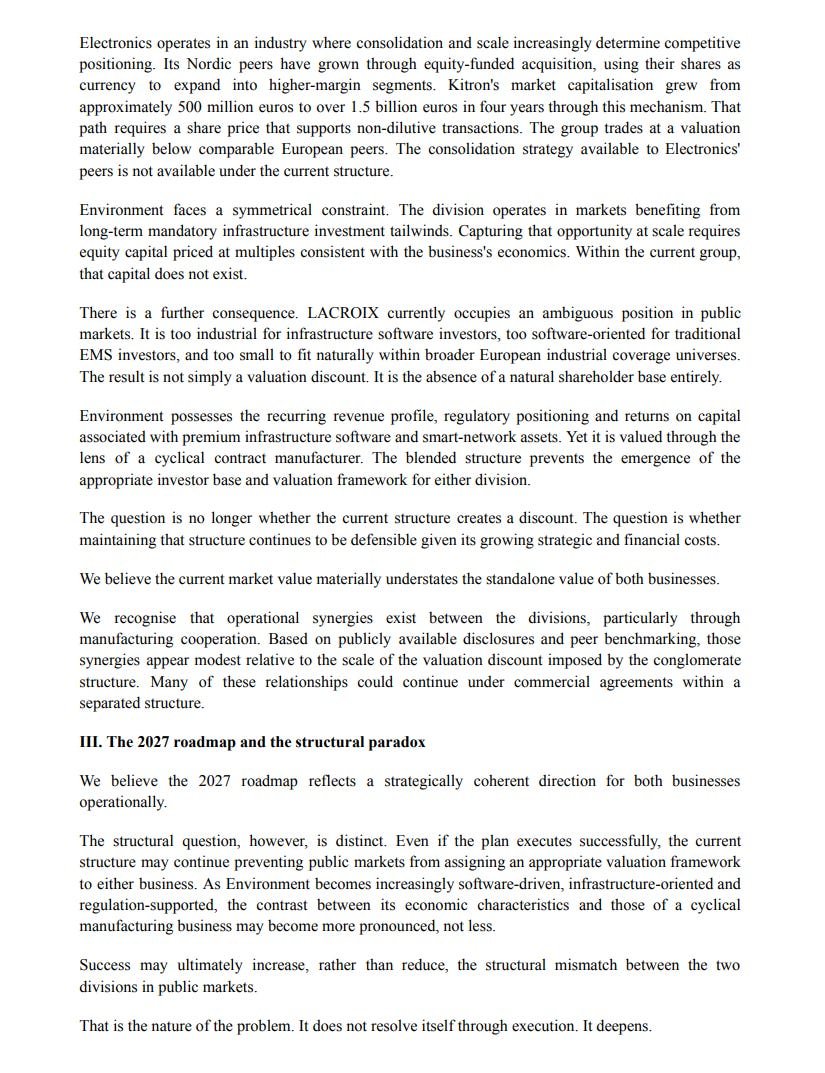
Today, we published a full deep dive and open letter to the Board.
🧵👇
For all retail investors:
The most common question I get about micro caps:
"Are you sure it is not a value trap?"
And I understand the instinct.
Something this cheap, this ignored, must have a problem nobody has found yet.
But most of the time the question is looking in the wrong direction.
The business is real. It grows. It earns.
The numbers are not hiding anything.
What people miss is not a flaw in the company.
It is the structural reason why the opportunity exists and why it will keep existing long after you have found it.
Liquidity.
The fund manager who would love to own this cannot build a position without moving the price by 20% on the way in and 20% on the way out.
So he does not.
The analyst who would love to cover it has a minimum market cap threshold.
So he does not.
The sophisticated private investor who has the flexibility to buy rarely finds these companies because finding them requires reading filings in languages nobody reads
on exchanges nobody uses.
So the price stays where it is.
Not because the business is broken.
Because the only people who can buy it
are the people who will never look.
And the only people who will look
are priced out by their own size.
Illiquidity is not the risk.
It is the edge.
It is what keeps the opportunity open long enough for you to find it, size into it slowly, and wait.
The smart money is locked out.
You are not.
That is the entire advantage.
It does not get more structural than that.
For all retail investors:
The most common question I get about micro caps:
"Are you sure it is not a value trap?"
And I understand the instinct.
Something this cheap, this ignored, must have a problem nobody has found yet.
But most of the time the question is looking in the wrong direction.
The business is real. It grows. It earns.
The numbers are not hiding anything.
What people miss is not a flaw in the company.
It is the structural reason why the opportunity exists and why it will keep existing long after you have found it.
Liquidity.
The fund manager who would love to own this cannot build a position without moving the price by 20% on the way in and 20% on the way out.
So he does not.
The analyst who would love to cover it has a minimum market cap threshold.
So he does not.
The sophisticated private investor who has the flexibility to buy rarely finds these companies because finding them requires reading filings in languages nobody reads
on exchanges nobody uses.
So the price stays where it is.
Not because the business is broken.
Because the only people who can buy it
are the people who will never look.
And the only people who will look
are priced out by their own size.
Illiquidity is not the risk.
It is the edge.
It is what keeps the opportunity open long enough for you to find it, size into it slowly, and wait.
The smart money is locked out.
You are not.
That is the entire advantage.
It does not get more structural than that.
first post is up.
i will be honest: i debated whether to do this
for about two years. i am not a fund manager,
i do not have a bloomberg terminal, and my
compliance department is my wife, who has
already told me this introduction sounds like
an annual report.
what i do have is fifteen years of screening
european exchanges that nobody uses, attending
agms in places that do not appear in travel guides,
and finding companies that trade at half what
they are worth because nobody has bothered to
look at them in english.
i run screens every morning before i open the blinds.
i have printed screening results to read on the beach.
i once paid a retired chemistry teacher twenty euros
to translate a shareholder meeting held in a
tractor parts warehouse in romania.
the stock tripled. the chemistry teacher
did not know what a shareholder was.
if you are interested in european micro and nano caps
that nobody covers, trading on exchanges nobody uses,
run by founders nobody has called, this is
probably the only place on the internet
doing exactly that.
first post is live. link in bio.
in 2013 i took a night train from Budapest to attend the AGM of a Romanian industrial company with a €14 million market cap and a name i could not pronounce.
six hours. the compartment smelled like cabbage and diesel.
my seatmate was transporting live chickens.
this is not a metaphor.
the AGM was listed at an address on the edge of town.
i walked there the day before to check.
it was a former tractor parts warehouse.
a man loading boxes outside confirmed it.
he said yes, they set up a small stage
when they had meetings.
he said this like it was completely normal.
the morning of the AGM i could not find anyone who spoke english.
i invited the first person i saw on the street to lunch.
his name was gheorghe. retired chemistry teacher.
i paid for the meal. he agreed to come and translate.
gheorghe had never attended a shareholder meeting before.
gheorghe was also not entirely sure what a shareholder was.
gheorghe was doing his best.
nine people in the room including me and gheorghe.
the CEO opened with a story about his wife
refusing to eat the company's products for fifteen years
and then asking for seconds at christmas dinner.
he found this very funny.
everyone laughed.
gheorghe translated it as a story about a dog.
the stock was trading at 0.3x book value.
zero debt. dividends every year since 1998.
the last person to write about this company
was a local newspaper in 2004.
the article was about their christmas party.
i bought as much as the liquidity allowed.
eleven shares traded on a good day.
three years later the CEO's nephew acquired the company
at an 80% premium to market.
the nephew had also never heard of an AGM.
this is the entire job.
$LACR.PA (Lacroix Group) is a great one. At first glance, it looks like a "ugly" business due to recent headlines, as they’ve been divesting and selling unprofitable segments.
They own the 9th largest EMS plant in Europe, currently transitioning from the automotive sector toward Defense and Medtech, which offer better margin profiles and tailwinds. After some tough quarters, it seems it has finally hit rock bottom.
The most interesting part: Their second segment is one of the largest Smart Grid/Water IoT businesses in Europe. It has been growing at +11% since 2019 and grew +22% this quarter. It generates €141M in revenue with 23% margins (best in the industry). It has never declined and has recurring revenue.
Valuation:The entire company trades at a €70M market cap. They are repaying debt and have no covenants.
By SOTP, the Environmental segment alone is worth €320M - €480M.
The recovering EMS segment is worth €50M (conservative).
This implies an Equity Value of €290M - €450M vs. the current €70M. A +310% to +540% upside from here.
The Catalyst: The most logical step would be a Spin-off. Several investors are applying pressure, and an Open Letter to the Board was recently published.
The stock is already +165% from last year's lows, and yesterday's results verified the recovery. While the family controls +50%, the pressure is there, and a spin-off is what benefits the family the most. Since they’ve already sold several segments, a spin-off shouldn't be ruled out.
https://t.co/RJrMvWaiie
🇫🇷 LACROIX Group might be one of the most absurd mispricings in European equities today. $LACR $LACR.PA
The market values the ENTIRE company at just ~€69M equity value.
Inside it sits a hidden critical infrastructure software/IoT asset that alone could plausibly be worth 5-6x that amount.
Today, we published a full deep dive and open letter to the Board.
🧵👇
🇫🇷 LACROIX Group might be one of the most absurd mispricings in European equities today. $LACR $LACR.PA
The market values the ENTIRE company at just ~€69M equity value.
Inside it sits a hidden critical infrastructure software/IoT asset that alone could plausibly be worth 5-6x that amount.
Today, we published a full deep dive and open letter to the Board.
🧵👇
🇫🇷 LACROIX Group might be one of the most absurd mispricings in European equities today. $LACR $LACR.PA
The market values the ENTIRE company at just ~€69M equity value.
Inside it sits a hidden critical infrastructure software/IoT asset that alone could plausibly be worth 5-6x that amount.
Today, we published a full deep dive and open letter to the Board.
🧵👇
An Open letter to the Board of LACROIX Group.
We believe the current structure materially misrepresents the value of the underlying businesses.
Read the full letter here:
https://t.co/IaKAzwKcRH
$LACR $LACR.PA #LACR#LACROIX@LACROIX_Group