Valve is working on a kernel fix for one of the most annoying problems in Linux gaming: stutter.
Natalie Vock of Valve's Linux graphics driver team posted v2 of a 10-patch AMDGPU series today that reworks how the driver handles GPU virtual memory updates.
The background: many newer Windows games lean heavily on "sparse bindings", mapping and unmapping chunks of GPU memory on the fly. Right now the AMDGPU driver syncs those updates against every other piece of GPU work and handles them one call at a time. In her words, heavy sparse binding load "can stall the gfx/compute submissions for quite a long while, leading to very noticeable stutters and hitches."
Her fix adds a new AMDGPU_GEM_VA2 interface that batches many mapping changes into one call and uses explicit sync. The patch notes say apps that hammer sparse operations, "particularly some games running under Proton," should see "significant reductions in stuttering."
There are no benchmark numbers yet. The series is about 1,100 lines of code and is up for review on the amd-gfx mailing list. v1 was posted back in May, so it's still unclear whether this lands in Linux 7.5.
Both NeXT and 3DFX tried to “do the right thing” with color spaces, and it wound up generally making them look worse than competing options. I didn’t really understand it properly until years later.
It is natural to think that a pixel with a value of 1.0 is emitting twice the photons as a pixel with a value of 0.5, so you can do the obvious linear math to calculate partial pixel coverage, blending a foreground over a background, or interpolating between colors in a texture.
If displays are “linear”, that is correct. NeXT and 3DFX were much closer to linear than other contemporary displays. NeXT had crossover from the deep graphics understanding at Pixar, and 3DFX had the SGI heritage. They did this intentionally.
If you have 10+ bits per channel like the professional rendering systems, linear displays are The Right Thing.
Unfortunately, NeXTStation Colors were 4 bits per channel and 3DFX was 5 or 6 bits per channel, and there… it was not the right thing.
Human eyes aren’t linear intensity sensors. We mostly register relative changes in intensity, so we can tell the difference between 0.01 and 0.02 as a huge doubling, while 0.99 to 1.00 is almost imperceptible.
This distribution of intensities is often referred to as the “gamma” of the display system, but the actual curves like sRGB are a bit more complicated.
If you only have a small number of discrete pixel values, you definitely don’t want to spread them evenly from 0 to 1! If you do, you will have good precision in the brights, but very stark “intensity bands” in the dark colors.
If everything was authored specifically for 3DFX, you would still have the fundamental problem with the dark bands, but more accurate blending and filtering. The problem was that artists made all of their textures in paint programs on conventional non-linear displays, so when they were drawn by 3DFX cards, they got the characteristic “washed out color” look.
You can mathematically correct textures for differences in display gamma, but I didn’t really understand the issue back in the glQuake days, and we were so enthralled by the absolute performance of 3DFX that the color fidelity didn’t get as much attention as it should have.
Even today, tons of games don’t properly handle gamma across their textures and render targets. High resolutions and 24 bit color masks most of it, but you still see it in some slight shimmerings in high contrast textures and edges.
The Northrop YB-49, a jet-powered flying wing bomber that first flew almost 80 years ago, in 1947.
No fuselage, no tail: just one giant wing. On June 5, 1948, one broke apart during a test flight, killing test pilot Glen Edwards and his crew. Edwards Air Force Base in California is named after him.
The project was cancelled, but the idea never died.
Decades later, Northrop brought the flying wing back as the B-2 stealth bomber.
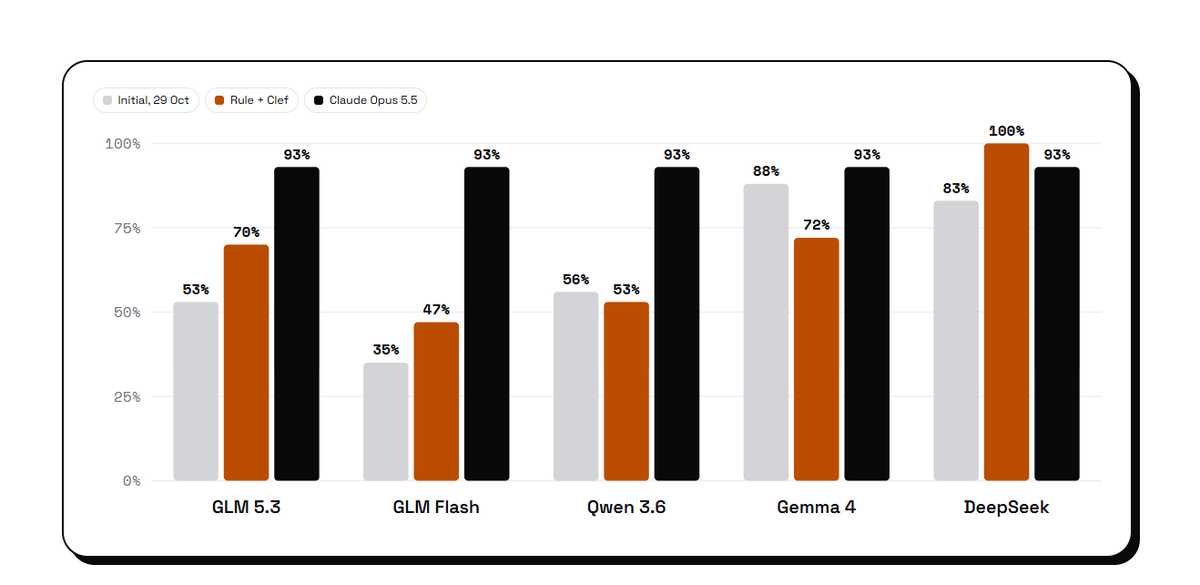
👀😏 Hemos probado una arquitectura nueva para coordinar agentes de IA y los resultados con DeepSeek han superado a Claude Opus 5.5 en el benchmark.
La idea es bastante interesante. 👇
En vez de dejar todas las decisiones al LLM, hemos introducido reglas y Clef, un modelo de decisión de @Cloudflare, para ayudar a coordinar el trabajo de los agentes.
¿Los resultados?
DeepSeek V4.1 Flash pasa del 83% al 100% de éxito en las ejecuciones evaluadas. Opus se queda en el 93%.
El experimento lo han hecho nuestros amigos de @agent__swarm , con quienes estamos colaborando para investigar cómo funcionan los modelos abiertos en sistemas multiagente. Seguidles, que están haciendo cosas muy interesantes. Y también a @voidisomorphism y @ecura
La muestra todavía es pequeña y hay bastante que investigar, pero creo que esto abre una vía muy prometedora: mejorar el rendimiento de los agentes cambiando la arquitectura, sin necesidad de utilizar siempre un modelo más grande.
Vamos a repetir el experimento con más tareas de ingeniería de software.
La semana que viene publicaremos un artículo y vídeo explicando la arquitectura, la metodología y todos los resultados.
Os dejo el benchmark por aquí:
https://t.co/UTgA2ku6HR
@BearBoruta@Dakaeras@stroggxp Nowadays RAM and SSD chips are so expensive that in China they are disassembled and reused. I don't know if that's the case.
@Dakaeras@XMihura He probado muchos y en Windows, @FoxitR sigue siendo de lo mejorcito. El #AcrobatReader me parece una vergüenza para el mundo del software en general. La tengo instalada por política de empresa y es la app que más ocupa y os juro que no la uso.
lmao lo acabo de probar en la Samsung y estamos llegando ya a niveles ridículos jajaja
que pena que no os lo pueda poner a 120Hz por aquí
(estos PDFs son criminales eh...)
@maximohistorico Estoy releyendo mi propio artículo y bueno soy optimista y quiero imaginar que han encontrado un montón de módulos de RAM de 1GB y van a sacar dos placas para romper la mierd# de pozo en que hemos caído. Ojalá dos placas en formato Zero y A con 1GB de RAM y SoC de #RaspberryPi4!
🔥 ¡La Raspberry Pi más deseada, en stock!
Raspberry Pi Zero 2 W disponible en RaspiPC. Dale vida a tu próximo proyecto 👇
https://t.co/mIRLb8tOkD
#RaspberryPi#Zero2W
@maximohistorico Se supone que además hay un nuevo modelo en camino https://t.co/Wx7hGR3fAh
Si esa supuesta #RPiZero3W tuviese 1GB de RAM y a rondase los 30€ con impuestos y el envío incluido podría ser un poco el mínimo razonable.
Mi análisis en @xataka del Mac Studio M5 Ultra (256 GB): bestial en todo.
Tras más de un mes haciendo pruebas, aquí está uno de los temas más largos que he preparado en mi vida. Espero que os guste.
Mac Studio M5 Ultra (256 GB), análisis: un mes intentando encontrar los límites de una máquina casi sin límites https://t.co/rCT5CMmAaD
En el trabajo alguien ha comentado que el silbo gomero es la mejor forma de comunicarse con una IA. Que es lo más parecido a como hablan R2-D2 y C3-P0. ¿Es eso cierto?
¿Creéis que merece la pena estudiar silbo gomero para trabajar con la IA?