Un universitario brasileño que dejó la carrera, se mudó de vuelta al garaje de sus padres y construyó un bot de trading para Polymarket usando un AI agent open source.
En 14 meses, ganó $794,000.
Lo más increíble es que él prácticamente no escribió código.
El código lo escribió básicamente Claude Opus.
El framework que usó se llama Hermes, un framework de agentes open source creado por NousResearch, respaldado por la inversión de Paradigm.
Su wallet:
https://t.co/L2EdWuOJtW
La wallet se llama Bonereaper.
40,266 operaciones.
El coste total del sistema es de aproximadamente $10/mes.
Este bot opera principalmente los mercados de subida/bajada de BTC en ventanas de 5 minutos en Polymarket.
288 ventanas al día.
En promedio, ejecuta una operación cada 81 segundos.
Su núcleo no consiste en adivinar si BTC va a subir o bajar, sino en usar cadenas de Markov para determinar si el precio ha entrado en algún tipo de "estado persistente".
En palabras simples:
Cuando el precio de BTC entra en un estado de tendencia alcista sostenida, matemáticamente la probabilidad de que la siguiente vela siga subiendo puede aumentar notablemente.
Si el modelo estima que la probabilidad supera cierto umbral, por ejemplo el 87%, y el precio del mercado aún no ha reaccionado, el bot entra a operar.
No se alimenta de noticias.
Ni de emociones.
Ni de señales de influencers.
Sino de ese pequeño hueco en el que el mercado todavía no ha reflejado correctamente la probabilidad.
Todo el sistema es en realidad bastante sencillo.
Claude Opus se encarga de leer las señales, tomar decisiones y ajustar la estrategia cada día.
El agente Hermes convierte esas decisiones en un flujo de ejecución automática.
Un servidor barato se encarga de mantenerlo corriendo 24 horas.
Telegram se encarga de enviar al móvil cada operación y el reporte diario.
Según se cuenta, montarlo solo lleva 30 minutos.
La clave real está en que cada noche hace un repaso automático.
A medianoche, Claude lee el registro de operaciones del día, marca qué trades ganaron dinero, cuáles perdieron, en qué estados se obtuvo mayor rentabilidad, y luego ajusta los parámetros automáticamente.
Por ejemplo, si ayer el umbral de entrada era 87%.
Mañana puede que sea 89%.
Si el mercado se vuelve más difícil, quizá lo suba al 91%.
Es decir, este bot no es un conjunto de reglas que se ejecutan a ciegas una vez programadas.
Se va ajustando con los datos de cada día.
Después de 50 operaciones, ya es más inteligente que cuando arrancó.
Después de 500, posiblemente ya no sea el mismo bot del principio.
Ese es el punto que realmente merece atención.
Aquí la IA no se usa para preguntarle "¿hoy compro a la alza o a la baja?".
Sino que se inserta en un flujo completo:
Leer datos.
Tomar decisiones.
Lanzar órdenes.
Registrar resultados.
Revisar errores.
Ajustar parámetros.
Y al día siguiente, seguir corriendo.
Mucha gente sigue usando Claude como una herramienta de chat, pero algunos ya lo han convertido en su propio ingeniero de trading.
No necesitas ser el mejor programador, ni dominar todos los detalles del trading.
La verdadera línea divisoria puede ser si tienes o no la capacidad de conectar la IA a un sistema que se ejecute, se autoevalúe y se itere de forma automática.
🚨 WARNING: TOMORROW WILL BE THE WORST DAY OF 2026!!
The U.S.-Iran peace deal just got officially CANCELLED.
When the market opens on Monday, it won’t be “just macro pressure” anymore.
There’s a geopolitical trigger building underneath it all.
Stocks will dump.
Metals will dump.
Crypto will take the hardest hit.
Smart money is already exiting.
They’re not taking profits.
They’re building cash positions because something deeper is starting to break.
The dollar is weakening in real time.
This is not a one-day shock.
This is pressure building across multiple fronts at the same time.
And now there’s another layer being added:
U.S.-Iran peace deal just got officially cancelled.
After 5 days of negotiations, both sides walked away with no agreement.
That changes everything.
Because when diplomacy fails, uncertainty becomes IMMEDIATE.
And markets don’t price “possibility.”
They price escalation.
There are only a few ways this plays out from here, and they are NOT equal:
1⃣ SOFT OUTCOME
Backchannel talks resume, tensions cool, markets stabilize after initial volatility.
2⃣ ESCALATION PHASE
No progress, tensions build, and markets begin pricing prolonged conflict risk.
3⃣ HARD BREAK
Situation deteriorates rapidly, and the market reprices oil, risk, and global stability in hours.
That last one is where things get dangerous.
Because this isn’t happening in isolation.
At the same time:
→ Bonds are being sold aggressively
→ Yields are rising fast
→ The dollar is losing stability
→ Liquidity is tightening
Now connect the dots.
When geopolitical risk collides with a fragile financial system, reactions don’t stay contained.
They COLLAPSE.
Oil doesn’t move slowly.
It reprices violently.
Capital doesn’t rotate calmly.
It rushes to safety all at once.
And risk assets?
They don’t “dip.”
They DUMP HARD.
This is how chain reactions begin.
Because once markets start pricing duration instead of shock, everything changes.
Inflation expectations rise.
Central banks get trapped.
And policy responses come too late.
That’s when the real damage happens.
This could still pass as a short-term scare.
But if markets start pricing escalation into next week,
This is no longer noise.
This is a regime shift.
Not a pullback.
Not a buying opportunity.
A STRUCTURAL CHANGE in how risk is priced across the system.
Pay attention to flows.
Watch oil.
Watch bonds.
Watch volatility.
Because once this accelerates, it doesn’t give you time to react.
I’ve spent years tracking macro turning points and market reactions like this.
When the next move becomes clear, I’ll share it.
Follow and turn notifications on.
Because by the time it hits the headlines, it’s already too late.
🚨 THE NEXT 24 HOURS WILL LIQUIDATE TRILLIONS...
What's happening now has NEVER happened before.
Everyone thinks the US-Iran crisis is about oil.
Look at this before March 9, when markets open.
It’s not.
It’s about what oil becomes.
And nobody is talking about the chain reaction that comes next.
Let me explain:
About 20 million barrels of oil per day normally move through the Strait of Hormuz.
20% of global petroleum supply.
Most people see that and think:
“Gas prices.”
But the real dependency is much deeper.
Roughly 92% of the world’s sulfur comes from oil and gas refining.
And sulfur is the feedstock for sulfuric acid - the most produced chemical on Earth.
Without sulfuric acid, modern industry stops.
Because sulfuric acid is how we extract:
→ Copper
→ Cobalt
→ Nickel
No sulfuric acid means:
→ No transformers
→ No EV batteries
→ No electronics substrates used in data centers
One chemical.
One feedstock.
And a huge portion of it ultimately depends on oil refining flows that rely on Hormuz.
But the cascade doesn’t stop there.
Qatar ships a major share of its liquefied natural gas through the Strait.
That gas powers countries across Asia, including Taiwan.
Taiwan currently has very limited LNG storage capacity, meaning disruptions quickly become power shortages.
And one company sits at the center of that risk:
TSMC.
TSMC produces around 90% of the world’s most advanced semiconductors.
And it consumes nearly 9% of Taiwan’s electricity.
No LNG → no power.
No power → no chips.
No chips → no AI hardware, no advanced electronics, no modern military systems.
Still think this is just an oil story?
Let’s talk about food.
Roughly one-third of the world’s nitrogen fertilizer feedstock moves through the Strait of Hormuz.
Synthetic nitrogen fertilizers are the reason the planet can feed billions of people.
Without them, global agricultural output collapses.
So the real system looks like this:
Energy → Sulfur → Sulfuric acid → Metals → Batteries & electronics
Gas → Electricity → Taiwan → Advanced semiconductors
Feedstock → Nitrogen fertilizer → Global food supply
Three civilization-critical supply chains.
All exposed to one narrow maritime chokepoint only 21 nautical miles wide.
And the world has very few scalable domestic alternatives if that chokepoint fails.
This isn’t just about oil prices.
It’s about how fragile the entire industrial system really is.
And EVERY market will feel the impact.
When supply chains like that start to strain, the shock doesn’t stop at factories or shipping lanes.
It spreads into every major market - energy, equities, currencies, commodities, crypto.
Because when the physical economy tightens, financial markets feel it next.
I’ve been studying markets for a decade and called every major market top and bottom.
Follow and turn on notifications if you want to survive in this market.
I’ll post the real warning before it hits the headlines.
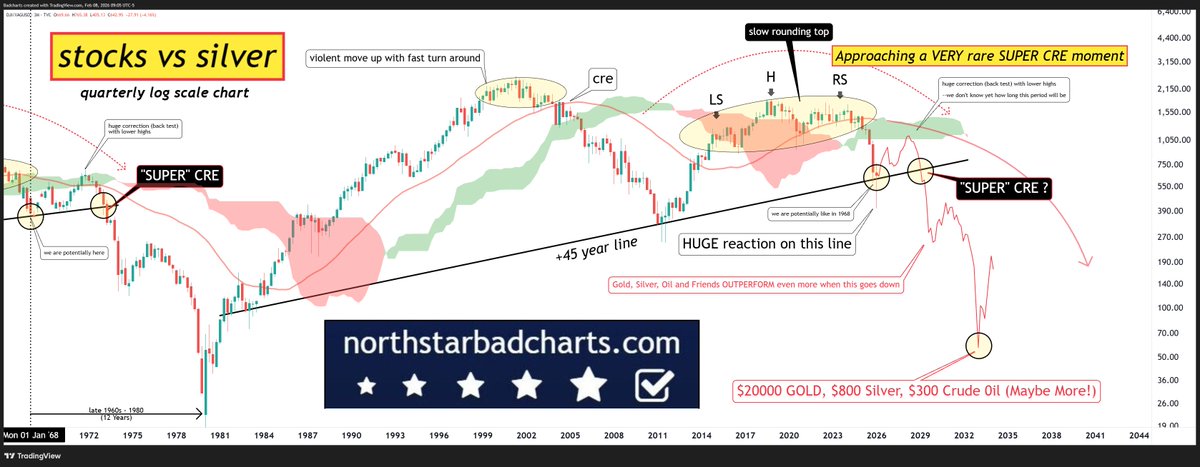
Roadmaps for $20000 Gold and $800 Silver.
HUGE reaction on that possible 45 year breakdown line for stocks vs silver.
If we get a bounce in Q2, it will OFFICIALLY morph into existence, making it a CRITICAL & VALID line.
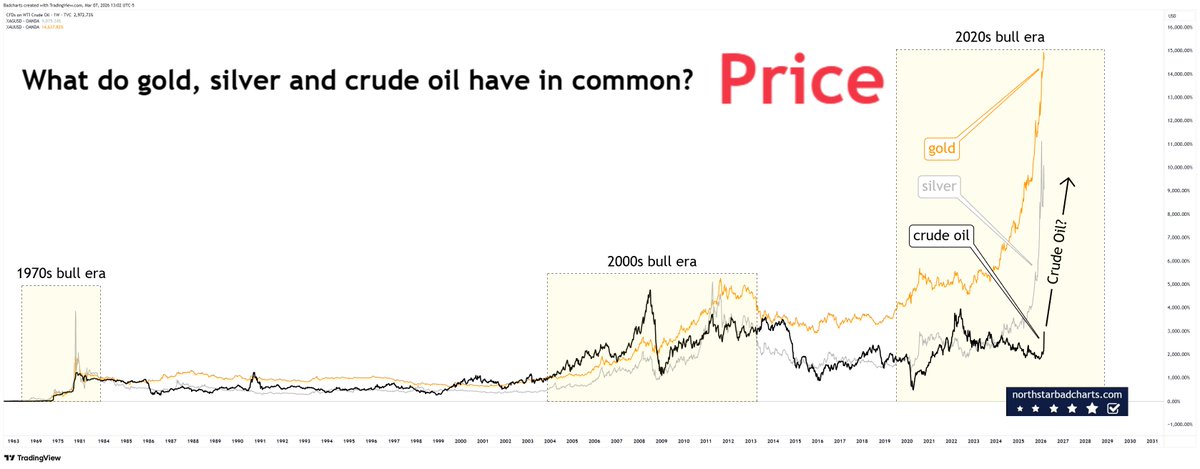
BIG moves for Gold, Silver, Oil and friends below that.
SILVER - funny how they waited to dump the price 40% overnight, load up then announce price floors few days later. Now it’s almost a guarantee $150-200 this year.
America is one big SCAM ‼️
🟥 THE MAN WHO PREDICTED 2008 JUST ISSUED A WARNING TEN TIMES MORE DANGEROUS.
The world is officially pulling the rug out from under the United States.
For decades, the dollar was the only game in town. Those days are over. Central banks are not just "diversifying" anymore. They are dumping USD and hoarding gold like their survival depends on it.
Here is the part no one wants to hear. This is not going to be another global financial crisis.
This is an American financial crisis.
While the rest of the world decouples from our mess and actually benefits, we are left holding the bag. Peter Schiff is clear: the bubble is the US economy itself.
If you thought 2008 was bad, get ready. This is going to make that look like a Sunday school picnic.
The dollar bubble is finally popping.
🚨 TOTAL LIQUIDATION IS HERE. NOTHING IS SAFE.
Gold, Silver, Bitcoin, and the S&P 500 are all dumping in sync. If you are waiting for a bounce, you are missing the bigger picture.
This is a massive deleveraging event and we are nowhere near the floor yet.
The S&P 500 has been trading at valuations that make 1929 and 2000 look reasonable. A reality check was inevitable. What we are seeing now is a market finally collapsing under its own weight.
Most people are confused why Gold and Silver are bleeding. It is simple: the system is starving for cash.
When the margin calls hit, funds don’t sell their losers. They sell their winners because those are the only liquid positions they have left. Metals are being sold off just to keep the lights on.
MY ROADMAP (NFA)
- HARD CAP:
I have said for months that 7,000 was the top for the S&P. We are officially entering a 10% to 15% drop. The air is getting very thin up here.
- PIVOT POINT:
Watch for the divergence. The bottom is only in when Gold stabilizes while stocks continue to slide. Until you see that happen, stay out of the way.
- CURRENT POSITIONING:
Cash is the only play. Don’t try to be a hero in a market that is forced to liquidate everything that isn't bolted to the floor.
I have nailed the last three major cycles while the crowd was buying the top. I will post the entry signal here the second I see it. Until then, protect your capital.
Wanted to give an update on @hytopia traction as we head into Q1 2026. A lot of exciting updates, as well as clarification on how the platform is starting to grow, and why it's growing the way it is.
It's very important to recognize that traction and growth in @hytopia is being 90% dominated right now by the Asia / Southeast Asia markets for those curious.
This is specifically driven by underserved countries with language barriers and lower end devices that most mobile games typically don't run well on or just don't optimize at all for.
This is intentional.
We started hitting this first because it gives us a lot of wins short and long term.
1. We had to build automated localization infrastructure to auto translate all content of all games without devs needing to do anything. All HYTOPIA games now play in every major language based on your device language, automatically. This is a benefit of building on web tech. Using a UI library would of made this a massive pain.
2. Targeting low end mobile devices (Think $30 to $100 android devices) and running smooth on them unlocks a whole under served market segment where we can predictably pick up players and iterate faster on systems with more player volume at the start.
3. More players has continued to bring more dev interest, more feedback from players to devs, and overall just more engagement for us to monitor and improve from.
4. As the platform improves, the games are getting better, the engine is getting better, and we continue to improve retention (We're up 2x on d1, 6x on d7 and 12x on d14 in the last 3 months, this isn't world shattering retention but the trajectory is clear and we very distinctly know what is blocking it from climbing higher), As retention responds to improvements, we'll start rolling out and focusing more modern markets with more modern devices.
5. Since we optimized for the bottom of the barrel and all language barriers to start, the experience on more modern markets is only going to be that much better. All games are also default-global distribution without any dev intervention. We're a 4.5 star app currently when the majority of devices using us are some of the worst android devices people use by majority.
The last piece here is we've seen a strong inflection point with our recent AI Agent changes where it's becoming so good that you can realistically build proper quality games not using just prompts to the HYTOPIA agent/mcp and using our point/click map editor. This will only improve, and we will very quickly (likely next 6 months) hit a cursor-like moment and product (wink wink, studio) for game dev.
To the future!