A 5-year-old boy falls off a climbing frame and lands on his wrist.
Should you reduce the fracture - or simply put it in a nice cast and let it remodel?
Until now, people might have had strong views about this, but no-one really knew. 👇
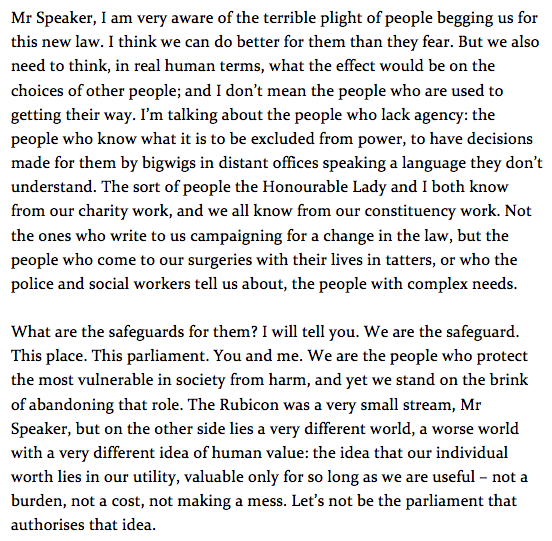
I’m biased because I agree, but @danny__kruger’s was honestly the best speech – best conclusion to one, anyway – I have heard from any living parliamentarian. Key passage:
Some hard questions which the media have failed to ask @kimleadbeater:
1. You’ve said feeling like “a burden” could be a “legitimate” reason to ask for an assisted suicide. How common do you think it is for terminally ill people to feel like a burden?
2. If somebody asks for assisted suicide only because they are on a long waiting list for treatment, doctors and judges will have to approve the suicide. Do you think that’s a legitimate reason too?
3. Sir Louis Appleby, who leads the Suicide Prevention Strategy for England, says this bill undermines the fundamental basis of that strategy. And studies suggest that (non-assisted) suicide rates go up in jurisdictions which adopt assisted suicide. Do you think a rise in non-assisted suicides is a price worth paying?
4. You say this doesn’t apply to eating disorders, but the chair and vice-chair of the Royal College of Psychiatrists’ eating disorders faculty say the bill “fails the public safety test.” What would you say to reassure them?
5. You have repeatedly claimed that a “High Court judge” will be involved, but the bill nowhere guarantees that. Why are you misleading the public about the level of approval needed?
6. You say there will be a second, “independent” doctor, but the first doctor chooses them. Why do you call them “independent”?
7. Dame Caroline Swift, the lead lawyer on the Harold Shipman inquiry, predicts that safeguards will become box-ticking. “Groups of doctors (‘death clinics’?) that support assisted dying will emerge … the safeguards will gradually be eroded in the same way.’ What, exactly, would prevent that happening?
8. You say that the public have spoken. But over 60% are “not very certain” of their views, and a poll found that when people are told the counter-arguments, support falls to eleven per cent. That’s not public support, is it?
9. Judges will have to assess coercion according to civil law – ie on the balance of probabilities: so if the judge thinks “coercion” is 1% less likely than “no coercion”, they have to approve the application. Why not say lack of coercion has to be proved beyond reasonable doubt?
10. Doctors are allowed to raise the subject when the patient hasn’t mentioned it. Do you agree vulnerable people would be safer if, as in Victoria, doctors were banned from doing so?
11. You say patients will need to have capacity, but under the Mental Capacity Act someone could be depressed or confused and still qualify: in the words of Baroness Hale, the Act’s “threshold for capacity is not a demanding one.” Why have you set the threshold so low?
12. According to Age UK, 375,000 over-60s experience domestic abuse. How will your bill protect them from pressure?
13. You say doctors will pick up on coercion. 50% of coercive control cases are dropped for lack of evidence, and only 3.7% of recorded coercive control crimes result in a charge. How will you make the doctors’ and judges’ checks on coercion any better than the police’s?
14. The former Chief Coroner, Thomas Teague, says the bill is unsafe because it removes the statutory duty to investigate suicides. Why have you got rid of this safeguard?
15. Why does the bill say assisted-suicide providers can’t be sued for clinical negligence?
16. According to experts quoted in the Financial Times yesterday, there is “no reliable way” to establish “six months to live”, and “months” diagnoses have a 32 per cent accuracy rate. How is this not a porous boundary?
17. Why is there no obligation to inform family members, who might be able to offer support and prevent mistakes?
18. You say you would consider assisted suicide yourself “If my body ends up not working in the way that it should and I want it to.” On what basis, then, do you promise us that people with disabilities can be permanently excluded?
What is the evidence around diagnosing Acute Aortic Dissection in the ED? At @EuropSocEM #eusem2024 I summarised the results of DAShED, ASES & PROFUNDUS. Here is a copy of my presentation; https://t.co/Ats8tole5K
More needs to be done to save the lives lost to #aorticdissection in #emergencymedicine.
Please watch and share this 3 minute masterclass created by experts, and together we can make a difference.
#AortaEd
https://t.co/subkUj6EdE
If you missed our live session, the replay of the ASES research webinar is now available. Delve into the latest on aortic dissection diagnosis with insights from experts and survivors. Don't miss out on this crucial #AortaEd https://t.co/gPtxd1UKQZ
🎉Congratulations to Professor Matt Reed @mattreed73 - RCEM's new Research Committee Chair 🎊
Make sure you don't miss the research grant opportunities ending 29 March🗓️
Learn about Matt, his brilliant passion for Emergency Medicine & exciting plans:
▶️https://t.co/UEg9HLmbTV
December ‘23 Papers Podcast
•Identifying Acute Aortic Syndrome in an undifferentiated population
•Stroke thrombectomy for acute large infarcts
•Small vs large BVMs in cardiac arrest
https://t.co/JllNsEB79d
https://t.co/ipr8fDYKCi
https://t.co/RNpmm817fz #FOAMed
Some thoughts about the recent DAShED study which looked at the diagnosis of acute aortic syndrome in the Emergency Department. @stemlyns#FOAMed
https://t.co/ixvQ5nPfqk
Delighted to announce that the DAShED study is now available to read in the EMJ! A look at the true undifferentiated population of UK ED patients in whom we need to consider Acute Aortic Syndrome/Aortic Dissection - a population not studied before.
https://t.co/WqUGnsZ2NA
Last day to grab your @RCollEM ASC ticket. The program is fab and lots of networking opportunities and come on is there is better city in the UK than #Glasgow 😉
https://t.co/Tqng8tM2J7
Check out our case series and descriptive analysis on 'Why do emergency department clinicians miss acute aortic syndrome?' published today in the emergency care journal https://t.co/0LiPlZbyw1
Really important UK parliamentary debate on Aortic Dissection patient pathways and research funding yesterday. Issues clearly and powerfully summarised by @Pauline_Latham. Delighted that Pauline mentioned the two ongoing ED diagnostic studies @dashedstudy and ASES