Kashmir word itself comes from Rishi Kashyap.
Similarly, following are from Sanskrit and ancient Hindu texts/ traditions.
Srinagar — Śrīnagara
Anantnag — Anantanāga
Baramulla — Varāhamūla
Avantipora — Avantipura
Pampore — Padmapura
Kulgam — Kulagrāma
Budgam — Vadagrāma
Bijbehara — Vijayeśvara
Gulmarg — Gaurimārga
Tral — Trigarta
Awantipora — Avantipura
Mattan — Mārtāṇḍa
Kheer Bhawani — Kṣīra Bhavānī
Dachigam — Daśagrāma
Devsar — Devasara
Devbal — Devavala
Khanabal — Khaṇḍavala
Sopore — Suyyapura
Bandipora — Bhandapura
Pattan — Pattana
Kanispora — Kanishkapura
Ushkur — Huvishkapura
Kalampora — Kalyanapura
Chadura — Chandrapura
Ganderbal — Gandharapura
Dachigam — Daśagrāma
Shadipora — Śāradāpura
Rainawari — Rāṇavāri
Khrew — Kharva
Pulwama — Pālavana
Kashmir was, is and will remain a Hindu land. We lost it for a while but we will take it back.
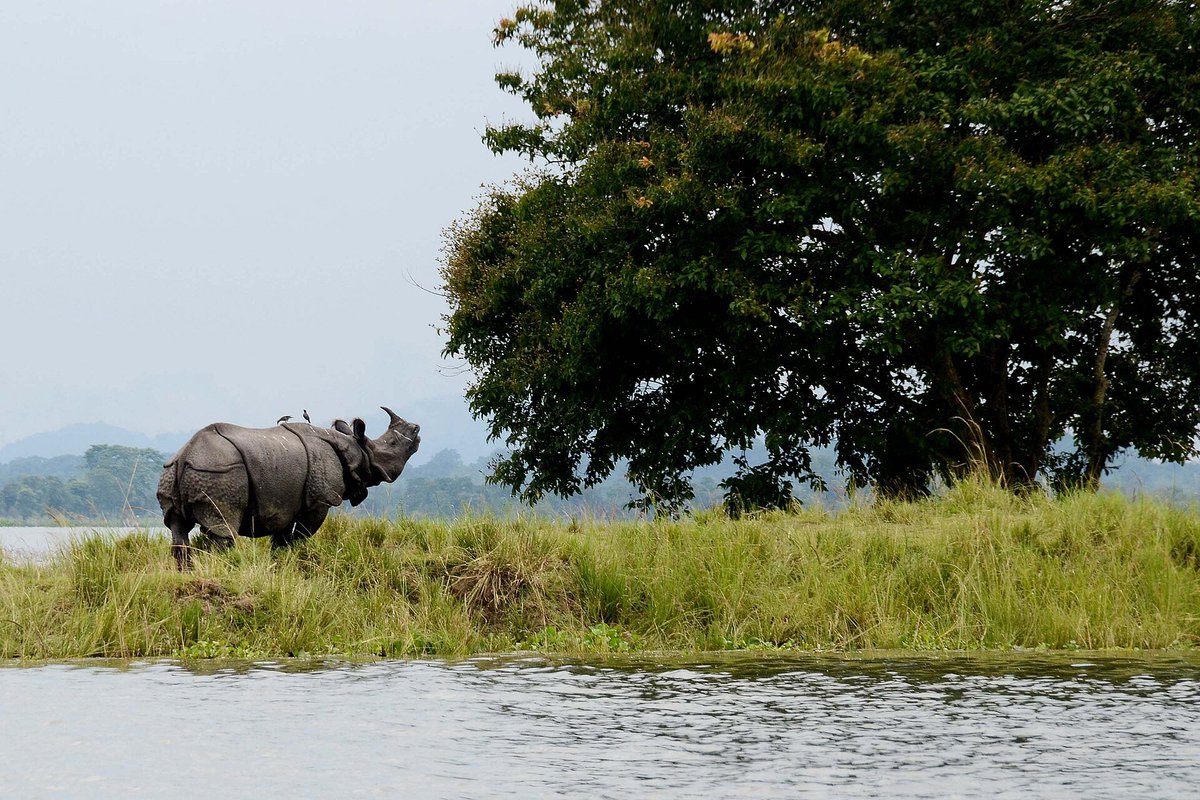
For decades, Kaziranga lost rhinos to men who knew the ground better than the rangers chasing them. Then someone changed the odds. In 2022, for the first time in 45 years, it went a full year without losing one. Read on.
1/12
spoke to enough people at the top, you realize the game is actually pretty simple
once basic needs are met, everyone starts chasing the same things
good sleep, a stable relationship, regular workouts, time alone, books, deep focus, eating on time, and freedom from other people’s opinions
funnily enough, you don’t need to reach the top to start optimizing for any of them
Every Indian should read this report, because the jobs it puts at risk are exactly the jobs we spent thirty years building.
The headline finding is that in the worst case, America is 32% richer by 2030 and nearly one in five knowledge workers has no job.
Yes, both at the same time.
Let me explain how they got there, and what it means for us.
The whole model rests on one idea. A job is not one thing. It is a bundle of tasks.
Take a nurse in a Bengaluru hospital. She does rounds. She draws blood. She triages patients arriving in casualty. She charts vitals. She orders supplies for the ward.
AI cannot bathe a patient. It might help her write discharge instructions faster, which the report calls augmenting. It might just do the charting and the supply ordering by itself, which is automating. And it creates new tasks, like checking whether the AI triaged a patient correctly.
So, her job does not vanish. It changes shape.
Now multiply that across every worker. The model splits everyone into two groups.
Knowledge workers, meaning management, professionals, sales and office work.
And everyone else, meaning construction, drivers, nursing aides, repair, food service, farming.
In America that first group is about 62% of workers. AI touches that group and basically leaves the second alone.
With this, five numbers decide everything.
> How many tasks AI can do.
> How much it actually gets used.
> How much faster it makes each task.
> How often it does the task alone.
> And how long a displaced worker takes to find work in a completely different line.
Set those five dials three ways and you get three futures for America.
In the modest one, AI is about as big as the internet was. GDP is 1.6% higher by 2030. Growth goes from 2% a year to 2.4%. Unemployment goes from 3.8% to 3.9%. Nothing you would notice.
In the substantial one, AI is bigger than the internet and bigger than the railway. GDP is 8.3% higher. Growth hits 5.4% a year, faster than any year of the dot-com boom, which peaked at 4.7% in 1999.
Overall unemployment stays at a normal 4.6%. But knowledge worker pay sits slightly below where it would have been, while everyone else's pay is up 5.9%.
In the extreme one, GDP is 32.4% higher and growth reaches 15.4% a year, doubling the economy every four and a half years.
Knowledge employment falls 21.5%. Unemployment among knowledge workers hits 17.9%. Knowledge pay falls 11.5%. Pay for everyone else rises 33.6%.
To understand this better, suppose AI cuts the time to produce building designs and clear approvals for a metro project or a township.
More projects start. More projects means more demand for masons, electricians, welders and crane operators. Their wages go up.
The architect and the planning engineer who made the drawings faster do not get the raise. The person laying the cable does.
Now there is a finding that I think matters a lot for India.
Today, out of every rupee an economy produces, roughly 60 paise goes to workers as wages and 40 goes to capital, which means whoever owns the machines, the buildings, the software and the data centres.
In the substantial scenario that shifts to 56 and 44. Four points in four years. America's entire labour share decline across the four decades after 1980 was about that size.
In the extreme scenario it goes to 45 and 55. Capital takes more than half.
And here is the number that stopped me cold.
In that scenario, total wages paid across the whole country in 2030 are almost exactly what they would have been with no AI at all.
The economy grew by a third and workers as a group got none of it. Capital income rose 81%.
But why should an Indian care about a shift from wages to capital?
Because our largest and most successful industry is a wage industry. When TCS or Infosys or a GCC in Bengaluru earns a dollar, most of that dollar leaves as salaries to Indian families.
It becomes rent in Marathahalli, school fees in Hyderabad, an EMI in Pune.
When a data centre earns a dollar, most of it goes to whoever paid for the chips. Very little becomes a salary.
The report is describing a world where the second kind of dollar grows and the first kind shrinks.
India is disproportionately built on the first kind.
There is a second India-specific problem the report does not cover, as well.
A large part of Indian IT is billed by time. So many people, so many hours, so many months. If AI does the same work in half the time, the revenue halves unless the contract changes.
Efficiency gains do not automatically become profit here. They become a smaller invoice.
Third, our version of displacement may look different from America's. The report models people losing jobs and searching. In India the sharper risk is at the entry gate.
The most automatable work in any office is the junior work, and India produces an enormous number of graduates every year who need exactly that first job to begin a career.
What will happen is that nobody would get counted as displaced.
They will just never get hired.
That is my extension, not the report's, but I think it is the more likely Indian shape of this.
Fourth, switching occupations is harder here.
An engineering graduate in India will not take an electrician's job even if it pays more, because of what that means socially in his family.
The report's friction is about training. Ours is about status too.
One genuinely reassuring difference. India's non-exposed group is enormous. Agriculture alone still employs the largest share of Indians, and construction, transport and retail employ crores more.
AI does not touch that work directly. In America the exposed group is 62% of workers. Here it is a much smaller share of the workforce, even though it is a large share of our exports and almost all of our urban middle class.
So the disruption in India would be narrower and deeper. Fewer people affected, but concentrated in exactly the households that have been the story of Indian economic mobility for a generation.
Now, there are no robots in this model at all. It covers thinking work only. That is why the authors refuse to go past 2030.
And they attach no probabilities to any scenario. These are not forecasts.
They are three settings of five dials. Serious outside economists reviewed it, and some said the extreme scenario reads as a thought experiment while others said the modest one understates what is already visible in the data.
But the survey covers nearly 11,000 Americans, which will feel familiar to anyone in an Indian office. Knowledge workers said about 71% of the listed tasks would be doable by AI in 2030, but only 27% of their own working hours.
Everyone thinks it is coming for the person sitting next to them, until it comes for them. :)
The banana in your kitchen is a sterile mutant that can't reproduce. Every single one is a clone, and nearly the entire global export supply traces back to one plant raised in an English greenhouse in the 1830s.
Wild bananas are stuffed with hard seeds the size of peppercorns. Barely any flesh. Around 7,000 years ago, farmers in New Guinea stumbled on rare mutants carrying three sets of chromosomes instead of two. An odd number can't split evenly during reproduction, so seed-making fails and the plant pours everything into flesh. Those tiny black specks in the middle of your banana are the remains of seeds that never developed.
Perfect fruit, one catch. No seeds means no planting. Growing another one requires cutting a shoot off the base and sticking it in the ground.
A clone.
Back in the 1830s, the Duke of Devonshire's gardener raised one of these plants at Chatsworth House. His family name was Cavendish. Cuttings descended from that greenhouse now make up 99% of bananas exported on Earth, genetically identical from Ecuador to the Philippines.
Identical genes means a fungus that kills one plant kills all of them. And it already happened. Gros Michel, the banana everyone ate before 1960, was wiped out commercially by a soil fungus called Panama disease. The industry quietly swapped in the Cavendish, a lookalike that resisted it, and most shoppers never noticed their banana had been replaced.
A new strain called TR4 kills Cavendish too. No cure exists, the spores survive in soil for decades, and it has spread to more than 20 countries. Late 2025 it reached Ecuador, the world's biggest exporter.
The world already lost its banana once and got handed a body double. The body double is dying the same way.
Chandrashekhar Azad's mother died while begging on the streets of Shahjahanpur because some Congress members had branded her a traitor's mother. Some people in Shahjahanpur even claim that Nehru conspired to have Azad shot.
An Indian, Sobha Singh (father of the famous writer Khushwant Singh), appeared as an eyewitness against Bhagat Singh in a British court, a testimony that led to Bhagat Singh's execution. Later, the British honored Sobha Singh with the title of 'Sir'; he acquired vast tracts of land in Delhi in his name.
Kunj Bihari Thapar—grandfather of Karan Thapar and Romila Thapar—raised ₹1.75 lakh after his retirement for Michael O'Dwyer, the mastermind behind the Jallianwala Bagh massacre. He was honored with the title of 'Diwan Bahadur' and, in recognition of his loyalty, was made a Member of the Order of the British Empire (MBE) in 1920.
Chimanlal Harilal Setalvad was the great-grandfather of civil rights activist and journalist Teesta Setalvad. A barrister, he served on the Hunter Commission, which gave a clean chit to Michael O'Dwyer regarding the Jallianwala Bagh massacre.
If there are 10,000 stories of bravery, there are just as many stories of betrayal.
Migration out of India seeded the ancient world.
Two hills in southwest Ireland are named after a Rig Veda goddess. They are called the Paps of Danu. Every spring, farmers lit fires around them and drove cattle between the flames for protection. The Vedas describe the same ritual.
Danu is the Rig Veda mother goddess of the flowing waters. Her name is written into the geography of half of Eurasia. The Danube. The Dniester. The Dnieper. The Don. The Donau. Greek Demeter. Northern Greeks once called themselves the Dannuni. In Ireland, the pre-Christian pantheon called itself the Tuatha de Danaan. Children of Danu.
The mainstream story that pale steppe nomads invaded India around 1500 BC and imposed Sanskrit on a dying Indus Valley civilisation has been steadily dismantled over the last thirty years. The recent genetic and linguistic papers still cited in its defence describe contact at the edges, not replacement at the centre.
The direction of travel runs the other way. Out of India, in pulses, over thousands of years.
Iran took the name of the people, Aryans. Ahura Mazda is the Vedic Asura. The magi are the Vedic magoi.
The Germanic and Slavic pulse moved overland from the ninth millennium BC. They carried the sky-father Dyaius, who became Tyr in Scandinavia, Zeus in Greece, Deus in Rome.
The Italo-Celtic pulse moved by sea from the seventh millennium. When the Celtic branch turned up the Atlantic coast around 5,400 BC, it left place names all the way from Iberia to Ireland. Portugal. Galicia. Gaul. Pays de Galles. Cornwall. Galloway. Galway.
Then the Sarasvati river dried around 2000 BC. A military wave moved west into the Near East. The Kassites ruled Babylonia for 500 years. The Mitanni signed a treaty with the Hittite king Suppiluliuma in 1380 BC swearing by Mitra, Varuna, Indra and the Nasatyas. Four Vedic gods, on a Hittite tablet, thirteen centuries before the earliest date the invasion theory allows for the Vedas.
The Greeks came in the same window. Zeus is Dyaius. When Alexander crossed the Hindu Kush he met people at Nysa claiming descent from Dionysus. Some of their heroes, they said, had come this way.
Link to full Substack essay, with sources, in the comments below.
3 years back Hombale films released the full version of Vande Mataram. It’s sung by Vijay Prakash & features achievers across fields from Karnataka
It remains my favourite rendition of this beautiful song 🇮🇳
From 2004–2014, many emerging economies rode a favourable global cycle to rapid growth.
India, despite operating in a relatively stable international environment interrupted mainly by the 2008 financial crisis, failed to translate its demographic and economic potential into economic leadership.
From 2014–2026, India emerged as the G20's fastest-growing major economy while navigating a far more turbulent world shaped by the pandemic, inflation, fractured supply chains and geopolitical conflicts.
The "lost decade" was not defined by difficult global conditions.
It was defined by India's inability to convert a favourable global environment into sustained economic leadership.
The following decade demonstrated that stronger leadership can deliver high growth even in an era of persistent global disruption.
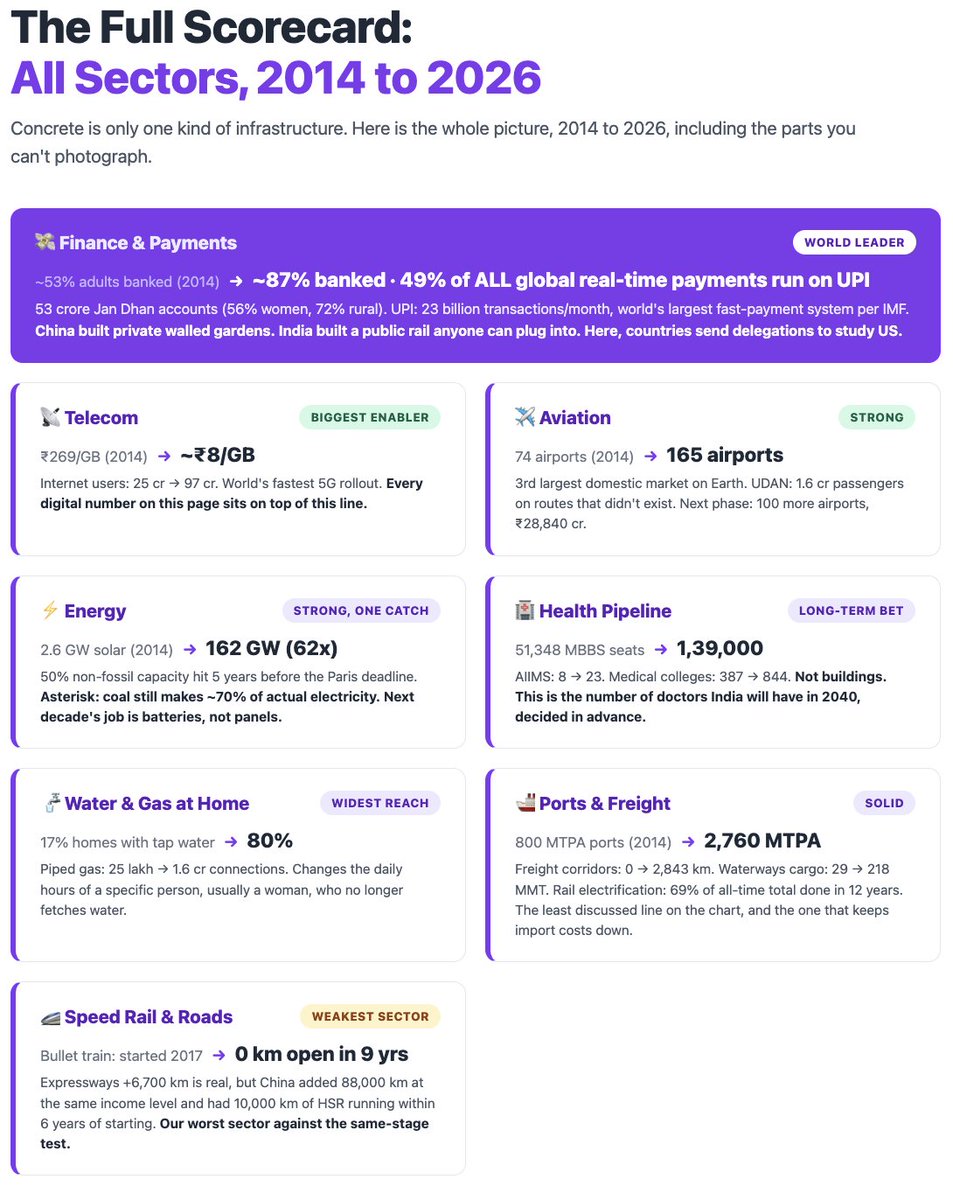
I looked at these numbers yesterday.
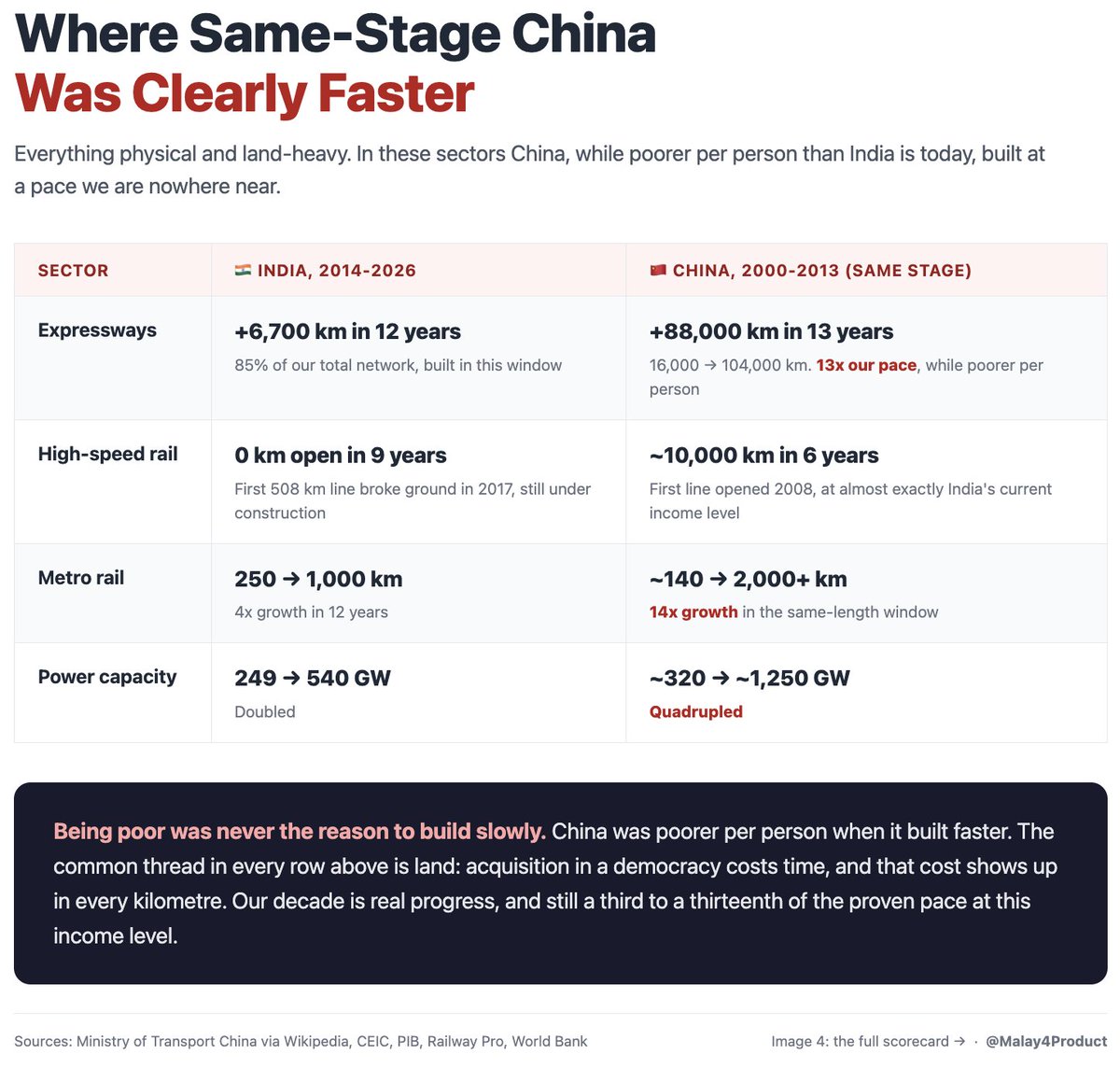
They are genuinely impressive. 85% of our expressways, 75% of our metro, all in twelve years.
Then I wanted to dig one level deeper, so I put the chart next to China.
I know, every time someone compares India with China, half the replies say it is unfair, different system, different scale, thirty year head start.
And yes if you compare with China today, the comparison is useless.
But any study is only as good as its benchmark.
You cannot judge a build decade in a vacuum. So I did the comparison with China from 2000 to 2013, when their per capita income was where ours is now.
They crossed today's Indian income level around 2007. Their 2000s are our 2014 to 2026.
If you analyse it like that, the answer splits cleanly in two.
They were faster on physical work. Much, much faster.
Expressways.
China went from 16,000 km to 104,000 km in that window. They added 88,000 km. We added about 6,700. One thirteenth of their pace, at the same income level.
High speed rail.
China opened its first line in 2008, at almost exactly our current income. Six years later, around 10,000 km were running. We broke ground in 2017 and nine years on, our first 508 km is still not open.
Metro.
They went from about 140 km to over 2,000. We went from 250 to 1,000.
Power.
They roughly quadrupled capacity, from about 320 GW to about 1,250. We doubled, 249 to 540.
Anyone who calls our pace world‑beating should consider those numbers for a more honest picture.
But here is the other half, and the comparison flips completely.
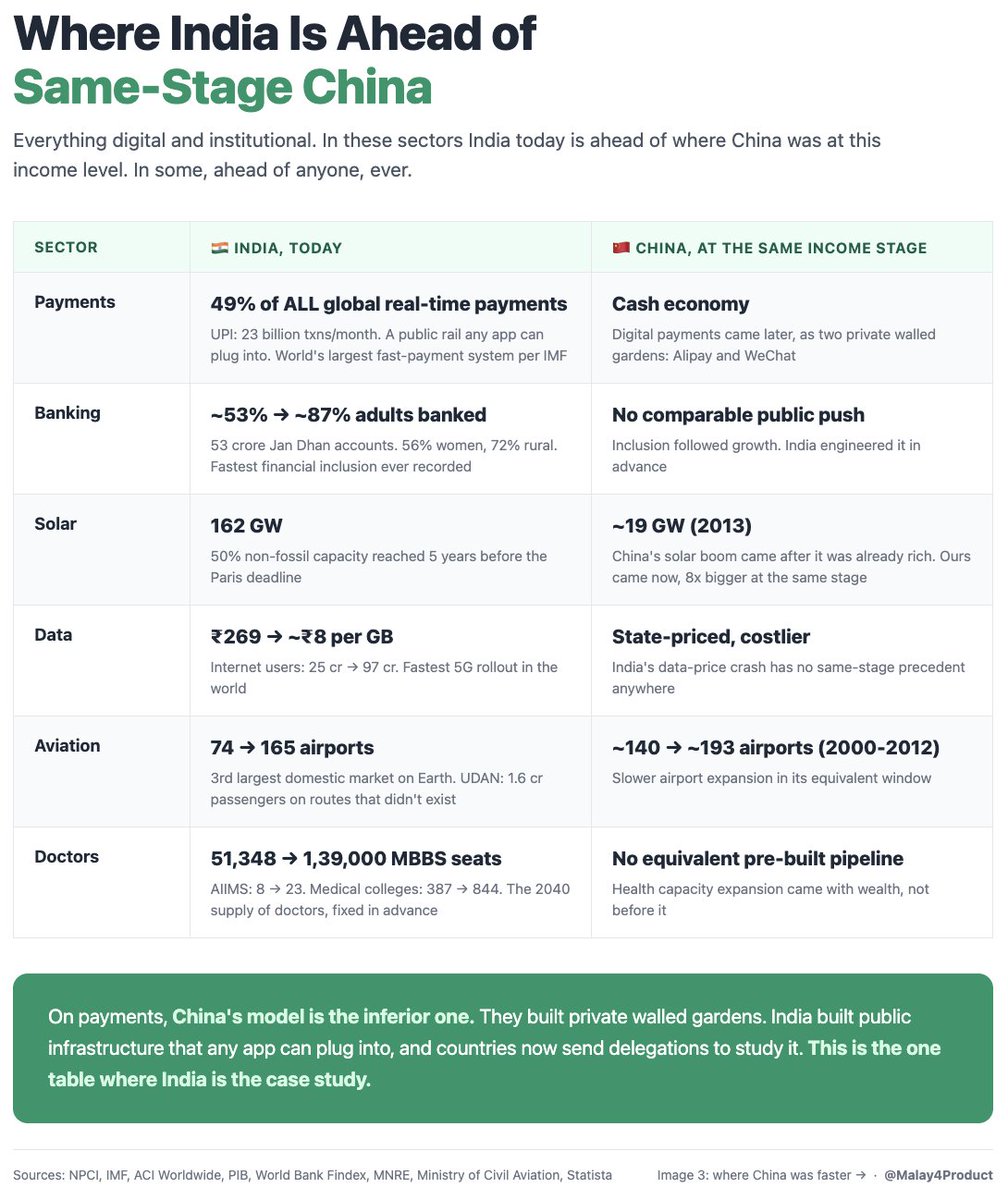
Where the work was digital or institutional, we are ahead of same-stage China.
In some places, ahead of anyone ever.
Solar.
When China was at our income in 2013, it had about 19 GW of solar. We have 162. Eight times more, and we hit 50% non-fossil capacity five years before our Paris deadline. Their clean energy boom came after they got rich. Ours came now.
Payments.
China at our stage was a cash economy, and when digital payments arrived there, they arrived as two private walled gardens, Alipay and WeChat.
We built a public rail any app can plug into. UPI runs 23 billion transactions a month, which is 49% of every real time digital payment on the planet. The IMF calls it the world's largest fast payment system. On this one, delegations come to study us.
Banking.
Around 53% of our adults had a bank account in 2014. Around 87% now. 53 crore Jan Dhan accounts, most held by women, most rural. Nobody has moved that many people into formal finance that fast, at any income level.
Data.
₹269 per GB in 2014 to about ₹8 now. Internet users from 25 crore to 97 crore. Fastest 5G rollout anywhere.
Aviation.
74 airports to 165, third biggest domestic market in the world. Holds up against anyone's decade.
And the doctor pipeline.
AIIMS from 8 to 23. Medical colleges 387 to 844. MBBS seats 51,000 to 1.39 lakh. That is the number of doctors India will have in 2040.
If you step back, the pattern is hard to miss.
Wherever the job needed land, we were slow. Land acquisition in a democracy costs time, and it shows in every kilometre.
Wherever the job was digital or institutional, we moved faster than China ever did at this income.
We are not building the way China built. We are building a different stack in a different order. Digital first, concrete second. They did the reverse.
The 2040s will answer which order turns out better.
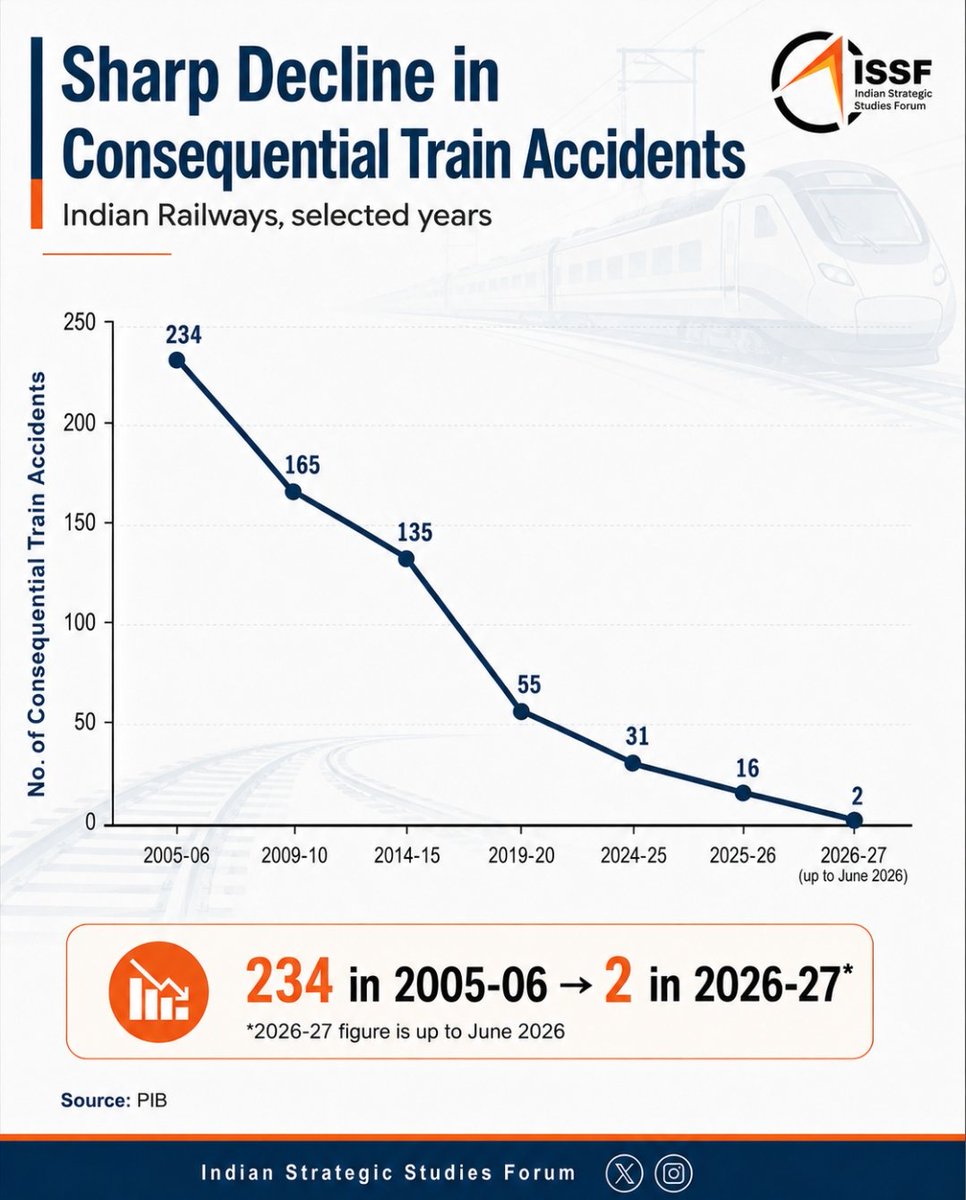
India’s railway safety record has witnessed a remarkable transformation.
Consequential train accidents declined from 234 in 2005-06 to just 2 in 2026-27, reflecting sustained improvements in infrastructure and operational safety.
Source: PIB
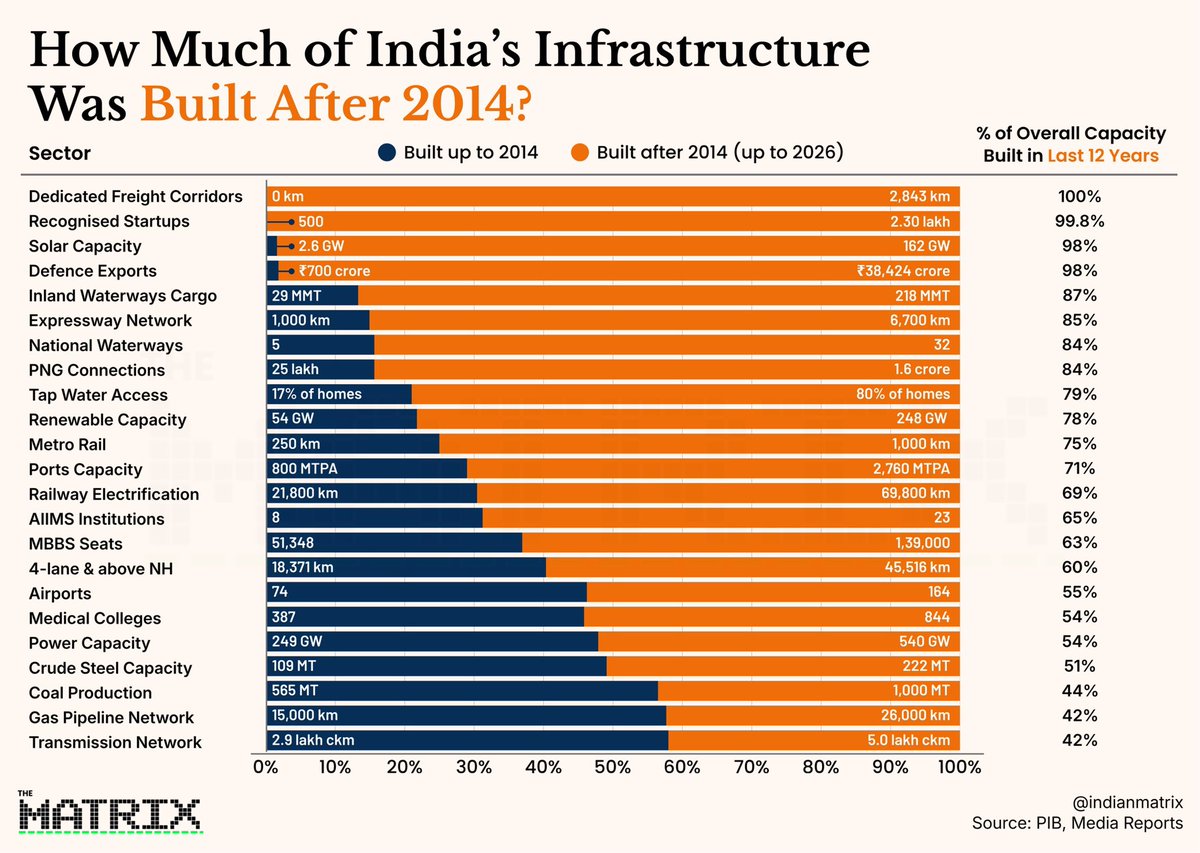
How much of India's infrastructure was built after 2014?
• 100% of Dedicated Freight Corridors
• 98% of Solar Capacity
• 85% of the Expressway Network
• 79% of Tap Water Access
• 75% of Metro Rail
• 71% of Port Capacity
• 69% of Railway Electrification
• 60% of 4-Lane National Highways
Infrastructure is built over decades.
But some decades build more than others.
India could have been a semiconductor superpower in 1964 but Congress spent the next 50 years making sure every opportunity was killed before it started, the story of what we lost becomes impossible to read without anger.
In 1964 Robert Noyce, the co-founder of Intel, came to India with a complete blueprint to make this country the global leader in chip manufacturing. He did not come empty handed. He came with the technology, the vision and the intent to build something that would have changed India's trajectory for generations.
Congress sent him to 50 government offices.
He got tired. He left. He went to Hong Kong. And Hong Kong's fortunes changed instead of ours.
That was not bad luck. That was a policy outcome.
The story did not end there. In 1989 India's only chip plant, SCL Mohali, burned down in a fire. The government took 8 years to rebuild it. 8 years. In a sector where technology generations turn over faster than most government files get processed.
Then 2005. Intel was ready to bring a 700 million dollar plant to India. UPA government refused to offer tax incentives. Intel walked. In the same era AMD's imported equipment sat at Indian ports for years gathering dust before being sent back to the country it came from.
By 2014 India did not have a single commercial chip fabrication plant. Not one.
The country that produces a significant portion of the world's semiconductor engineers. The country that built ISRO's computational infrastructure. The country whose mathematicians and scientists power Silicon Valley. Had zero chip plants of its own after 50 years of governance that treated every serious investor like a bureaucratic inconvenience.
Now look at the last 12 years.
Over 25 billion dollars committed under India's Semiconductor Mission. Micron's plant operational in Gujarat. 80,000 wafers being produced monthly at Taloja. Tata's Assam plant packaging 48 million chips daily. Tata Electronics partnering with ASML for the Dholera fab. India entering the semiconductor supply chain that three countries controlled for decades.
The talent was always here.
The difference between 1964 and 2024 is not technology. It is not capital. It is not engineering capability.
It is a government that finally said yes instead of sending the investor to the 51st office.
Nothing is more important than the welfare and future of our youth!
We have decided to set up fast-track courts to ensure swift and stringent punishment for those involved in paper leaks. Have directed the concerned authorities and officials to take all necessary steps in this regard. This continues our series of steps for safeguarding the interests of students.
Those who try to harm the future of our youth will not be spared.
देश के युवाओं का हित और उनका भविष्य हमारी सर्वोच्च प्राथमिकता है।
पेपर लीक के सभी मामलों में दोषियों को जल्द से जल्द कठोर दंड देने के लिए, केस के त्वरित निस्तारण के लिए फास्ट ट्रैक कोर्ट्स का गठन किया जाएगा। इस संबंध में निर्देश दे दिए गए हैं कि संबंधित विभाग आवश्यक कार्रवाई सुनिश्चित करें।
विद्यार्थियों के हितों को सुरक्षित करने के लिए, सरकार द्वारा लिए जा रहे निर्णयों की श्रृंखला में ये एक महत्वपूर्ण कदम है।
युवाओं के भविष्य के साथ खिलवाड़ करने वाले किसी भी व्यक्ति को बख्शा नहीं जाएगा।
It’s all about the Foreign Contribution (Regulation) Act (FCRA) bill. Too many foreign countries and their nefarious designs in India will come to a screeching halt.
The FCRA Amendment bill is set to be tabled in Parliament.
India changed one word in its FCRA rules: proselytisation. That has triggered criticism from some US lawmakers. Why can't India decide how foreign money operates within its borders? Watch: