Associate Professor, Chemical Engineering, IIT Bombay, Tweeting in personal capacity.
Education - JNCASR Bangalore, Weizmann Institute, Rehovot, NIT Rourkela
Today I launch Separatrix 1.0: a free desktop app for nonlinear dynamics.
Type ẋ = f(x, y) and get the phase portrait, fixed points classified, Lyapunov exponents, orbit diagrams and bifurcations, copy it as LaTeX.
Offline, open source, Mac/Win/Linux.
https://t.co/qIEMgPynZn
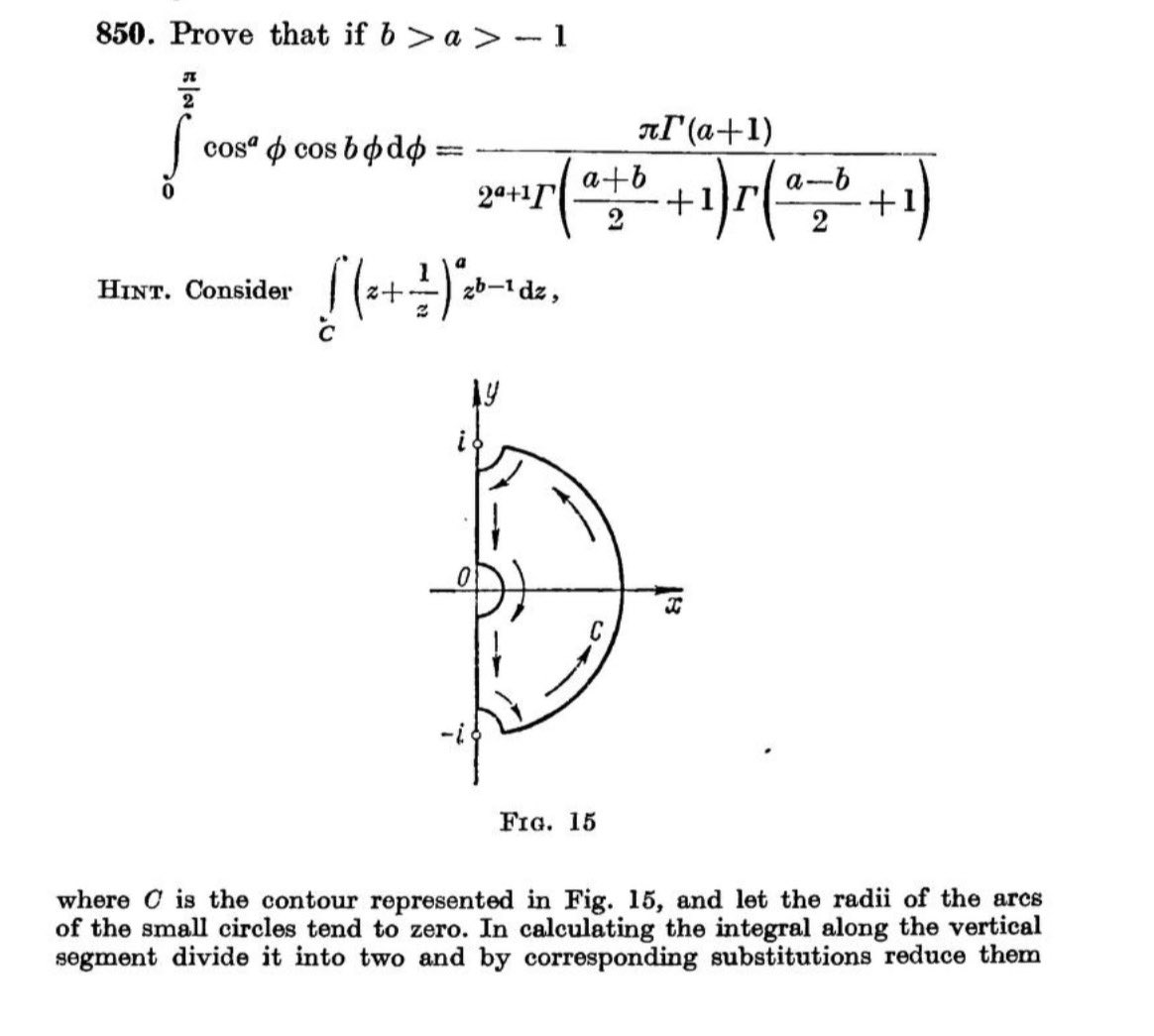
Here’s a fun one: a complex contour integral that gives a purely real answer, −2π/(n−1)!. One substitution explains the factorial. I’ve drawn both contours so you can see what happens and how we avoid the branch cut. We await @CPierre67’s solution to a related integral.
My friend Priti’s sister in USA got a massive heart attack. She is on life support and family needs to reach ASAP. However, their emergency visa application has not been processed yet.
Please retweet for amplification.
It’s urgent and a truly life-defining situation.
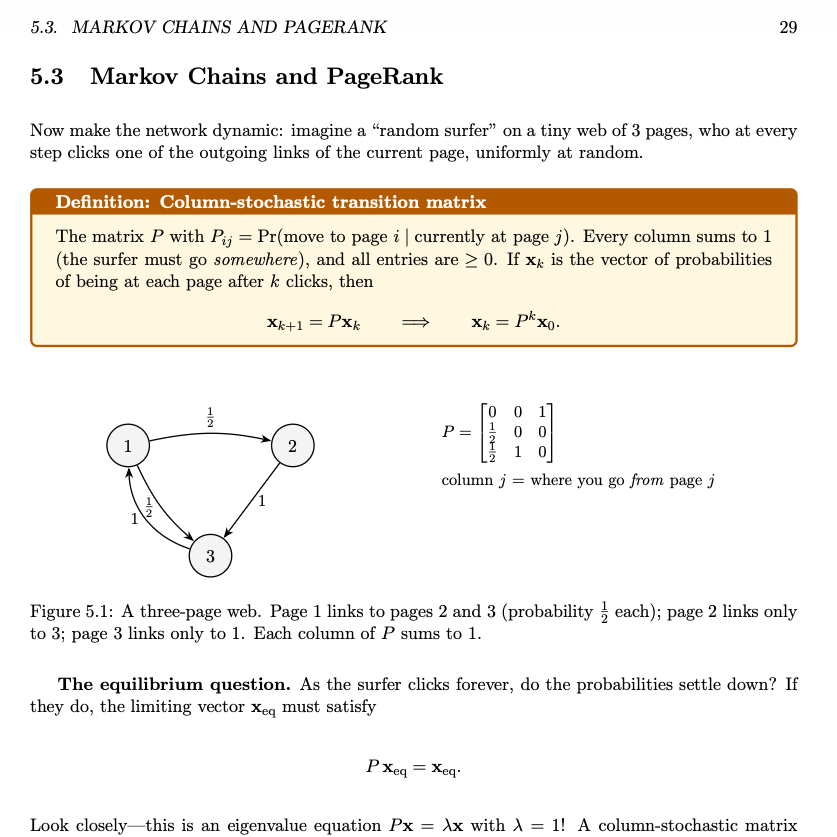
"Advanced Linear Algebra with Applications" is a set of lecture notes that explores the mathematical foundations of numerical linear algebra and its applications to scientific computing, graph theory, and machine learning.
The notes cover matrix norms and decompositions, floating-point arithmetic, numerical errors and conditioning, LU and Cholesky factorizations, iterative methods such as Jacobi, Gauss–Seidel, and SOR, sparse matrices, graph Laplacians, Krylov subspace methods, conjugate gradients, Lanczos and Arnoldi algorithms, GMRES, and preconditioning techniques.
One particularly interesting section explains the mathematics behind Google's original PageRank algorithm. PageRank essentially treats the web as a directed graph and the ranking of its pages as an eigenvalue problem. Since the web graph is far too large for conventional matrix decompositions, iterative numerical methods make it possible to compute the rankings efficiently. This is an interesting example of how classical linear algebra became the foundation of one of the most influential technologies in the history of the web.
https://t.co/AHUSFtAIHs
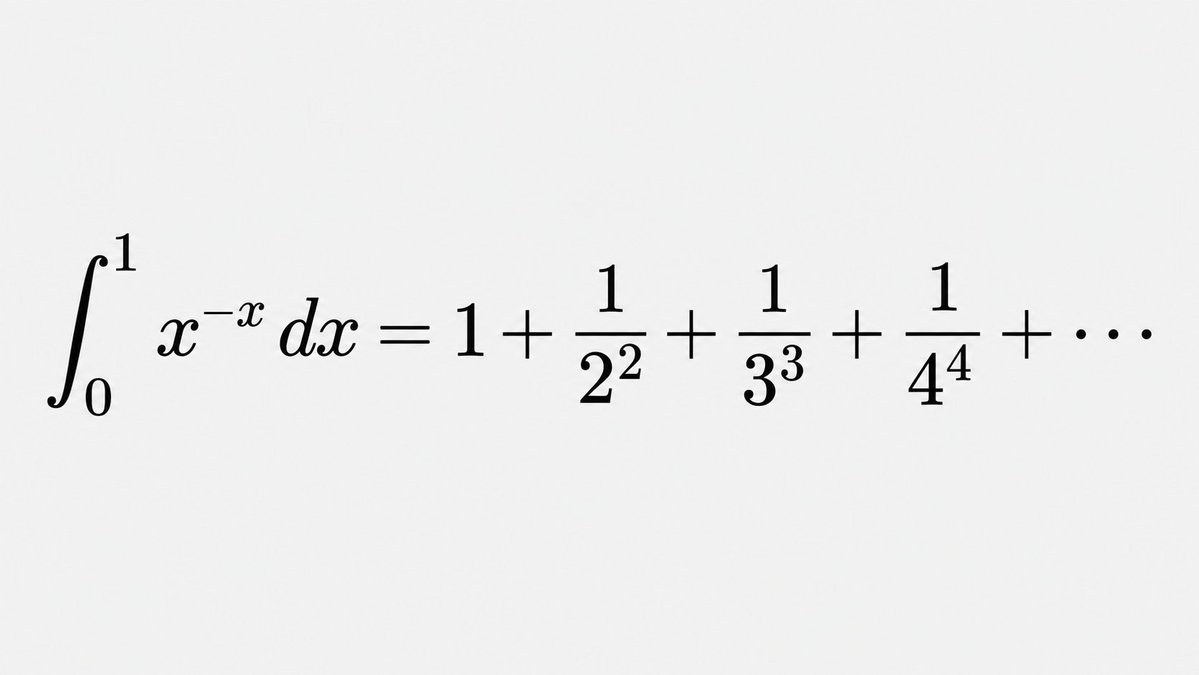
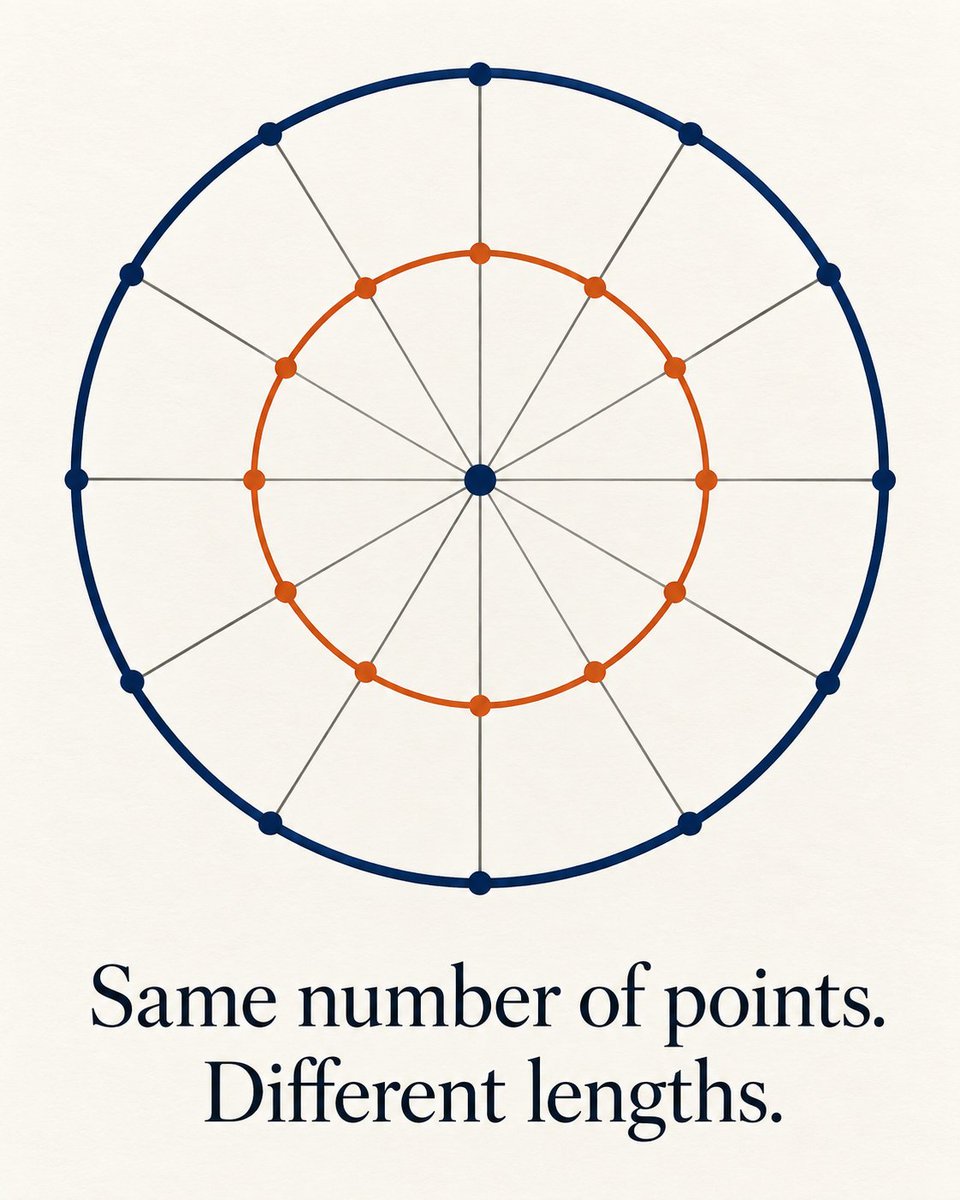
A paradox that puzzled mathematicians for centuries:
Take two concentric wheels of different sizes, rigidly joined together. Every point on the larger circle corresponds to exactly one point on the smaller circle.
So why don’t the two circles have the same circumference?
The resolution is subtle: a one-to-one correspondence between points does not imply equal length. In fact, Cantor later showed that line segments of different lengths contain the same cardinality of points.
So we can say that size in geometry and size in set theory are different ideas.
"Mathematical Pathways to Machine Learning" is a new introduction to the mathematical foundations of machine learning, published in August 2026.
It is a collection of lecture notes that develops the mathematics from first principles and covers vectors and matrices, inner and outer products, orthogonality and projections, Gram–Schmidt and QR factorization, eigenvalues and eigenvectors, SVD, PCA, derivatives and gradients, Jacobians, Hessians, Taylor approximations, convexity, least squares, gradient descent, convergence and conditioning, Newton's method, momentum, Lagrange multipliers, KKT conditions, duality, and support vector machines.
The mathematical concepts are directly connected to actual machine learning applications, including neural networks and backpropagation, PageRank, recommender systems, dimensionality reduction, regression, optimization, and SVMs.
The presentation is accessible and very well structured, with worked examples and exercises throughout, including exam-practice problems and small computational exercises.
https://t.co/WvXDlV27Md
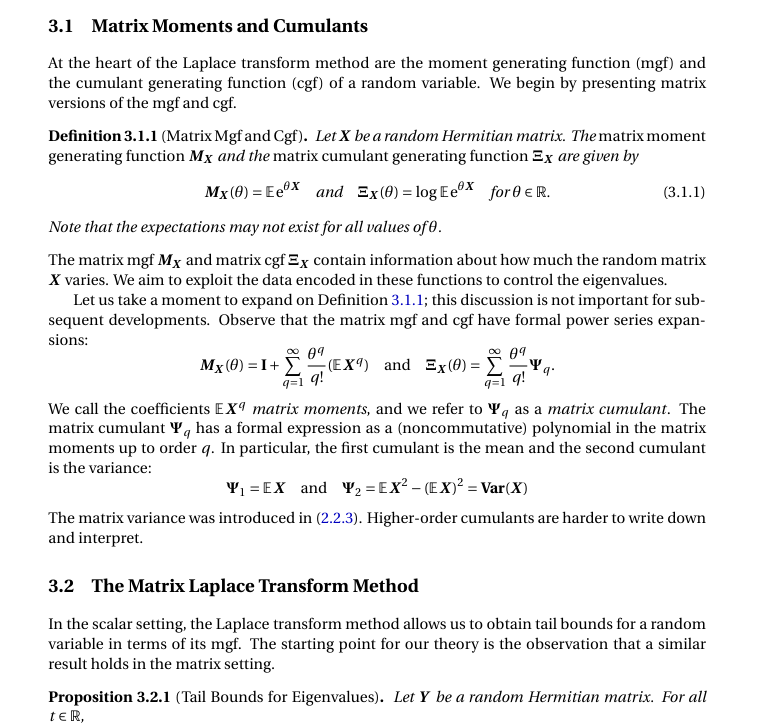
"Matrix Analysis" is an interesting book that explores the mathematics of random matrices, which, in simple terms, are matrices whose entries or other properties involve random variables. They are deeply connected with probability and appear in areas such as multivariate statistics, numerical linear algebra, the geometry of numbers, and many other fields.
The book covers a wide range of topics, including matrix functions, Hermitian matrices, eigenvalues and singular values, spectral norms, probability with matrices, Laplace transforms, Gaussian and Rademacher series, Chernoff and Bernstein inequalities, intrinsic dimension, matrix approximation, randomized matrix multiplication, random features, and much more.
It's an advanced text, but also a very interesting one, especially because it connects the matrix methods familiar from linear algebra with ideas from probability and statistics, showing how these tools can be used to study random matrices and their applications.
https://t.co/XPXSYGZQkQ
My classes from the ongoing course of "Math of GenAI" at IISc are online. If one is interested in knowing the rigorous math behind the models that have revolutionised the world, this is the place. New lectures every week. The link to the playlist is in the first reply.