Oncologist, Chief of the Oncology Service of the National Hospital EsSalud, research, teaching at the Faculty of Health Sciences, Human Medicina UNSAAC
🔖 Bookmark now, reference later: Management of #ThyroidCancer increasingly reflects #tumor size, #disease extent, and #molecular profile.
This #JAMAReview indicates that observation without surgical resection can be considered for microcarcinomas ≤1 cm, while surgery with or without #RadioactiveIodine is curative in most cases for tumors >1 cm with or without lymph node metastases.
➡️ Save this Review to your citation manager and reference it in future research: https://t.co/aSFQfwJdvO
Landmark Trial in Locoregionally Advanced NPC
Induction gemcitabine–cisplatin (GP) before concurrent cisplatin-IMRT changed the treatment paradigm for high-risk locoregionally advanced nasopharyngeal carcinoma.
Key findings (NEJM 2019): • 49% relative reduction in recurrence or death (HR 0.51) • Improved recurrence-free, overall, and distant metastasis-free survival • Benefit driven primarily by better distant metastatic control • Higher acute toxicity, but no meaningful increase in late grade 3–4 toxicity
A practice-changing study that established GP induction followed by concurrent chemoradiotherapy as a standard of care for suitable patients.
📖 Zhang Y et al. N Engl J Med. 2019;381:1124–1135. DOI: 10.1056/NEJMoa1905287
#MedTwitter #Oncology #RadOnc #MedOnc #HeadAndNeckCancer #NasopharyngealCarcinoma #NPC #ESMO #ASCO #NEJM #MVOnco
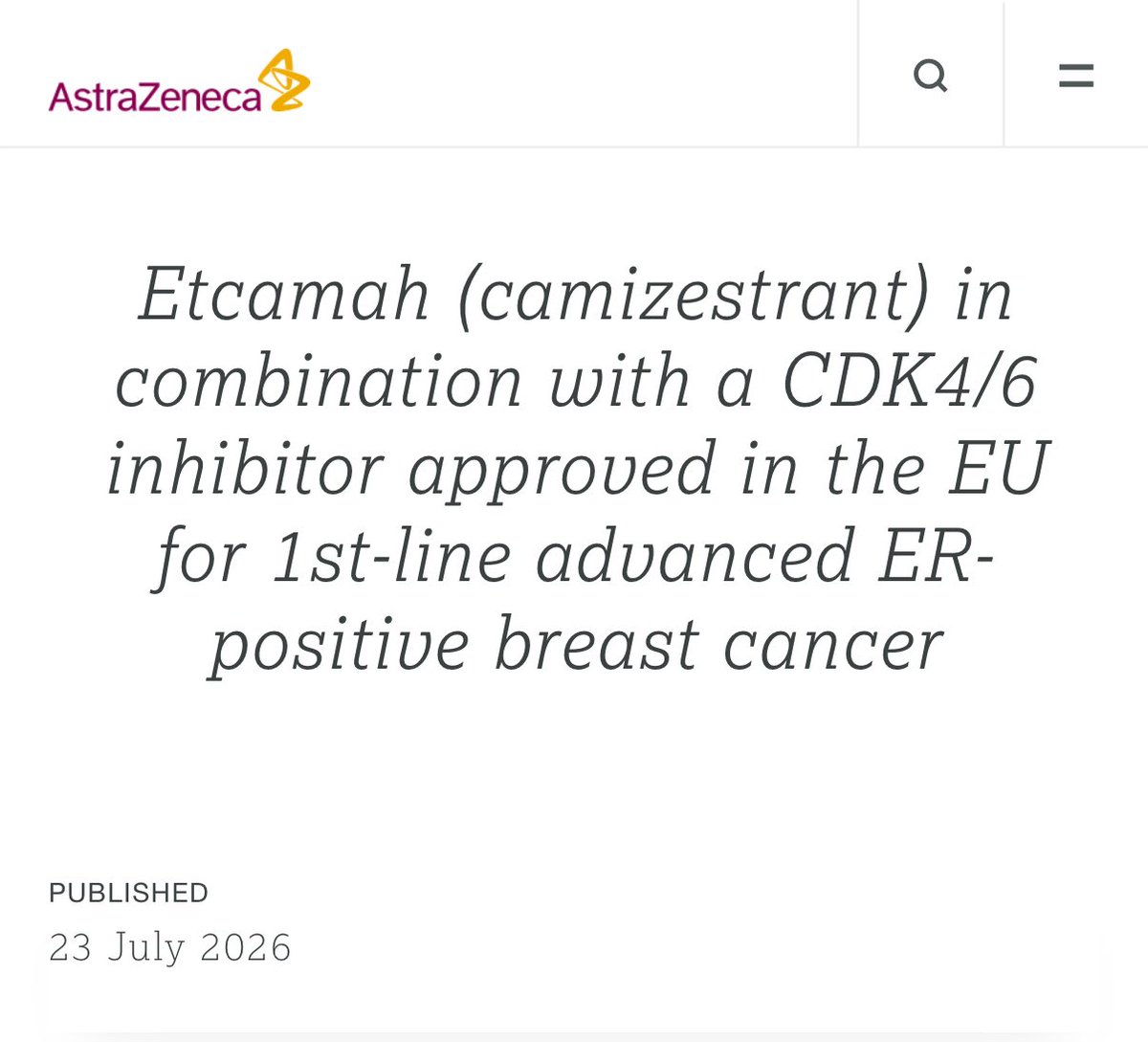
Camizestrant now approved in Europe. New treatments are always welcome. Though implementation of cami will require sequential ctDNA testing without PD, which may not be immediately available across 🇪🇺. Hoping to have the drug also available in the 🇺🇸 soon. https://t.co/aoCU4ak1pp
🔥off the press🔥
Expanding the path to cure - a narrative review on optimizing multimodality sequencing in HCC
👉HCC management is shifting toward a personalized, multimodal continuum, a 🇨🇦 perspective
👇my author link
https://t.co/sbOxoPLAL3
@myESMO@asco
The MONARCH Trials — The Complete Abemaciclib Story
From metastatic HR+/HER2− breast cancer to high-risk early breast cancer, HER2-positive disease, and CDK4/6 inhibitor continuation beyond progression, the MONARCH program has defined the clinical role of abemaciclib across the breast cancer continuum.
This infographic provides a one-glance visual summary of the key MONARCH trials and their major clinical take-home messages.
What trial from the MONARCH program has had the greatest impact on your clinical practice?
#BreastCancer #bcsm #Oncology #MedTwitter #Abemaciclib #CDK46 #MONARCH #MedicalEducation #MVOnco
Should taxanes always be the default first-line chemotherapy with trastuzumab + pertuzumab?
The EMERALD final analysis suggests the answer may be no.
🔹 Eribulin achieved comparable long-term survival.
🔹 Median OS exceeded 6 years.
🔹 No significant OS difference versus taxanes.
🔹 ctDNA PIK3CA mutation identified high-risk patients, while HER2 amplification predicted better prognosis.
A valuable option for patients in whom taxane toxicity is a concern.
#BreastCancer #HER2Positive #Oncology #MedTwitter #CancerResearch @OncoDailyBreast #larvol
Phase III Trial | Will this become the new TNT standard for high-risk rectal cancer?
The TNTCRT trial tested an intensified long-course TNT strategy with uninterrupted CAPOX + long-course RT versus conventional long-course chemoradiotherapy in 458 patients with high-risk stage II/III rectal cancer.
Key results:
✅ 3-year DFS: 74.8% vs 66.0%
• HR 0.67 (95% CI 0.49-0.93)
• P=0.016
✅ Metastasis-free survival:
• 77.7% vs 67.6%
• HR 0.66
✅ Pathologic CR:
• 26.4% vs 9.8%
• P<0.001
⚖️ Trade-off:
• Higher grade ≥3 toxicity during neoadjuvant therapy
27.6% vs 8.6%
• But overall severe toxicity across the entire treatment course was similar
28.0% vs 24.3%
• Major postoperative complications were also comparable.
Clinical takeaway 🩺
This is one of the strongest phase III datasets supporting doublet chemotherapy integrated throughout long-course radiotherapy in high-risk LARC, delivering meaningful improvements in DFS, MFS, and pCR with acceptable overall safety.
Will this approach replace conventional long-course CRT in your practice, or do you still prefer other TNT strategies such as RAPIDO/PRODIGE-23/STELLAR?
#RectalCancer #GIOncology #ASCO #OncoAlert
@ASCO@JCO_ASCO@oncoalert
Approximately 30% of HER2+ breast cancers harbor PIK3CA mutations. In this interesting report just published in @ESMO_Open, gedatolisib + trastuzumab yielded an ORR of 43% and PFS 6 months for pretreated, PIK3CAm, HER2+ MBC. Key toxicity: stomatitis. https://t.co/vrsXZA9JgS
In a small subset of patients, immune checkpoint inhibitors can paradoxically accelerate tumor growth—a phenomenon known as hyperprogressive disease (HPD).
🧬 Why does it happen?
• Tumor microenvironment changes
• MDM2/MDM4 amplification
• EGFR alterations
• Fc receptor–mediated effects
• Expansion of immunosuppressive cells
Recognizing patients at risk and monitoring early can make a critical difference.
Understanding why helps us deliver the right treatment to the right patient at the right time.
#Immunotherapy #Hyperprogression #Cancer #Oncology #MedicalOncology #ImmunoOncology #CheckpointInhibitors #CancerResearch #PrecisionMedicine #TumorMicroenvironment #MedEd #FOAMed #OncX #CancerConcepts #DrRupamOncology
And it is on again!
The Annual Mayo Clinic Oncology Review. First up is @rleonferre talking about HER2+ and triple negative breast cancer. As expected, a superb presentation, packed with pearls!
A full day ahead, packed with exciting updates. Join us next year!
@MayoCancerCare@MayoHemeOnc@MayoMedEd
Durante demasiado tiempo, la medicina ha tratado la marcha como un síntoma periférico: un simple acto mecánico reducido a pasos, equilibrio y velocidad. Pero caminar es mucho más que desplazarse. Es una conversación continua entre el cerebro, la médula espinal, los nervios periféricos y el entorno; una coreografía biológica que revela, a veces antes que cualquier resonancia o biomarcador, cuándo el sistema nervioso comienza a fallar.
La neurología contemporánea está empezando a reconocer una verdad incómoda y fascinante: la pérdida de estabilidad al caminar puede anticipar deterioro cognitivo, fragilidad sistémica e incluso mortalidad. En enfermedades como el Parkinson, la esclerosis múltiple o las ataxias, la marcha no solo refleja discapacidad; puede convertirse en una ventana predictiva hacia el futuro clínico del paciente.
Los avances tecnológicos han acelerado esta transformación conceptual. Sensores portátiles, inteligencia artificial y sistemas de captura de movimiento permiten cuantificar variaciones invisibles al ojo humano: un aumento milimétrico en la variabilidad del paso, una fracción extra de tiempo en doble apoyo, una vacilación apenas perceptible antes de girar. Lo que antes dependía de la intuición clínica ahora puede medirse con precisión y seguirse longitudinalmente.
Sin embargo, el entusiasmo tecnológico no debe confundirse con madurez científica. Persisten interrogantes fundamentales: ¿qué métricas son realmente significativas?, ¿cómo evitar sesgos algorítmicos?, ¿qué ocurre cuando los datos de movilidad se convierten en vigilancia biométrica? La promesa de la “marcha como sexto signo vital” exige no solo innovación, sino también estándares rigurosos, validación multicéntrica y marcos éticos sólidos.
Aun así, la dirección es clara. En una era obsesionada con imágenes moleculares y genética de precisión, quizá uno de los biomarcadores más poderosos siga siendo profundamente humano: la manera en que una persona atraviesa una habitación.
https://t.co/v4ztI7qXVD
Beyond AR and BRCA. An outstanding review on the genomic landscape of prostate cancer. From targetable alterations to lineage plasticity and therapeutic strategies.
Are we finally ready to identify and treat aggressive-variant PC?
📖 https://t.co/Mea3Gr3zFk…
@OncoAlert
#SABCS25 | A-BRAVE translational analysis: Baseline TIL ≥30% predicted benefit from adjuvant avelumab in high-risk early TNBC (3-year DDFS 92% vs 59%). No benefit was seen with lower TIL levels. Evidence for TILs as a predictive IO biomarker continues to grow.
https://t.co/Dtn5wWqoFH
Co-mutations: The Next Frontier in Precision Oncology for NSCLC 🧬
Not all patients with the same driver mutation have the same clinical outcome.
The missing piece? Co-mutations.
While the driver mutation determines the primary targeted therapy, co-mutations refine prognosis, predict response to immunotherapy and targeted therapies, identify resistance mechanisms, and increasingly guide clinical trial selection.
Key takeaways:
🔹 KRAS + TP53 → Immune-hot phenotype, greater likelihood of benefit from immunotherapy
🔹 KRAS + STK11 → Immune-cold tumor, poor prognosis, but KRAS inhibitor activity is generally preserved
🔹 KRAS + KEAP1 → Aggressive biology with reduced benefit from immunotherapy and poorer outcomes
🔹 EGFR + TP53 → Earlier resistance to EGFR TKIs; selected patients may benefit from treatment intensification (e.g., the FLAURA2 concept)
Precision oncology is evolving from “Driver Mutation” to “Driver Mutation + Co-mutational Profile.”
📌 Understanding co-mutations is becoming essential for personalized treatment decisions in NSCLC.
#LungCancer #NSCLC #PrecisionOncology #ThoracicOncology #KRAS #EGFR #TP53 #STK11 #KEAP1 #Immunotherapy #TargetedTherapy #MolecularOncology #CancerGenomics #MedicalOncology #Oncology #CancerConceptsExplained