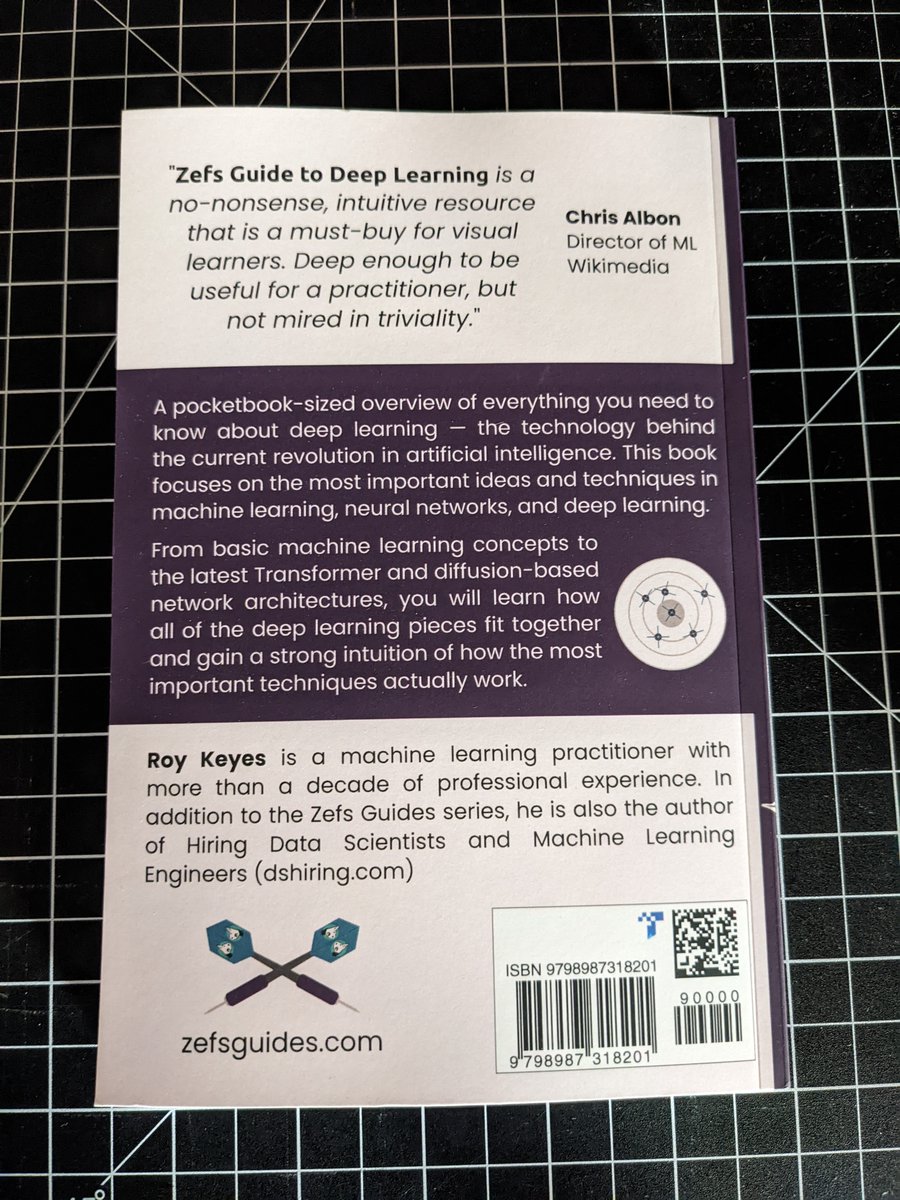
🎉🎉Zefs Guide to Deep Learning is finally out🎉🎉
Covering the most important concepts in deep learning, it takes you from basic ML all the way to Transformers and Stable Diffusion
The paperback, ebook, and digital flashcards are all available now at https://t.co/3qaneajt4X
An illustration of how neural networks warp features to make the data easily separable into classes using linear and non-linear transformations that they learn.
From Zefs Guide to Deep Learning.
Inspired by and adapted from some of @alfcnz's code from the NYU DL course.
@sarahcat21 There's some nuance lost given the wide definition of startup, but I can think of many counterexamples of self-described startups with millions of users who gain value from testing. The more interesting discussion IMO is why A/B testing is *sometimes* more harmful than good.
@bernhardsson These are great KRs for an objective along the lines of developer speed, but there's a second objective around quality that is arguably more important: test coverage, reducing bugs, code readability, etc. IME quality impacts longterm productivity more than developer speed.
Leading data scientist Ravi Mody joins the Aloe Care Health advisory board to help identify issues in eldercare before they become crises. Read more here: https://t.co/QlstUfcatL #spotify#iheartradio#dailyharvest
@bernhardsson I suspect hard skills are trimodal; people who: 1. don't grok/don't care about the field, 2. work to live, 3. are passionate about their field and bring it home. Group 1 is huge & group 3 is rare, so if you squint your eyes you'd have a long tail distribution.
@bernhardsson I had the opposite experience on the data marketing side, where most of the major players are attempting to cover larger parts of the stack, often poorly, always at a large premium.
@fulhack For example, Fivetran et al abstracts away the concern of how your backend database and your data warehouse are implemented, and you don't need 200 different solutions for this.
@fulhack I can't think of a term for this, but it feels related to what I'd called vertical interoperability: the ability for layer 1 to interact with layer 2 regardless of how they are implemented. In practice O(n^-2) can eventually be avoided with a new layer of abstraction in between.
My book is finally out 😌
Hiring Data Scientists and Machine Learning Engineers is a practical guide to hiring data roles.
It also features interviews about DS/MLE hiring from across tech with @chrisalbon@jkru@seanjtaylor@AngeBassa and @ravi_mody
https://t.co/qEoLjdWTfr
@databozo@chrisalbon A key distinction is KNN is non-parametric i.e. the algorithm isn't 'learning' the values of any parameters. It's not about lossiness per se, a parametric model can perfectly fit a dataset
@fulhack I agree - the trend I've witnessed is better data infra/tooling = fewer or less-specialized data engineers. Data meshes seem to prescribe specialized data engineers and puts "data infra" as a footnote. Without great data infra or a centralized function the silos will be a mess.