Pretty remarkable what’s happening with open weights AI right now. We’re seeing models achieve SOTA results on specific tasks, and getting close to frontier on some areas of coding and other domains.
The more that open weights is able to maintain only a marginal gap from the frontier, instead of a widening gap, the more value that can be created with AI.
Incidentally, this is actually fine for the frontier labs as well; if we can lower the cost of an overall task then AI usage goes up in general. You’re still likely using frontier models for planning, orchestration, reviewing, and other parts of work.
But this is all very good for the applied layer of AI, which is now in a great position to cost optimize workloads with cheaper models or use tailored open models post-trained for specific tasks to improve performance.
$META
Meta’s AMD deal is fascinating:
If AMD hits $600, Meta’s 160M share warrants ($0.01 strike) vest into $96B of equity—effectively wiping out their entire $60B–$100B AI hardware bill
Free compute, funded by the supplier’s own stock
A bit of news: After nearly 9 years, I have decided to leave Google DeepMind and join Anthropic (after taking some time to recharge). I am incredibly grateful for my time at GDM. @demishassabis took a real chance letting me lead the AlphaFold team just six months after finishing my PhD, and the entire GDM team taught me so much about how to do great science. GDM is a special place, and I’ll still be excited to hear about what amazing things they discover next.
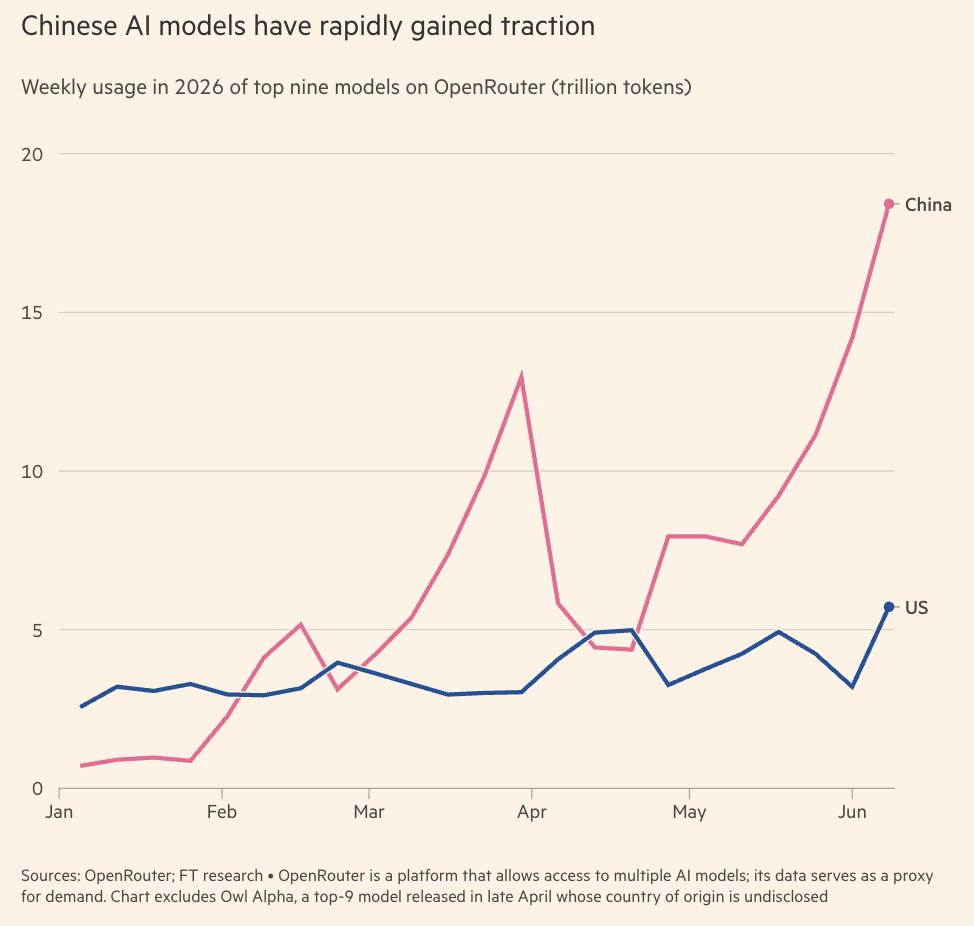
FT: "Goldman Sachs analysts last month predicted that use of AI agents would result in a 24-fold increase in token consumption by 2030 and that the huge rise in demand would exacerbate a shortage of chips over the next 12 to 18 months. While token usage and AI spending by businesses continue to grow, efforts to curb costs could weigh on the growth of the world’s largest AI labs such as Anthropic and OpenAI, which plan to go public later this year at near-trillion-dollar valuations. Since the start of the year, Chinese AI models have overtaken their US counterparts in token consumption, according to data from OpenRouter, an aggregation platform that allows users to access multiple AI models. China’s cheaper energy and more efficient models have allowed the country’s AI labs to charge less than leading US groups for tokens, giving China a new edge on the AI battleground."
Again, I believe market participants are underestimating the pricing power challenges US hyperscalers face, both due to domestic and international competition. As I wrote in my December report on "GenAI & Productivity" (https://t.co/kEx5Z4BJH7):
"While there’s a lot of speculative fear about how a single LLM could rise to dominance and what that could mean for economic, societal, and political stability, we believe the bigger concern for investors today is how relative model parity could compromise pricing power. Tech giants have thrived on monopolies and duopolies for a decade or more. Now, they’re in an LLM arms race where it’s unclear when or even if ever leadership will be sustainable. We believe competition from akin models will apply downward pressure on pricing at least for the next three years."
Learn more about Sage Road Research here: https://t.co/Wgwz2xnvR6. Interested in subscribing? Message me.
FT link: https://t.co/xssgGXkLtb
SITUATION DETECTED: John Jumper, who won the Nobel Prize in Chemistry for AlphaFold along with Demis Hassabis, has left Google DeepMind to join Anthropic.
SpaceX IPO float unlock timeline:
Initial free float: ~4.9%
Potential float available:
Aug 8: ~11.8%
Aug 20: ~15.2%
Sep 9: ~17.7%
Sep 24: ~20.1%
Oct 9: ~22.6%
Oct 24: ~25.1%
Dec 8: ~40.0%
Mar 18, 2027: ~44.1%
May 17, 2027: ~46.7%
Jun 12, 2027: ~50.8%
Musk’s 46.1% stake becomes eligible after Day 366.
Potential float jumps to ~96.9%.
Aug 2027: ~99.5%
Sep 2027: full unlock, 100%
Eligible to sell does not mean actual selling.
It means those shares become available supply.
🚨 SCOOP: After the release of Fable 5 and with GPT-5.6 looming, the mood behind the scenes at Google DeepMind is increasingly one of frustration and broad discontent over the lab's perceived fall into a distant third—or even fourth—place.
"I can't blame Noam [Shazeer] for walking. He won't be the last big name to go, either," a well-connected DeepMind employee told me.
DeepMind's last major model release, 3.5 Flash, was a significant jump over its predecessor; however, it was not meaningfully better in most cases than 3.1 Pro, released back in February. In real-world use, it remains several steps behind the frontier. That was four months ago, and Google's best model now sits in a lowly fifth place on the Artificial Analysis Intelligence Index—lapped by models from Anthropic, OpenAI, and now China's Zhipu AI. Other releases have proven similarly disheartening: the small video generation model Gemini Omni Flash launched to little fanfare and was easily beaten by ByteDance's Seedance 2.
Gemini 3.5 Pro, slated to launch June 30th, is "not the step change we need to be truly competitive in the race [to AGI]," per another individual at the company. The consensus seems to be that leadership at Google has all but conceded that race to Anthropic and OpenAI, and that "only a big shake-up" will propel them back to the highs of mid-to-late 2025.
But employees are not hopeful: "We no longer have a frontier model in text, image, video, voice, or even vision... if we can't release a real frontier model after over four months of work with all of these resources, what are we doing?"
After the disappointing WWDC 2026 conference, Apple should authorize more stock repurchases to return cash flow to investors. That way, investors can hopefully find real innovation somewhere other than Apple.
⚡️Accenture is the professional-services pyramid getting repriced in public.
This matters because Accenture is one of the biggest embodiments of the old white-collar machine.
Sell trust at the top. Sell bodies in the middle. Sell offshore labor at scale underneath.
Turn enterprise confusion into billable hours.
Stretch complexity into programs. Wrap transformation in process, decks, migration teams, testing teams, PMOs, compliance layers, and managed services.
AI attacks that whole spread.
The old model made money because enterprises could not translate messy internal problems into software and workflows without armies of humans. Now agents can read code, document systems, generate migration plans, map processes, create tests, summarize requirements, write scripts, clean data, debug issues, produce decks, and compress the grunt layer that used to justify huge teams.
That does not remove the need for Accenture tomorrow. Big enterprises still need trust, governance, integration, politics, change management, compliance, accountability, procurement, and someone to blame when the transformation breaks.
But the margin story changes.
Clients will increasingly ask why a project needs 400 consultants when agents can do the first draft, the code migration, the documentation, the testing scaffolds, the data mapping, and the support workflow. The client may still hire Accenture, but the engagement gets smaller, more outcome-based, more discounted, and harder to staff with a giant pyramid.
That is the death of easy billable-hour inflation.
The most dangerous part for Accenture is the contradiction inside its own pitch. It has to sell AI transformation. But real AI transformation teaches clients that fewer human hours are needed. So every honest AI project weakens the old revenue engine.
That is why the stock is breaking.
The market is starting to understand that AI does not only disrupt software vendors. It disrupts the companies that monetized software complexity.
Consulting, outsourcing, staff augmentation, implementation partners, junior analysts, offshore delivery centers, enterprise IT services, BPO, corporate process labor. That whole belt is exposed.
Accenture survives because it has relationships, scale, trust, and access. The old multiple does not survive cleanly if investors conclude the labor pyramid is structurally impaired.
The deeper labor signal is brutal. Junior white-collar work is the shock absorber. The apprenticeship ladder gets thinner. Entry-level analysts, testers, documentation people, PMO support, data-cleanup teams, offshore implementation staff. Those roles become easier to compress, delay, offshore further, automate, or replace with a smaller number of higher-agency operators supervising agents.
That is the white-collar repricing map becoming visible on a giant ticker.
The next phase will be ugly across the sector: weaker hiring, smaller project teams, pressure on pricing, client demands for AI productivity discounts, more outcome-based contracts, fewer bodies per engagement, and more consolidation around firms that can prove actual implementation authority rather than just manpower scale.
The cleanest line:
AI is coming for the rent collectors of corporate complexity.
Accenture was one of the largest. Now the market is marking the model down.
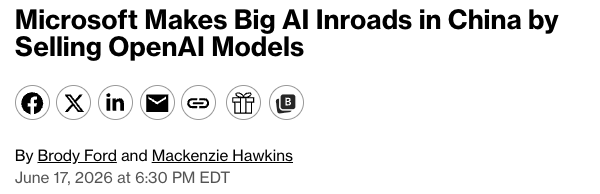
Microsoft is reportedly selling AI models to major Chinese tech firms through Azure, even as OpenAI and Anthropic avoid selling directly into China.
Per Bloomberg, ByteDance is on track to spend more than $1B a year on Microsoft AI and cloud services, while Ant Group, Meituan, and Tencent are also major Azure AI customers.
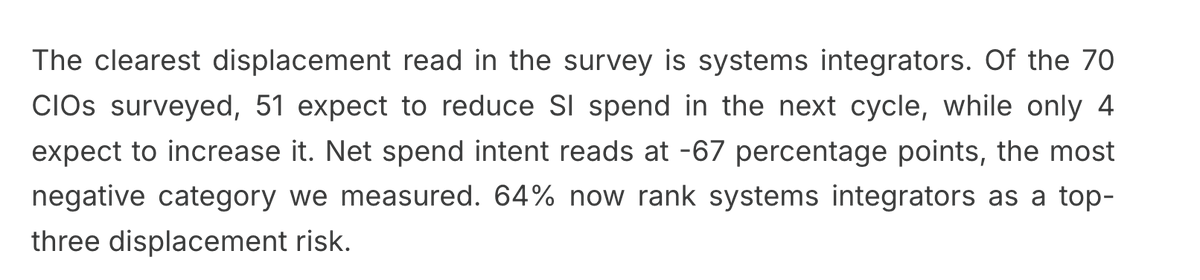
Not going to call the death of services/ISVs, but on the back of Accenture's stock plunge, our CIO/CTO survey seems directionally consistent.
https://t.co/q8I4QW5HCo
$SNOW's biggest threat is not Amazon. It's Anthropic.
Sridhar Ramaswamy told Nicolai Tangen @NicolaiTang1 that AI coding agents scare him more than any cloud hyperscaler. The conventional CEO answer names AWS or Azure. Ramaswamy named Anthropic.
His logic: software has always been protected by scarcity - engineers as concert pianists, he called them. Coding agents are industrializing that craft at a scale that breaks the moat around purpose-built platforms like Snowflake.
If you model $SNOW against Redshift and Fabric, you are watching the wrong fight. The competitive battleground is now the coding agent interface layer.
Full competitive threat map - which layer Anthropic is actually attacking and what Snowflake is doing about it:
https://t.co/Li2Chhe9Ql
Source: In Good Company with Nicolai Tangen - https://t.co/2ePscUgqln






![synthwavedd's tweet photo. 🚨 SCOOP: After the release of Fable 5 and with GPT-5.6 looming, the mood behind the scenes at Google DeepMind is increasingly one of frustration and broad discontent over the lab's perceived fall into a distant third—or even fourth—place.
"I can't blame Noam [Shazeer] for walking. He won't be the last big name to go, either," a well-connected DeepMind employee told me.
DeepMind's last major model release, 3.5 Flash, was a significant jump over its predecessor; however, it was not meaningfully better in most cases than 3.1 Pro, released back in February. In real-world use, it remains several steps behind the frontier. That was four months ago, and Google's best model now sits in a lowly fifth place on the Artificial Analysis Intelligence Index—lapped by models from Anthropic, OpenAI, and now China's Zhipu AI. Other releases have proven similarly disheartening: the small video generation model Gemini Omni Flash launched to little fanfare and was easily beaten by ByteDance's Seedance 2.
Gemini 3.5 Pro, slated to launch June 30th, is "not the step change we need to be truly competitive in the race [to AGI]," per another individual at the company. The consensus seems to be that leadership at Google has all but conceded that race to Anthropic and OpenAI, and that "only a big shake-up" will propel them back to the highs of mid-to-late 2025.
But employees are not hopeful: "We no longer have a frontier model in text, image, video, voice, or even vision... if we can't release a real frontier model after over four months of work with all of these resources, what are we doing?"](https://pbs.twimg.com/media/HLLmjWXXEAAKcY8.jpg)