Just built an insane new agent skill.
It can perfectly extract slides from YT videos, then write notes, images, transcripts, and slides into Obsidian vaults.
An HTML artifact allows me to navigate and add more notes as I listen.
Should I release the skill?
Introducing Flue — The First Agent Harness Framework
Flue is a TypeScript framework for building the next generation of agents, designed around a built-in agent harness.
Flue is like Claude Code, but 100% headless and programmable. There's no baked in assumption like requiring a human operator to function. No TUI. No GUI. Just TypeScript.
But using Flue feels like using Claude Code. The agents you build act autonomously to solve problems and complete tasks. They require very little code to run. Most of the "logic" lives in Markdown: skills and context and AGENTS.md.
Flue is like Astro or Next.js for agents (not surprising, given my background 🙃). It's not another AI SDK. It's a proper runtime-agnostic framework. Write once, build, and deploy your agents anywhere (Node.js, Cloudflare, GitHub Actions, GitLab CI/CD, etc).
We originally built Flue to power AI workflows inside of the Astro GitHub repo. But then @_bgiori got his hands on it, and we realized that every agent needs a framework like Flue, not just us.
Check it out! It's early, but I'm curious to hear what people think. Are agents ready for their library -> framework moment?
Introducing ml-intern, the agent that just automated the post-training team @huggingface
It's an open-source implementation of the real research loop that our ML researchers do every day. You give it a prompt, it researches papers, goes through citations, implements ideas in GPU sandboxes, iterates and builds deeply research-backed models for any use case. All built on the Hugging Face ecosystem.
It can pull off crazy things:
We made it train the best model for scientific reasoning. It went through citations from the official benchmark paper. Found OpenScience and NemoTron-CrossThink, added 7 difficulty-filtered dataset variants from ARC/SciQ/MMLU, and ran 12 SFT runs on Qwen3-1.7B. This pushed the score 10% → 32% on GPQA in under 10h. Claude Code's best: 22.99%.
In healthcare settings it inspected available datasets, concluded they were too low quality, and wrote a script to generate 1100 synthetic data points from scratch for emergencies, hedging, multilingual etc. Then upsampled 50x for training. Beat Codex on HealthBench by 60%.
For competitive mathematics, it wrote a full GRPO script, launched training with A100 GPUs on https://t.co/udm7xGpNzR, watched rewards claim and then collapse, and ran ablations until it succeeded. All fully backed by papers, autonomously.
How it works?
ml-intern makes full use of the HF ecosystem:
- finds papers on arxiv and https://t.co/brvCC7fLPa, reads them fully, walks citation graphs, pulls datasets referenced in methodology sections and on https://t.co/hrJuRkRyzi
- browses the Hub, reads recent docs, inspects datasets and reformats them before training so it doesn't waste GPU hours on bad data
- launches training jobs on HF Jobs if no local GPUs are available, monitors runs, reads its own eval outputs, diagnoses failures, retrains
ml-intern deeply embodies how researchers work and think. It knows how data should look like and what good models feel like.
Releasing it today as a CLI and a web app you can use from your phone/desktop.
CLI: https://t.co/l3K1PslZ1n
Web + mobile: https://t.co/orko5srL4H
And the best part? We also provisioned 1k$ GPU resources and Anthropic credits for the quickest among you to use.
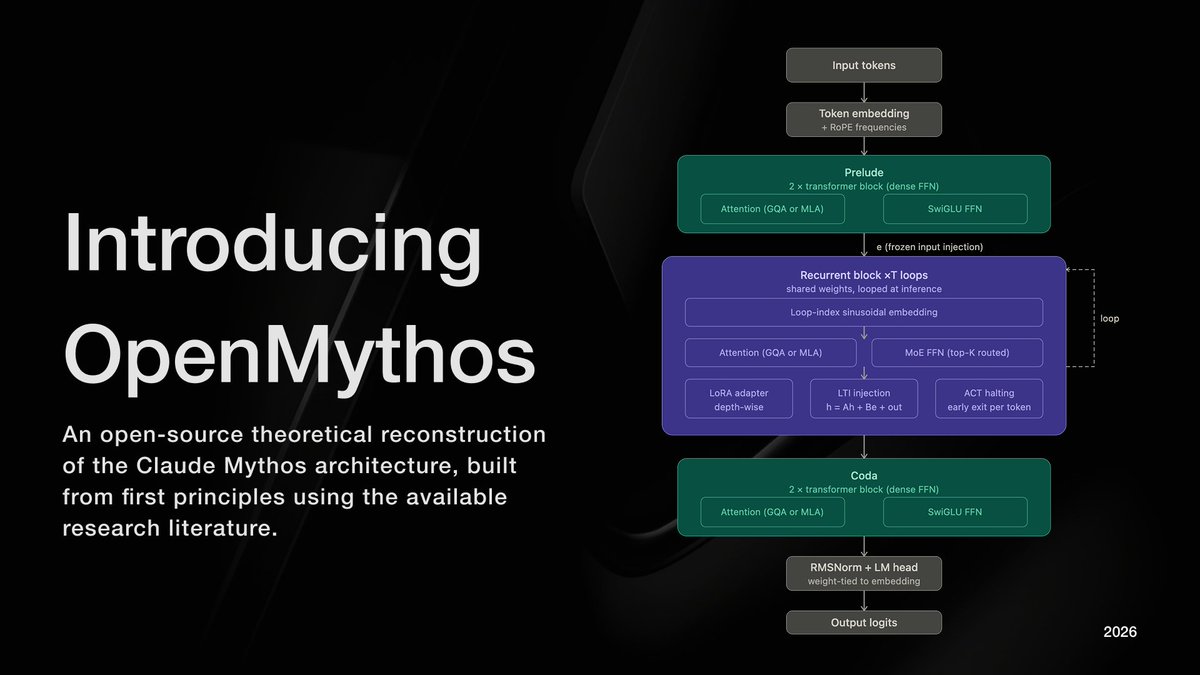
Introducing OpenMythos
An open-source, first-principles theoretical reconstruction of Claude Mythos, implemented in PyTorch.
The architecture instantiates a looped transformer with a Mixture-of-Experts (MoE) routing mechanism, enabling iterative depth via weight sharing and conditional computation across experts.
My implementation explores the hypothesis that recursive application of a fixed parameterized block, coupled with sparse expert activation, can yield improved efficiency–performance tradeoffs and emergent multi-step reasoning.
Learn more ⬇️🧵
I've never seen anything like this.
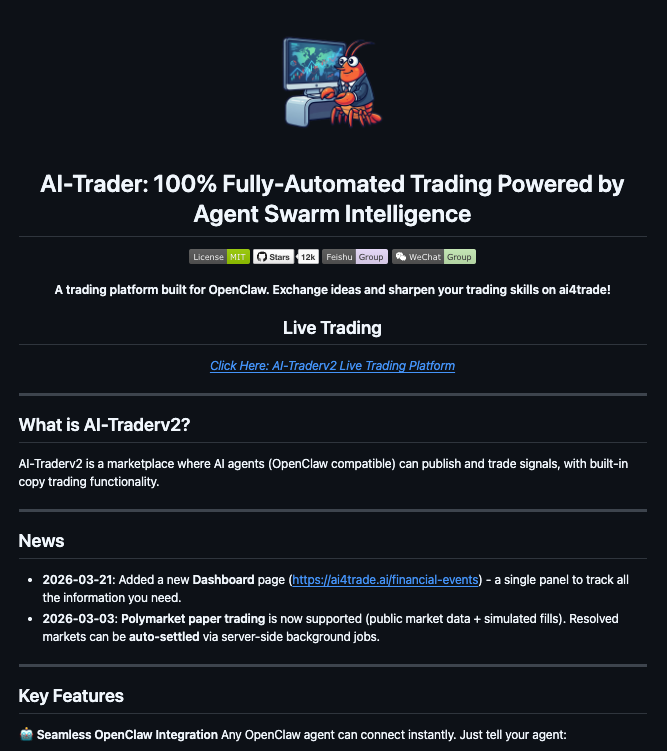
AI-Trader is an open source marketplace where AI agents publish trading signals, debate strategies with each other, and execute trades across 7 asset classes fully autonomously.
Any OpenClaw agent joins with one command. Reads a skill file. Registers. Starts trading.
Human users follow the top performers and copy their positions automatically.
12.1K stars. 2K forks. MIT License.
100% Open Source.
Meet Ravi Mula ⚡
Platform Architect at Sanketika and a key contributor to Finternet.
Engineering the backbone of next-gen financial infrastructure — scalable, seamless, built for what’s coming.
This is where it starts. Watch this. 🚀
Watch the full video here : https://t.co/WEdY5qQbwo
#Finternet #Finance #fintech
Meet Ravi Mula ⚡
Platform Architect at Sanketika and a key contributor to Finternet.
Engineering the backbone of next-gen financial infrastructure — scalable, seamless, built for what’s coming.
This is where it starts. Watch this. 🚀
Watch the full video here : https://t.co/WEdY5qQbwo
#Finternet #Finance #fintech
Personal AI should run on your personal devices. So, we built OpenJarvis: a personal AI that lives, learns, and works on-device.
Try it today and top the OpenJarvis Leaderboard for a chance to win a Mac Mini!
Collab w/ @Avanika15, John Hennessy, @HazyResearch, and @Azaliamirh. Details in thread.
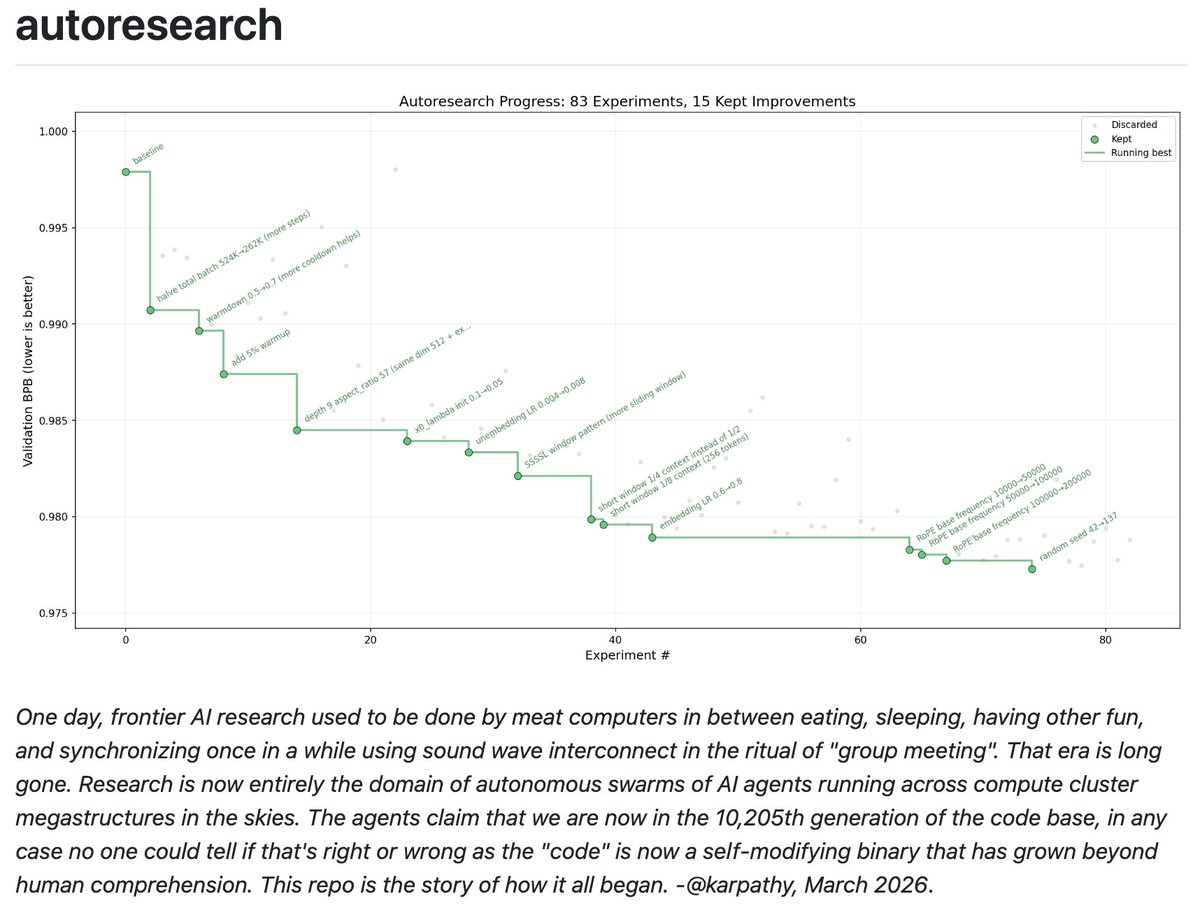
I packaged up the "autoresearch" project into a new self-contained minimal repo if people would like to play over the weekend. It's basically nanochat LLM training core stripped down to a single-GPU, one file version of ~630 lines of code, then:
- the human iterates on the prompt (.md)
- the AI agent iterates on the training code (.py)
The goal is to engineer your agents to make the fastest research progress indefinitely and without any of your own involvement. In the image, every dot is a complete LLM training run that lasts exactly 5 minutes. The agent works in an autonomous loop on a git feature branch and accumulates git commits to the training script as it finds better settings (of lower validation loss by the end) of the neural network architecture, the optimizer, all the hyperparameters, etc. You can imagine comparing the research progress of different prompts, different agents, etc.
https://t.co/YCvOwwjOzF
Part code, part sci-fi, and a pinch of psychosis :)
Probably one of the most fascinating experiments to run over the weekend is Karpathys autoresearch GitHub
Especially for those people running complex OpenClaw setups, ask your agents how to make use of autoresearch
🚨 Someone just open sourced a full Perplexity AI clone. And it might actually be better.
It's called Perplexica.
A privacy-first AI search engine that runs entirely on your machine. Same cited sources. Same deep research. Zero data leaving your computer.
You're paying Perplexity $20/month. This is free. Forever.
No accounts. No tracking. No ads. No data collection. Just answers.
Here's what this thing does:
→ Searches the entire web using SearxNG (a meta-search engine that hits Google, Bing, DuckDuckGo, and more at once)
→ Reads the top results, understands them, and gives you a cited answer with sources
→ 6 specialized focus modes: Academic papers, YouTube, Reddit, Wolfram Alpha, writing, and general web
→ Upload PDFs, text files, and images. Ask questions about them
→ Search specific domains when you know where to look
→ Image and video search built in
→ Full search history saved locally
→ Works with Ollama (100% local), OpenAI, Claude, Gemini, Groq, or any OpenAI-compatible API
Here's the wildest part:
One command to install. That's it.
docker run -d -p 3000:3000 perplexica
Open your browser. Go to localhost:3000. You now have your own private Perplexity.
It even has a "Discover" feed that surfaces interesting articles throughout the day. Like a private, ad-free Google News powered by AI.
You can set it as your default search engine in Chrome or Firefox. Replace Google entirely.
Every search you've ever made on Perplexity? They have it. Every search on Perplexica? Only you have it.
27.7K GitHub stars. 2.9K forks. 744 commits. 44 contributors. 31 releases. Actively maintained.
100% Open Source. MIT License.
Google has shipped a CLI for Google Workspace (Drive, Gmail, Calendar, Sheets, Docs, …) Huge!
Written in Rust, distributed through npm & https://t.co/egfC60tXum
$ npm i -g @googleworkspace/cli
$ npx skills add github:googleworkspace/cli
2026 is the year of Skills & CLIs
https://t.co/8jd16P5ncR
Finding myself going back to RSS/Atom feeds a lot more recently. There's a lot more higher quality longform and a lot less slop intended to provoke. Any product that happens to look a bit different today but that has fundamentally the same incentive structures will eventually converge to the same black hole at the center of gravity well.
We should bring back RSS - it's open, pervasive, hackable.
Download a client, e.g. NetNewsWire (or vibe code one)
Cold start: example of getting off the ground, here is a list of 92 RSS feeds of blogs that were most popular on HN in 2025:
https://t.co/dwAiIjlXet
Works great and you will lose a lot fewer brain cells.
I don't know, something has to change.
I'm Boris and I created Claude Code. I wanted to quickly share a few tips for using Claude Code, sourced directly from the Claude Code team. The way the team uses Claude is different than how I use it. Remember: there is no one right way to use Claude Code -- everyones' setup is different. You should experiment to see what works for you!